Key Laboratory of Mental Health, Ministry of Health (Peking University), Beijing, PR China.
PLoS One. 2013 Apr 19;8(4):e61021. doi: 10.1371/journal.pone.0061021. Print 2013.
Autism is a neurodevelopmental disorder with a high estimated heritability. ATP2B2, located on human chromosome 3p25.3, encodes the plasma membrane calcium-transporting ATPase 2 which extrudes Ca(2+) from cytosol into extracellular space. Recent studies reported association between ATP2B2 and autism in samples from Autism Genetic Resource Exchange (AGRE) and Italy. In this study, we investigated whether ATP2B2 polymorphisms were associated with autism in Chinese Han population.
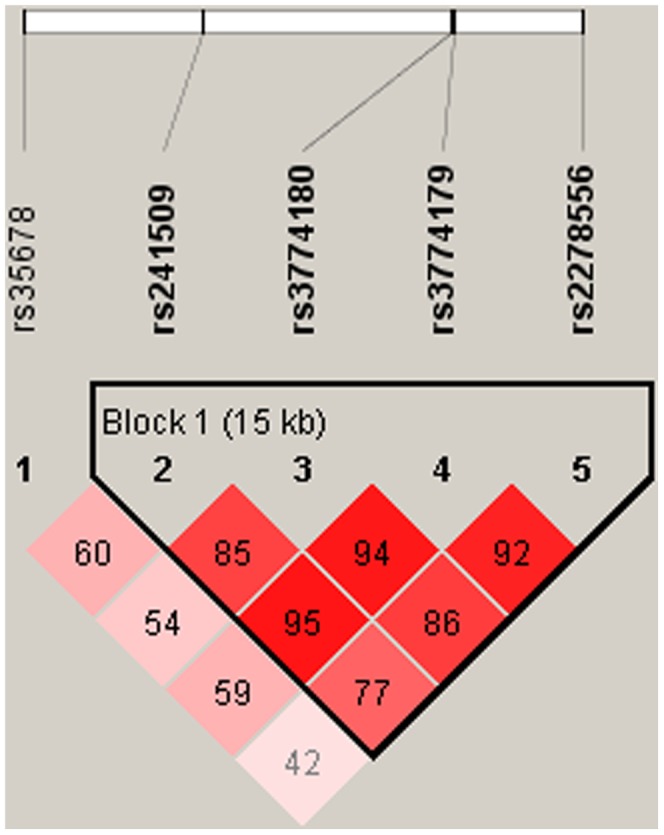
We performed a family based association study between five SNPs (rs35678 in exon, rs241509, rs3774180, rs3774179, and rs2278556 in introns) in ATP2B2 and autism in 427 autism trios of Han Chinese descent. All SNPs were genotyped using the Sequenom genotyping platform. The family-based association test (FBAT) program was used to perform association test for SNPs and haplotype analyses.
This study demonstrated a preferential transmission of T allele of rs3774179 to affected offsprings under an additive model (T>C, Z = 2.482, p = 0.013). While C allele of rs3774179 showed an undertransmission from parents to affected children under an additive and a dominant model, respectively (Z = -2.482, p = 0.013; Z = -2.591, p = 0.0096). Haplotype analyses revealed that three haplotypes were significantly associated with autism. The haplotype C-C (rs3774180-rs3774179) showed a significant undertransmission from parents to affected offsprings both in specific and global haplotype FBAT (Z = -2.037, p = 0.042; Global p = 0.03). As for the haplotype constructed by rs3774179 and rs2278556, C-A might be a protective haplotype (Z = -2.206, p = 0.027; Global p = 0.04), while T-A demonstrated an excess transmission from parents to affected offsprings (Z = 2.143, p = 0.032). These results were still significant after using the permutation method to obtain empirical p values.
Our research suggested that ATP2B2 might play a role in the etiology of autism in Chinese Han population.
自闭症是一种具有高度遗传性的神经发育障碍。ATP2B2 位于人类染色体 3p25.3 上,编码质膜钙转运 ATP 酶 2,该酶将 Ca(2+)从细胞质中排出到细胞外空间。最近的研究报告称,在来自自闭症基因资源交换(AGRE)和意大利的样本中,ATP2B2 与自闭症之间存在关联。在这项研究中,我们调查了 ATP2B2 多态性是否与中国汉族人群中的自闭症有关。
我们在 427 个汉族自闭症三系中,对 ATP2B2 中的 5 个 SNP(rs35678 在外显子、rs241509、rs3774180、rs3774179 和 rs2278556 在内含子)进行了基于家系的关联研究。所有 SNP 均使用 Sequenom 基因分型平台进行基因分型。使用基于家系的关联测试(FBAT)程序对 SNP 和单倍型分析进行关联测试。
本研究表明,在加性模型下,rs3774179 的 T 等位基因优先传递给受影响的后代(T>C,Z=2.482,p=0.013)。而 rs3774179 的 C 等位基因在加性和显性模型下均表现为从父母向受影响的子女的传递不足,分别为(Z=-2.482,p=0.013;Z=-2.591,p=0.0096)。单倍型分析显示,三个单倍型与自闭症显著相关。C-C(rs3774180-rs3774179)单倍型在特定和整体单倍型 FBAT 中均表现出从父母向受影响的后代的显著传递不足(Z=-2.037,p=0.042;全球 p=0.03)。对于由 rs3774179 和 rs2278556 构建的单倍型,C-A 可能是一种保护性单倍型(Z=-2.206,p=0.027;全球 p=0.04),而 T-A 则表现为从父母向受影响的后代的过度传递(Z=2.143,p=0.032)。在使用置换法获得经验 p 值后,这些结果仍然具有统计学意义。
我们的研究表明,ATP2B2 可能在中国汉族人群自闭症的发病机制中起作用。