Vaidyanathan Balu, Kumar Shine, Sudhakar Abish, Kumar Raman Krishna
Department of Pediatric Cardiology, The Fetal Cardiology Unit, Amrita Institute of Medical Sciences and Research Center, Kochi, Kerala, India.
Ann Pediatr Cardiol. 2013 Jan;6(1):15-20. doi: 10.4103/0974-2069.107227.
To describe the referral patterns and pregnancy outcomes of fetuses with conotruncal anomalies (CTA) from a fetal cardiology unit in South India.
Records of 68 women identified to have diagnosis of CTA on fetal echocardiography (mean gestational age 26.8 ± 5.9 weeks; range 17-38 weeks) during the period 2008-2011 were reviewed.
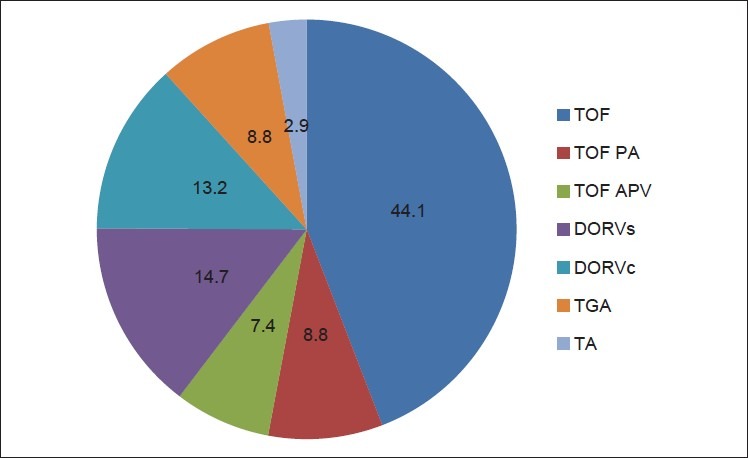
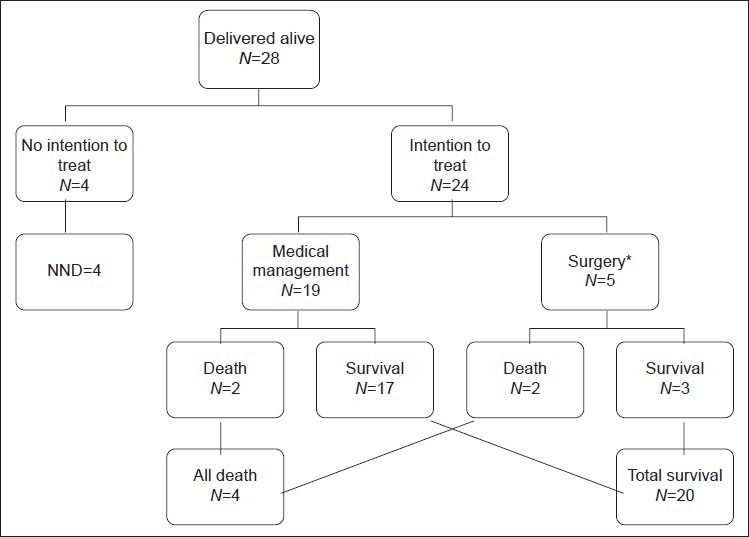
The most common indication for referral was suspected congenital heart disease during routine antenatal scan (89.7%). The various CTA diagnosed included Tetralogy of Fallot (TOF, 44.1%), Double outlet right ventricle (DORV, 27.9%), Transposition of great vessels (TGA, 8.8%), TOF with pulmonary atresia (TOF-PA, 8.8%), TOF absent pulmonary valve (TOF-APV, 7.4%) and truncus arteriosus (TA, 2.9%). Extra cardiac anomalies were reported in 4 fetuses (7.1%). Pregnancy outcomes included pregnancies not culminating in live-birth (54.4%), delivery at term (41.2%) with 3 patients (4.4%) being lost to follow-up. Proportion of pregnancies not culminating in live-birth lesion wise include: TOF (53.3%), DORV (52.6%), TGA (50%), TOF -APV (80%), TOF-PA (50%), and TA (50%). Twenty-four babies (35.3%) received post-natal cardiac care with 5 (7.4%) undergoing neonatal surgical procedures. Seven babies (10.3%) died in neonatal period, including 2 who underwent surgery. The accuracy of fetal echo was 96.4% for primary lesion and 67.9% for complete segmental diagnosis.
Pre-natal diagnosis of CTA, despite a high diagnostic accuracy, prompted utilization of post-natal tertiary cardiac care in a limited proportion of patients, including those with reparable lesions. Focus in developing countries should shift towards earlier referral, improving awareness about treatment options and a comprehensive evaluation for associated anomalies.
描述印度南部一家胎儿心脏病学单位中患有圆锥动脉干异常(CTA)胎儿的转诊模式及妊娠结局。
回顾了2008年至2011年期间68例经胎儿超声心动图诊断为CTA的孕妇记录(平均孕周26.8±5.9周;范围17 - 38周)。
最常见的转诊指征是常规产前扫描时怀疑先天性心脏病(89.7%)。诊断出的各种CTA包括法洛四联症(TOF,44.1%)、右心室双出口(DORV,27.9%)、大动脉转位(TGA,8.8%)、法洛四联症合并肺动脉闭锁(TOF - PA,8.8%)、法洛四联症无肺动脉瓣(TOF - APV,7.4%)和动脉干(TA,2.9%)。4例胎儿(7.1%)报告有心脏外异常。妊娠结局包括未足月分娩(54.4%)、足月分娩(41.2%),3例患者(4.4%)失访。按病变类型划分,未足月分娩的妊娠比例包括:TOF(53.3%)、DORV(52.6%)、TGA(50%)、TOF - APV(80%)、TOF - PA(50%)和TA(50%)。24例婴儿(35.3%)接受了产后心脏护理,5例(7.4%)接受了新生儿外科手术。7例婴儿(10.3%)在新生儿期死亡,其中2例接受了手术。胎儿超声对主要病变的诊断准确率为96.4%,对完全节段性诊断的准确率为67.9%。
尽管CTA的产前诊断准确率较高,但仅在有限比例的患者(包括那些可修复病变的患者)中促使其利用产后三级心脏护理。发展中国家应将重点转向更早的转诊、提高对治疗选择的认识以及对相关异常进行全面评估。