Department of Medicine and Carbone Cancer Center, University of Wisconsin School of Medicine and Public Health, Madison, WI, USA.
Lung Cancer. 2013 Jul;81(1):138-41. doi: 10.1016/j.lungcan.2013.03.020. Epub 2013 Apr 28.
Nuclear EGFR (nEGFR) has been identified in various human tumor tissues, including cancers of the breast, ovary, oropharynx, and esophagus, and has predicted poor patient outcomes. We sought to determine if protein expression of nEGFR is prognostic in early stage non-small cell lung cancer (NSCLC).
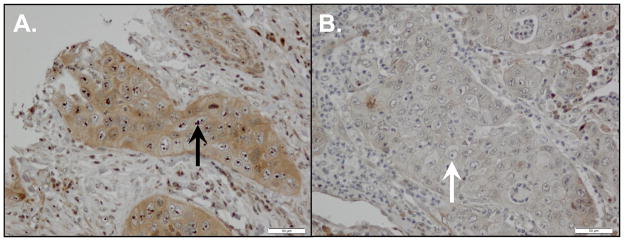
Resected stages I and II NSCLC specimens were evaluated for nEGFR protein expression using immunohistochemistry (IHC). Cases with at least one replicate core containing ≥5% of tumor cells demonstrating strong dot-like nucleolar EGFR expression were scored as nEGFR positive.
Twenty-three (26.1% of the population) of 88 resected specimens stained positively for nEGFR. Nuclear EGFR protein expression was associated with higher disease stage (45.5% of stage II vs. 14.5% of stage I; p = 0.023), histology (41.7% in squamous cell carcinoma vs. 17.1% in adenocarcinoma; p = 0.028), shorter progression-free survival (PFS) (median PFS 8.7 months [95% CI 5.1-10.7 mo] for nEGFR positive vs. 14.5 months [95% CI 9.5-17.4 mo] for nEGFR negative; hazard ratio (HR) of 1.89 [95% CI 1.15-3.10]; p = 0.011), and shorter overall survival (OS) (median OS 14.1 months [95% CI 10.3-22.7 mo] for nEGFR positive vs. 23.4 months [95% CI 20.1-29.4 mo] for nEGFR negative; HR of 1.83 [95% CI 1.12-2.99]; p = 0.014).
Expression of nEGFR protein was associated with higher stage and squamous cell histology, and predicted shorter PFS and OS, in this patient cohort. Nuclear EGFR serves as a useful independent prognostic variable and as a potential therapeutic target in NSCLC.
核 EGFR(nEGFR)已在多种人类肿瘤组织中被鉴定出来,包括乳腺癌、卵巢癌、口咽癌和食管癌,并且预测患者预后不良。我们试图确定 nEGFR 的蛋白表达是否对早期非小细胞肺癌(NSCLC)具有预后意义。
使用免疫组织化学(IHC)评估切除的 I 期和 II 期 NSCLC 标本中 nEGFR 的蛋白表达。至少有一个含有≥5%肿瘤细胞呈强点状核 EGFR 表达的复制品核心的病例被评为 nEGFR 阳性。
88 例切除标本中有 23 例(占人群的 26.1%)染色呈 nEGFR 阳性。核 EGFR 蛋白表达与较高的疾病分期(45.5%的 II 期 vs. 14.5%的 I 期;p = 0.023)、组织学(41.7%的鳞状细胞癌 vs. 17.1%的腺癌;p = 0.028)、较短的无进展生存期(PFS)(nEGFR 阳性的中位 PFS 为 8.7 个月[95%CI 5.1-10.7 mo],nEGFR 阴性的中位 PFS 为 14.5 个月[95%CI 9.5-17.4 mo];危险比(HR)为 1.89[95%CI 1.15-3.10];p = 0.011)和较短的总生存期(OS)(nEGFR 阳性的中位 OS 为 14.1 个月[95%CI 10.3-22.7 mo],nEGFR 阴性的中位 OS 为 23.4 个月[95%CI 20.1-29.4 mo];HR 为 1.83[95%CI 1.12-2.99];p = 0.014)相关。
在本患者队列中,nEGFR 蛋白的表达与较高的分期和鳞状细胞组织学相关,并预测 PFS 和 OS 较短。核 EGFR 可作为 NSCLC 中有用的独立预后变量和潜在的治疗靶点。