Diabetes Unit, Spedali Riuniti, Pistoia, Italy.
Diabetes Metab Syndr Obes. 2013 Apr 8;6:123-9. doi: 10.2147/DMSO.S42729. Print 2013.
To investigate whether gender affects therapeutic response by exenatide twice a day (BID) in type 2 diabetes by using a database concerning patients monitored by five outpatient clinics in Tuscany, Italy.
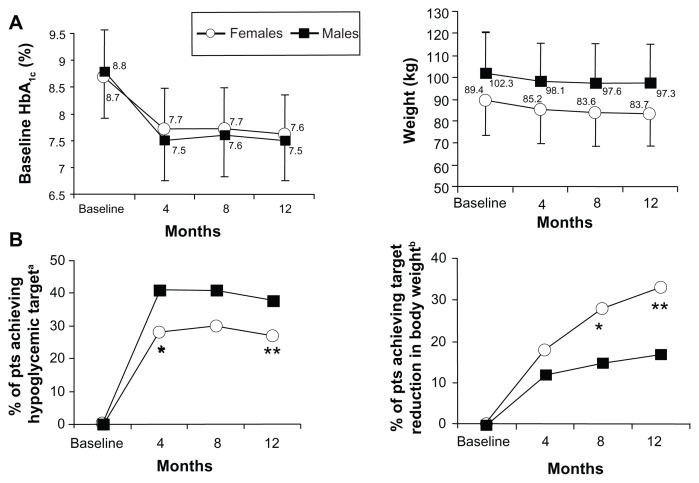
We considered a cohort of 315 (154 male/161 female) patients experiencing therapeutic failure while on oral therapy (metformin, or combination therapy metformin + sulphonylureas), who were given exenatide (10 μg/BID) and who fully completed 4 months, 8 months, and 12 months of follow-ups.
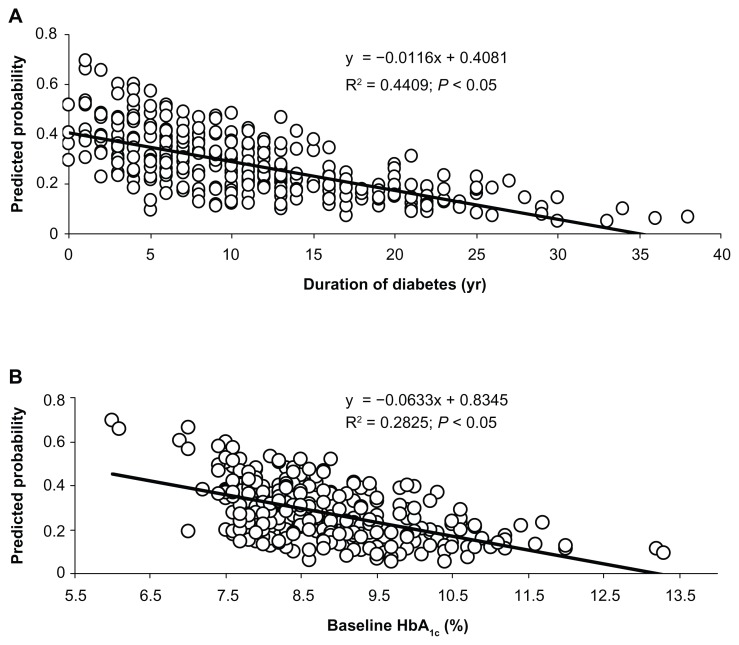
Among patients stratified by gender and well matched for age, body mass index, and hemoglobin A1c (HbA1c), it was found that the length of disease was longer in females than in males (12 ± 8 years versus 10 ± 7 years; P = 0.037), and the ratio of patients on metformin to those on combination therapy was higher in men (P = 0.018). Target glycemic response (1-year HbA1c ≤ 7%) was achieved in a significantly higher proportion of males than females (38% versus 27%; χ(2) = 4.66; P = 0.03). Target weight loss expressed as 1-year weight percent fall from baseline ≥ 75th percentile (8.5%) was significantly higher in females at 8 and 12 months (P < 0.05; for both). One-year glycemic target response was inversely related to baseline HbA1c levels and diabetes duration among males, while metformin therapy (compared to oral combination therapy) was a significant predictor of better glycemic targets among females. Homeostasis model assessment-B, measured in 117 patients, predicted hypoglycemic response only in women (P = 0.009). Target 1-year weight loss was predicted by longer diabetes duration among males and by lower baseline HbA1c among females. Finally, no significant difference between genders was noted as to gastrointestinal side effects after exenatide therapy.
According to this "real world" experience, predictors of glycemic control and body weight loss after 12 months of exenatide BID therapy are different between genders in type 2 diabetes.
利用意大利托斯卡纳地区 5 家门诊的患者监测数据库,调查性别是否会影响接受每日两次(BID)艾塞那肽治疗的 2 型糖尿病患者的治疗反应。
我们对 315 名(男性 154 名,女性 161 名)正在接受口服药物(二甲双胍或二甲双胍+磺脲类药物)治疗但治疗失败的患者进行了研究,这些患者给予艾塞那肽(10μg/BID),并完成了 4 个月、8 个月和 12 个月的随访。
在按性别分层且年龄、体重指数和糖化血红蛋白(HbA1c)相匹配的患者中,女性的疾病病程比男性长(12±8 年比 10±7 年;P=0.037),而且男性服用二甲双胍的患者比例高于服用联合疗法的患者(P=0.018)。男性达到目标血糖反应(1 年 HbA1c≤7%)的比例明显高于女性(38%比 27%;χ²=4.66;P=0.03)。女性在 8 个月和 12 个月时体重减轻百分比(体重下降≥第 75 百分位数 8.5%)的目标值显著更高(P<0.05;两者均如此)。男性的 1 年血糖目标反应与基线 HbA1c 水平和糖尿病病程呈负相关,而二甲双胍治疗(与口服联合治疗相比)是女性血糖目标更好的显著预测因素。在 117 名患者中测量的稳态模型评估-B,仅能预测女性的低血糖反应(P=0.009)。男性的糖尿病病程较长和女性的基线 HbA1c 水平较低,预示着 1 年的体重减轻目标。最后,在接受艾塞那肽治疗后,性别之间没有明显的胃肠道副作用差异。
根据这项“真实世界”经验,在接受每日两次(BID)艾塞那肽治疗 12 个月后,2 型糖尿病患者的血糖控制和体重减轻的预测因素在性别之间存在差异。