Azorean Biodiversity Group and Platform for Enhancing Ecological Research and Sustainability, Departamento de Ciências Agrárias, Universidade dos Açores, Angra do Heroísmo, Portugal.
PLoS One. 2013 Apr 22;8(4):e62118. doi: 10.1371/journal.pone.0062118. Print 2013.
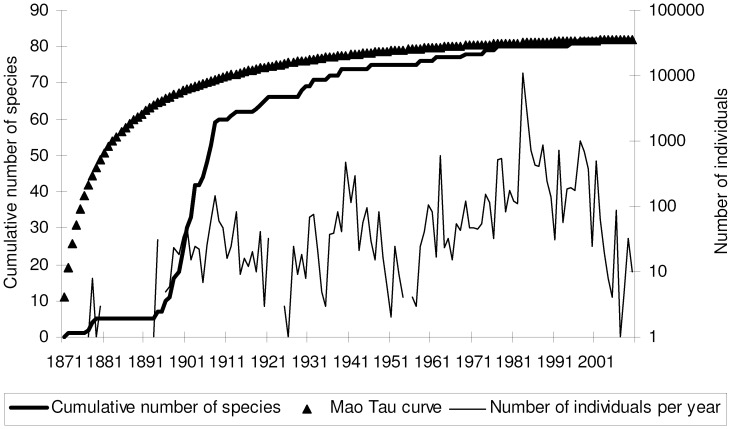
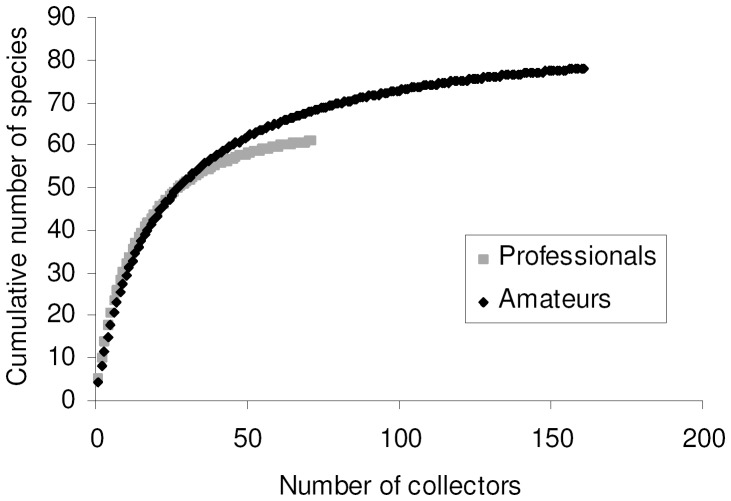
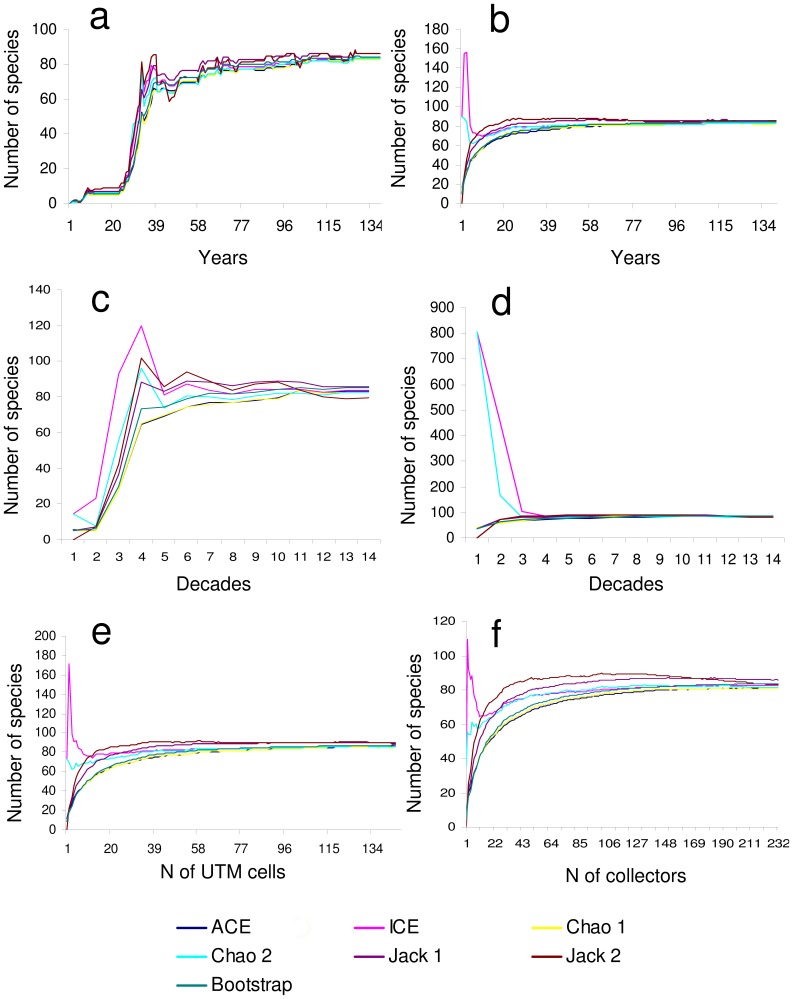
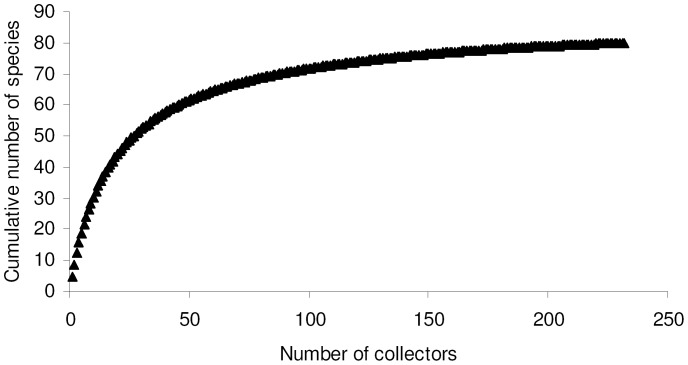
Understanding how faunistic knowledge develops is of paramount importance to correctly evaluate completeness of insect inventories and to plan future research at regional scale, yet this is an unexplored issue. Aim of this paper was to investigate the processes that lead to a complete species inventory at a regional level for a beetle family. The tenebionid beetles of Latium region (Italy) were analysed as a case study representative of general situations. A comprehensive faunistic database including 3,561 records spanning from 1871 to 2010 was realized examining 25,349 museum specimens and published data. Accumulation curves and non-parametric estimators of species richness were applied to model increase in faunistic knowledge over time, through space and by collectors' number. Long time, large spatial extent and contribution of many collectors were needed to obtain a reliable species inventory. Massive sampling was not effective in recovering more species. Amateur naturalists (here called parafaunists) were more efficient collectors than professional entomologists. Museum materials collected by parafaunists over long periods and large spatial extent resulted to be a cost effective source of faunistic information with small number of collected individuals. It is therefore important to valuate and facilitate the work of parafaunists as already suggested for parataxonomists. By contrast, massive collections by standardized techniques for ecological research seem to be of scarce utility in improving faunistic knowledge, but their value for faunistic studies may be enhanced if they are conducted in poorly surveyed areas.
了解动物区系知识的发展过程对于正确评估昆虫名录的完整性以及规划区域尺度的未来研究至关重要,但这是一个尚未被探索的问题。本文的目的是研究导致在区域尺度上完成甲虫科昆虫物种名录的过程。作为一般情况的代表,我们分析了拉齐奥地区(意大利)的 tenebionid 甲虫。一个包括 1871 年至 2010 年的 3561 条记录的全面动物区系数据库,通过检查 25349 件博物馆标本和已发表的数据得以实现。积累曲线和物种丰富度的非参数估计器被应用于通过时间、空间和采集者数量来模拟动物区系知识的增加。获得可靠的物种名录需要很长的时间、很大的空间范围和许多采集者的贡献。大量采样并不能有效地发现更多的物种。业余自然学家(这里称为副动物学家)比专业昆虫学家更有效率。副动物学家长期在大的空间范围内收集的博物馆标本是一种具有成本效益的动物区系信息来源,其采集的个体数量很少。因此,像已经建议的那样,评估和促进副动物学家的工作非常重要。相比之下,为生态研究而进行的标准化技术的大量采集似乎对改善动物区系知识的作用不大,但如果在调查不足的地区进行,它们对动物区系研究的价值可能会提高。