Department of Medicine, VA Palo Alto HCS, Palo Alto, California 94303, USA.
Kidney Int. 2013 Sep;84(3):585-90. doi: 10.1038/ki.2013.154. Epub 2013 May 1.
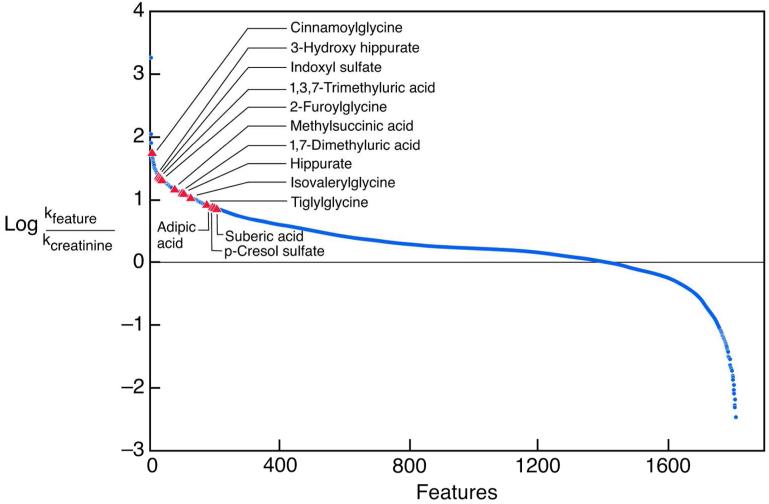
The kidney clears numerous solutes from the plasma; however, retention of these solutes causes uremic illness when the kidneys fail. We know remarkably little about which retained solutes are toxic and this limits our ability to improve dialysis therapies. To explore this, we employed untargeted mass spectrometry to identify solutes that are efficiently cleared by the kidney. High-resolution mass spectrometry detected 1808 features in the urine and plasma ultrafiltrate of 5 individuals with normal renal function. The estimated clearance rates of 1082 peaks were greater than the creatinine clearance indicating tubular secretion. Further analysis identified 90 features representing solutes with estimated clearance rates greater than the renal plasma flow. Quantitative mass spectrometry with stable isotope dilution confirmed that efficient clearance of these solutes is made possible by the combination of binding to plasma proteins and tubular secretion. Tandem mass spectrometry established the chemical identity of 13 solutes including hippuric acid, indoxyl sulfate, and p-cresol sulfate. These 13 efficiently cleared solutes were found to accumulate in the plasma of hemodialysis patients, with free levels rising to more than 20-fold normal for all but two of them. Thus, further analysis of solutes efficiently cleared by secretion in the native kidney may provide a potential route to the identification of uremic toxins.
肾脏从血浆中清除许多溶质;然而,当肾脏衰竭时,这些溶质的潴留会导致尿毒症。我们对哪些潴留的溶质是有毒的知之甚少,这限制了我们改善透析疗法的能力。为了探索这一点,我们采用非靶向质谱法来鉴定被肾脏有效清除的溶质。高分辨率质谱法在 5 名肾功能正常的个体的尿液和血浆超滤液中检测到 1808 个特征。1082 个峰的估计清除率大于肌酐清除率,表明存在肾小管分泌。进一步分析确定了 90 个特征,代表估计清除率大于肾血浆流量的溶质。用稳定同位素稀释的定量质谱法证实,这些溶质的有效清除是通过与血浆蛋白结合和肾小管分泌的结合来实现的。串联质谱法确定了 13 种溶质的化学结构,包括马尿酸、吲哚硫酸和对甲酚硫酸。这些 13 种被有效清除的溶质在血液透析患者的血浆中积累,除了两种溶质之外,所有溶质的游离水平上升到正常水平的 20 倍以上。因此,对在天然肾脏中通过分泌有效清除的溶质进行进一步分析,可能为鉴定尿毒症毒素提供一条潜在途径。