Division of Biology, Imperial College London, Ascot, Berkshire, United Kingdom.
PLoS One. 2013 Apr 29;8(4):e59031. doi: 10.1371/journal.pone.0059031. Print 2013.
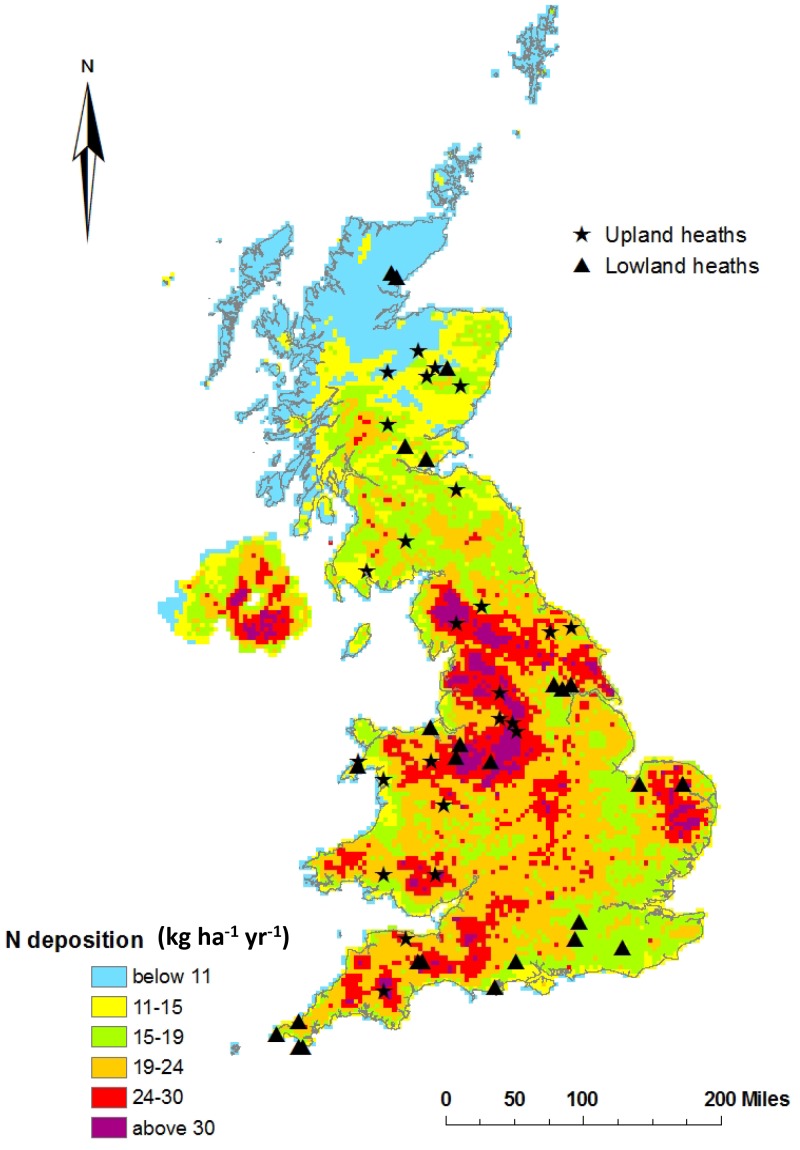
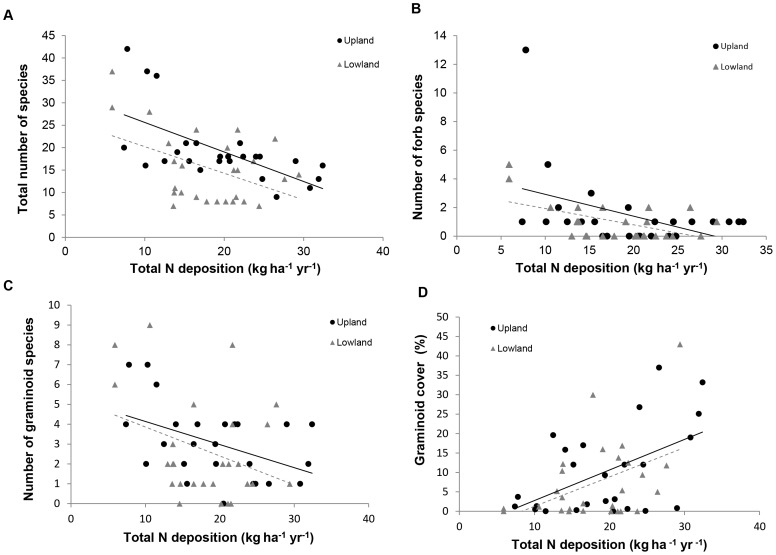
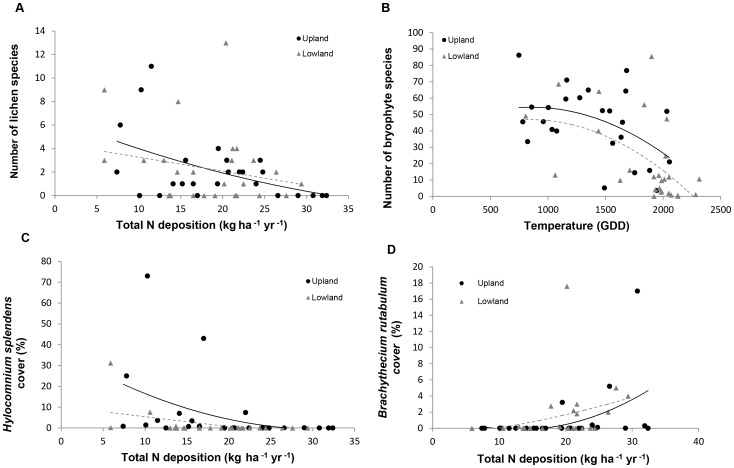
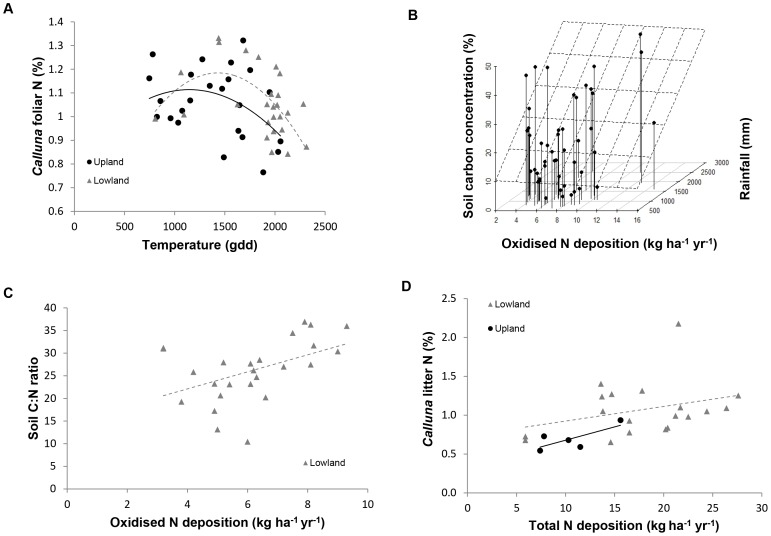
Findings from nitrogen (N) manipulation studies have provided strong evidence of the detrimental impacts of elevated N deposition on the structure and functioning of heathland ecosystems. Few studies, however, have sought to establish whether experimentally observed responses are also apparent under natural, field conditions. This paper presents the findings of a nationwide field-scale evaluation of British heathlands, across broad geographical, climatic and pollution gradients. Fifty two heathlands were selected across an N deposition gradient of 5.9 to 32.4 kg ha(-1) yr(-1). The diversity and abundance of higher and lower plants and a suite of biogeochemical measures were evaluated in relation to climate and N deposition indices. Plant species richness declined with increasing temperature and N deposition, and the abundance of nitrophilous species increased with increasing N. Relationships were broadly similar between upland and lowland sites, with the biggest reductions in species number associated with increasing N inputs at the low end of the deposition range. Both oxidised and reduced forms of N were associated with species declines, although reduced N appears to be a stronger driver of species loss at the functional group level. Plant and soil biochemical indices were related to temperature, rainfall and N deposition. Litter C:N ratios and enzyme (phenol-oxidase and phosphomonoesterase) activities had the strongest relationships with site N inputs and appear to represent reliable field indicators of N deposition. This study provides strong, field-scale evidence of links between N deposition--in both oxidised and reduced forms--and widespread changes in the composition, diversity and functioning of British heathlands. The similarity of relationships between upland and lowland environments, across broad spatial and climatic gradients, highlights the ubiquity of relationships with N, and suggests that N deposition is contributing to biodiversity loss and changes in ecosystem functioning across European heathlands.
研究发现,氮(N)的增加对石南荒原生态系统的结构和功能有不利影响。然而,很少有研究试图确定在自然条件下,实验观察到的反应是否也明显。本文介绍了一项在英国石南荒原进行的全国范围的野外规模评估的结果,该评估涵盖了广泛的地理、气候和污染梯度。在 5.9 至 32.4 千克公顷-1年-1的 N 沉积梯度范围内选择了 52 个石南荒原。在与气候和 N 沉积指数有关的情况下,评估了高等植物和低等植物的多样性和丰度以及一系列生物地球化学措施。植物物种丰富度随温度和 N 沉积的增加而下降,而喜氮物种的丰度随 N 的增加而增加。丘陵和平原地貌站点之间的关系大致相似,与沉积范围低端 N 输入增加相关的物种数量减少最大。氧化和还原形式的 N 都与物种减少有关,尽管在功能组水平上,还原 N 似乎是物种丧失的更强驱动力。植物和土壤生化指数与温度、降雨和 N 沉积有关。凋落物 C:N 比和酶(多酚氧化酶和磷酸单酯酶)活性与站点 N 输入的关系最强,并且似乎是 N 沉积的可靠现场指标。本研究提供了强有力的野外证据,表明 N 的增加(以氧化和还原形式)与英国石南荒原组成、多样性和功能的广泛变化之间存在联系。丘陵和平原地貌环境之间的关系相似,跨越了广泛的空间和气候梯度,突出了与 N 的关系的普遍性,并表明 N 沉积是导致欧洲石南荒原生物多样性丧失和生态系统功能变化的原因之一。