O'Brien Institute, University of Melbourne, Fitzroy, Victoria, Australia.
PLoS One. 2013 Apr 24;8(4):e60790. doi: 10.1371/journal.pone.0060790. Print 2013.
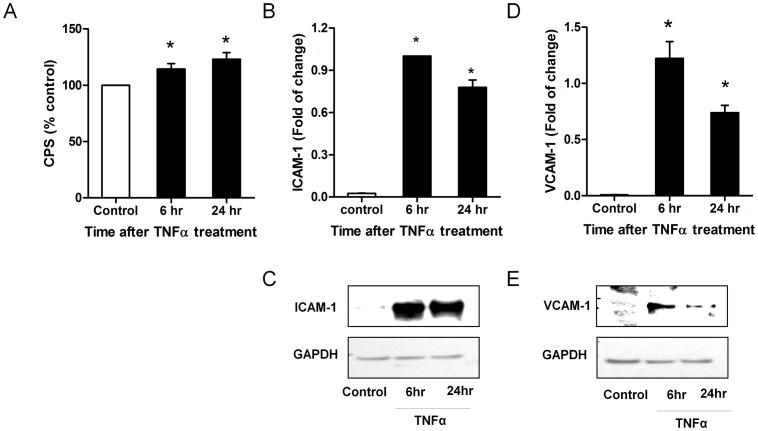
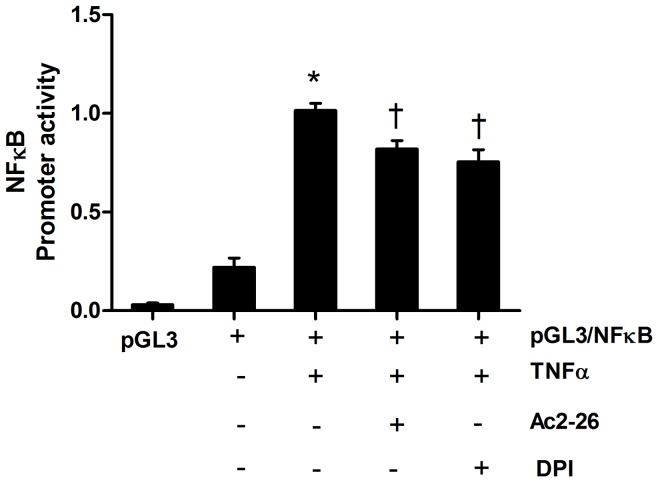
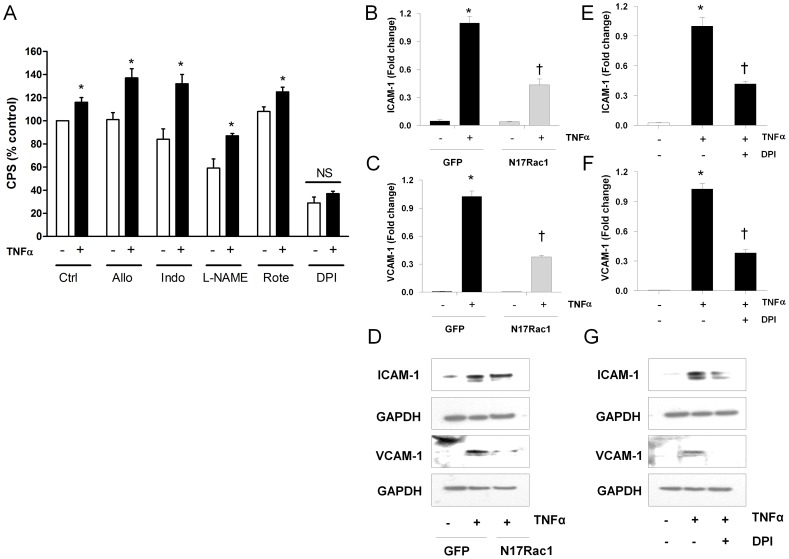
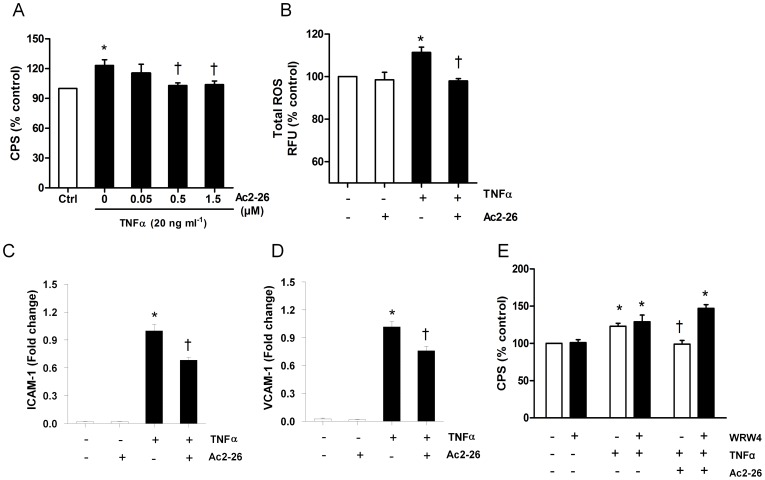
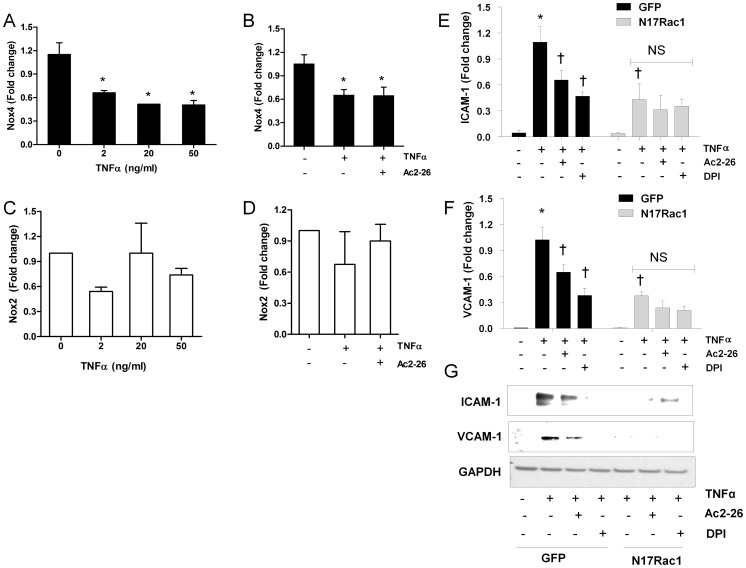
The anti-inflammatory peptide annexin-1 binds to formyl peptide receptors (FPR) but little is known about its mechanism of action in the vasculature. Here we investigate the effect of annexin peptide Ac2-26 on NADPH oxidase activity induced by tumour necrosis factor alpha (TNFα) in human endothelial cells. Superoxide release and intracellular reactive oxygen species (ROS) production from NADPH oxidase was measured with lucigenin-enhanced chemiluminescence and 2',7'-dichlorodihydrofluorescein diacetate, respectively. Expression of NADPH oxidase subunits and intracellular cell adhesion molecule (ICAM-1) and vascular cell adhesion molecule (VCAM-1) were determined by real-time PCR and Western blot analysis. Promoter activity of nuclear factor kappa B (NFκB) was measured by luciferase activity assay. TNFα stimulated NADPH-dependent superoxide release, total ROS formation and expression of ICAM-1and VCAM-1. Pre-treatment with N-terminal peptide of annexin-1 (Ac2-26, 0.5-1.5 µM) reduced all these effects, and the inhibition was blocked by the FPRL-1 antagonist WRW4. Furthermore, TNFα-induced NFκB promoter activity was attenuated by both Ac2-26 and NADPH oxidase inhibitor diphenyliodonium (DPI). Surprisingly, Nox4 gene expression was reduced by TNFα whilst expression of Nox2, p22phox and p67phox remained unchanged. Inhibition of NADPH oxidase activity by either dominant negative Rac1 (N17Rac1) or DPI significantly attenuated TNFα-induced ICAM-1and VCAM-1 expression. Ac2-26 failed to suppress further TNFα-induced expression of ICAM-1 and VCAM-1 in N17Rac1-transfected cells. Thus, Ac2-26 peptide inhibits TNFα-activated, Rac1-dependent NADPH oxidase derived ROS formation, attenuates NFκB pathways and ICAM-1 and VCAM-1 expression in endothelial cells. This suggests that Ac2-26 peptide blocks NADPH oxidase activity and has anti-inflammatory properties in the vasculature which contributes to modulate in reperfusion injury inflammation and vascular disease.
抗炎肽 annexin-1 与 formyl 肽受体 (FPR) 结合,但关于其在血管中的作用机制知之甚少。在这里,我们研究了 annexin 肽 Ac2-26 对肿瘤坏死因子 alpha (TNFα)诱导的人内皮细胞中 NADPH 氧化酶活性的影响。使用荧光素增强化学发光法和 2',7'-二氯二氢荧光素二乙酸酯分别测量超氧化物释放和 NADPH 氧化酶来源的细胞内活性氧 (ROS) 的产生。通过实时 PCR 和 Western blot 分析测定 NADPH 氧化酶亚基和细胞内细胞间黏附分子 (ICAM-1) 和血管细胞间黏附分子 (VCAM-1) 的表达。通过荧光素酶活性测定测量核因子 kappa B (NFκB) 的启动子活性。TNFα 刺激 NADPH 依赖性超氧化物释放、总 ROS 形成以及 ICAM-1 和 VCAM-1 的表达。用 annexin-1 的 N 端肽 (Ac2-26,0.5-1.5 μM) 预处理可降低所有这些作用,并且该抑制作用被 FPRL-1 拮抗剂 WRW4 阻断。此外,TNFα 诱导的 NFκB 启动子活性被 Ac2-26 和 NADPH 氧化酶抑制剂二苯基碘鎓 (DPI) 减弱。令人惊讶的是,TNFα 降低了 Nox4 基因表达,而 Nox2、p22phox 和 p67phox 的表达保持不变。用显性负 Rac1 (N17Rac1) 或 DPI 抑制 NADPH 氧化酶活性显著减弱了 TNFα 诱导的 ICAM-1 和 VCAM-1 表达。Ac2-26 未能抑制 N17Rac1 转染细胞中 TNFα 诱导的 ICAM-1 和 VCAM-1 的进一步表达。因此,Ac2-26 肽抑制 TNFα 激活的、Rac1 依赖性 NADPH 氧化酶衍生的 ROS 形成,减弱内皮细胞中 NFκB 途径和 ICAM-1 和 VCAM-1 的表达。这表明 Ac2-26 肽阻断 NADPH 氧化酶活性,在血管中具有抗炎特性,有助于调节再灌注损伤炎症和血管疾病。