Universidad de Málaga, Departamento Biología Animal, Málaga, Spain.
PLoS One. 2013 Apr 18;8(4):e62201. doi: 10.1371/journal.pone.0062201. Print 2013.
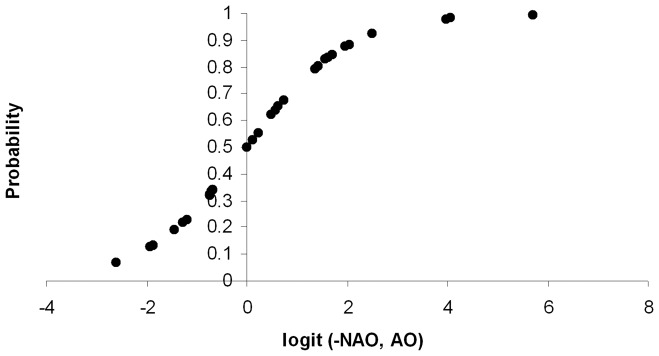
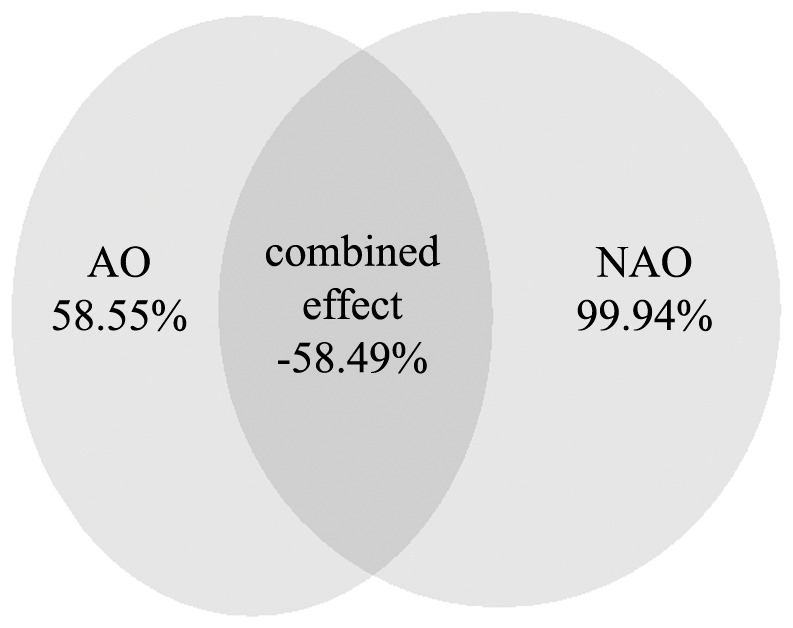
We explored the possible effects of the North Atlantic Oscillation (NAO) and Arctic Oscillation (AO) on interannual sea surface temperature (SST) variations in the Alborán Sea, both separately and combined. The probability of observing mean annual SST values higher than average was related to NAO and AO values of the previous year. The effect of NAO on SST was negative, while that of AO was positive. The pure effects of NAO and AO on SST are obscuring each other, due to the positive correlation between them. When decomposing SST, NAO and AO in seasonal values, we found that variation in mean annual SST and mean winter SST was significantly related to the mean autumn NAO of the previous year, while mean summer SST was related to mean autumn AO of the previous year. The one year delay in the effect of the NAO and AO on the SST could be partially related to the amount of accumulated snow, as we found a significant correlation between the total snow in the North Alborán watershed for a year with the annual average SST of the subsequent year. A positive AO implies a colder atmosphere in the Polar Regions, which could favour occasional cold waves over the Iberian Peninsula which, when coupled with precipitations favoured by a negative NAO, may result in snow precipitation. This snow may be accumulated in the high peaks and melt down in spring-summer of the following year, which consequently increases the runoff of freshwater to the sea, which in turn causes a diminution of sea surface salinity and density, and blocks the local upwelling of colder water, resulting in a higher SST.
我们探讨了北大西洋涛动(NAO)和北极涛动(AO)对阿尔沃兰海年际海面温度(SST)变化的可能影响,分别探讨了它们的单独影响和综合影响。观测到平均年 SST 值高于平均值的概率与前一年的 NAO 和 AO 值有关。NAO 对 SST 的影响为负,而 AO 的影响为正。由于它们之间存在正相关,NAO 和 AO 对 SST 的纯影响相互掩盖。当将 SST 分解为季节性值的 NAO 和 AO 时,我们发现平均年 SST 和平均冬季 SST 的变化与前一年秋季的平均 NAO 显著相关,而平均夏季 SST 则与前一年秋季的平均 AO 相关。NAO 和 AO 对 SST 的影响存在一年的滞后,这可能部分与积雪量有关,因为我们发现北阿尔沃兰海集水区一年内的总积雪量与次年的年平均 SST 之间存在显著相关性。正 AO 意味着极地地区的大气较冷,这可能有利于偶尔出现的伊比利亚半岛寒潮,当与负 NAO 有利于的降水相结合时,可能导致雪的降水。这些雪可能在高海拔地区积累,并在次年的春夏季融化,从而增加了淡水向海洋的径流量,这反过来又导致了海面盐度和密度的降低,阻止了当地较冷海水的上升流,导致 SST 升高。