Haynes Richard, Baigent Colin, Harden Paul, Landray Martin, Akyol Murat, Asderakis Argiris, Baxter Alex, Bhandari Sunil, Chowdhury Paramit, Clancy Marc, Emberson Jonathan, Gibbs Paul, Hammad Abdul, Herrington Will, Jayne Kathy, Jones Gareth, Krishnan Nithya, Lay Michael, Lewis David, Macdougall Iain, Nathan Chidambaram, Neuberger James, Newstead Chas, Pararajasingam Ravi, Puliatti Carmelo, Rigg Keith, Rowe Peter, Sharif Adnan, Sheerin Neil, Sinha Sanjay, Watson Chris, Friend Peter
Clinical Trial Service Unit & Epidemiological Studies Unit, Richard Doll Building, Old Road Campus, Roosevelt Drive, Headington Oxford OX3 7LF, UK.
Transplant Res. 2013 May 6;2(1):7. doi: 10.1186/2047-1440-2-7.
Kidney transplantation is the best treatment for patients with end-stage renal failure, but uncertainty remains about the best immunosuppression strategy. Long-term graft survival has not improved substantially, and one possible explanation is calcineurin inhibitor (CNI) nephrotoxicity. CNI exposure could be minimized by using more potent induction therapy or alternative maintenance therapy to remove CNIs completely. However, the safety and efficacy of such strategies are unknown.
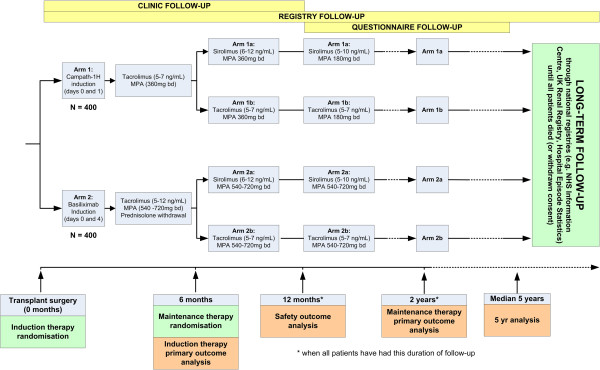
METHODS/DESIGN: The Campath, Calcineurin inhibitor reduction and Chronic allograft nephropathy (3C) Study is a multicentre, open-label, randomized controlled trial with 852 participants which is addressing two important questions in kidney transplantation. The first question is whether a Campath (alemtuzumab)-based induction therapy strategy is superior to basiliximab-based therapy, and the second is whether, from 6 months after transplantation, a sirolimus-based maintenance therapy strategy is superior to tacrolimus-based therapy. Recruitment is complete, and follow-up will continue for around 5 years post-transplant. The primary endpoint for the induction therapy comparison is biopsy-proven acute rejection by 6 months, and the primary endpoint for the maintenance therapy comparison is change in estimated glomerular filtration rate from baseline to 2 years after transplantation. The study is sponsored by the University of Oxford and endorsed by the British Transplantation Society, and 18 centers for adult kidney transplant are participating.
Late graft failure is a major issue for kidney-transplant recipients. If our hypothesis that minimizing CNI exposure with Campath-based induction therapy and/or an elective conversion to sirolimus-based maintenance therapy can improve long-term graft function and survival is correct, then patients should experience better graft function for longer. A positive outcome could change clinical practice in kidney transplantation.
ClinicalTrials.gov, NCT01120028 and ISRCTN88894088.
肾移植是终末期肾衰竭患者的最佳治疗方法,但对于最佳免疫抑制策略仍存在不确定性。长期移植物存活并未显著改善,一种可能的解释是钙调神经磷酸酶抑制剂(CNI)的肾毒性。通过使用更强效的诱导治疗或替代维持治疗以完全去除CNI,可将CNI暴露降至最低。然而,此类策略的安全性和有效性尚不清楚。
方法/设计:“坎帕珠单抗、钙调神经磷酸酶抑制剂减量与慢性移植肾肾病(3C)研究”是一项多中心、开放标签、随机对照试验,有852名参与者,旨在解决肾移植中的两个重要问题。第一个问题是基于坎帕珠单抗(阿仑单抗)的诱导治疗策略是否优于基于巴利昔单抗的治疗策略,第二个问题是从移植后6个月起,基于西罗莫司的维持治疗策略是否优于基于他克莫司的治疗策略。招募工作已完成,移植后随访将持续约5年。诱导治疗比较的主要终点是移植后6个月经活检证实的急性排斥反应,维持治疗比较的主要终点是移植后2年估计肾小球滤过率相对于基线的变化。该研究由牛津大学资助,并得到英国移植学会认可,18个成人肾移植中心参与其中。
移植肾晚期失功是肾移植受者的一个主要问题。如果我们的假设正确,即通过基于坎帕珠单抗的诱导治疗和/或选择性转换为基于西罗莫司的维持治疗来最小化CNI暴露可改善长期移植肾功能和存活,那么患者的移植肾功能在更长时间内应该会更好。阳性结果可能会改变肾移植的临床实践。
ClinicalTrials.gov,NCT01120028和ISRCTN88894088。