Lehavot Keren, Stappenbeck Cynthia A, Luterek Jane A, Kaysen Debra, Simpson Tracy L
Advanced Fellowship Program in Mental Illness Research and Treatment, VA Puget Sound Health Care System.
Department of Psychiatry and Behavioral Sciences, University of Washington.
Psychol Addict Behav. 2014 Mar;28(1):42-52. doi: 10.1037/a0032266. Epub 2013 May 6.
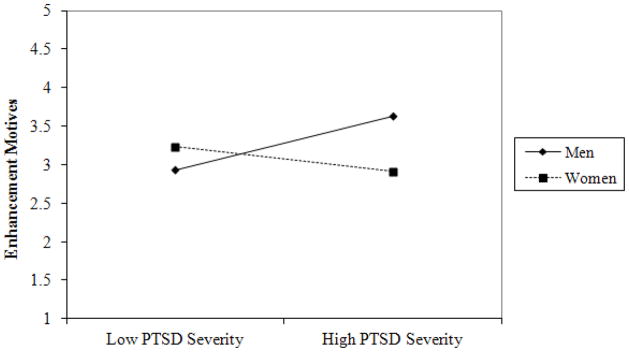
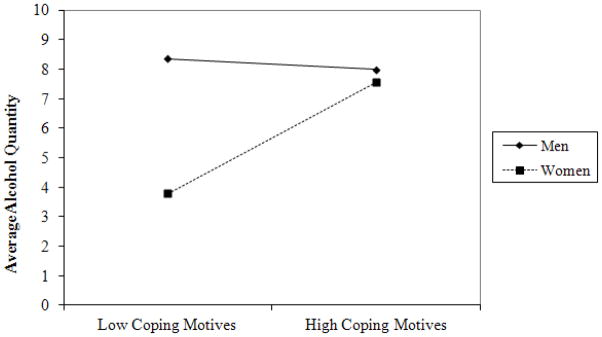
Alcohol dependence (AD) and posttraumatic stress disorder (PTSD) are highly prevalent and comorbid conditions associated with a significant level of impairment. Little systematic study has focused on gender differences specific to individuals with both AD and PTSD. The current study examined gender-specific associations between PTSD symptom severity, drinking to cope (i.e., reduce negative affect), drinking for enhancement (i.e., increase positive affect), and average alcohol use in a clinical sample of men (n = 46) and women (n = 46) with comorbid AD and PTSD. Results indicated that PTSD symptoms were highly associated with drinking-to-cope motives for both men and women, but with greater drinking for enhancement motives for men only. Enhancement motives were positively associated with average alcohol quantity for both men and women, but coping motives were significantly associated with average alcohol quantity for women only. These findings suggest that for individuals with comorbid AD and PTSD, interventions that focus on reducing PTSD symptoms are likely to lower coping motives for both genders, and targeting coping motives is likely to result in decreased drinking for women but not for men, whereas targeting enhancement motives is likely to lead to reduced drinking for both genders.
酒精依赖(AD)和创伤后应激障碍(PTSD)是高度普遍且共病的状况,会导致显著程度的功能损害。很少有系统研究聚焦于同时患有AD和PTSD的个体的性别差异。本研究调查了在患有共病AD和PTSD的男性(n = 46)和女性(n = 46)的临床样本中,PTSD症状严重程度、为应对而饮酒(即减轻负面影响)、为增强效果而饮酒(即增加正面影响)与平均酒精摄入量之间的性别特异性关联。结果表明,PTSD症状与男性和女性为应对而饮酒的动机高度相关,但仅与男性为增强效果而饮酒的动机相关性更强。增强效果的动机与男性和女性的平均酒精摄入量均呈正相关,但应对动机仅与女性的平均酒精摄入量显著相关。这些发现表明,对于患有共病AD和PTSD的个体,专注于减轻PTSD症状的干预措施可能会降低两性的应对动机,针对应对动机可能会导致女性饮酒量减少而男性不会,而针对增强效果的动机可能会导致两性饮酒量减少。