Department of Dermatology, University of Pennsylvania, Philadelphia, Pennsylvania, USA.
Cutaneous Biology Research Center, Massachusetts General Hospital and Harvard Medical School, Charlestown, Massachusetts, USA.
J Invest Dermatol. 2014 Jan;134(1):68-76. doi: 10.1038/jid.2013.224. Epub 2013 Jun 27.
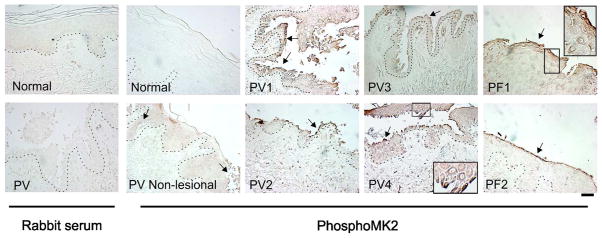
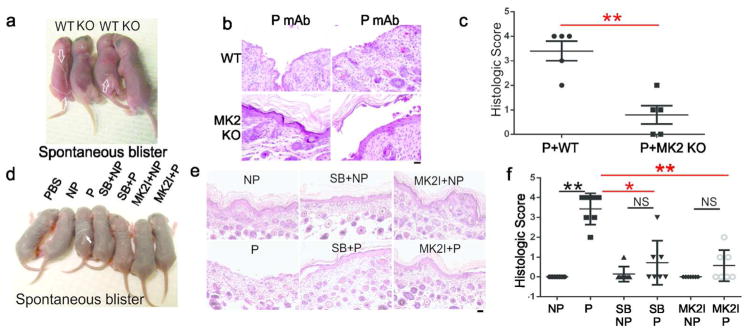
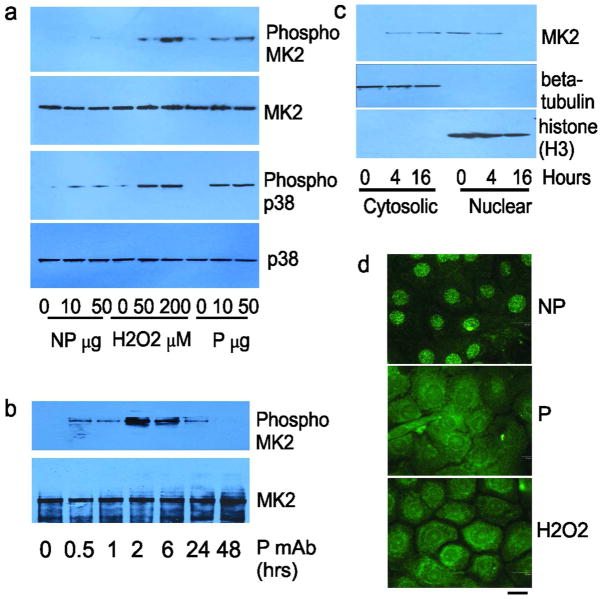
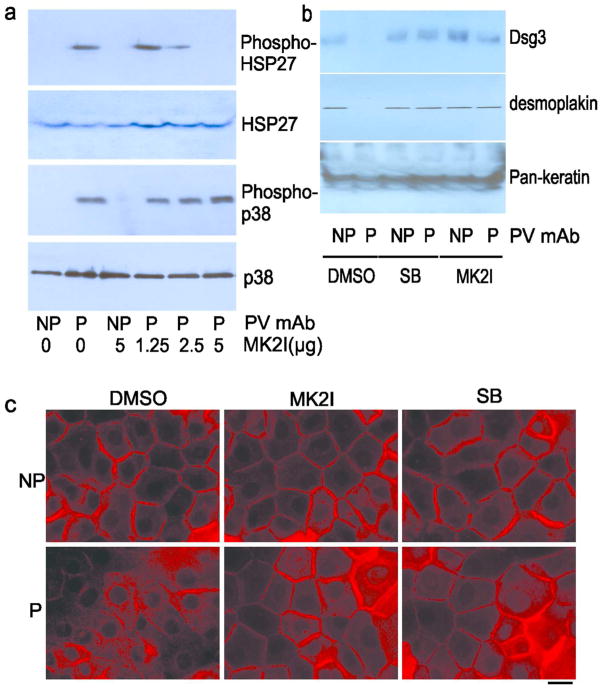
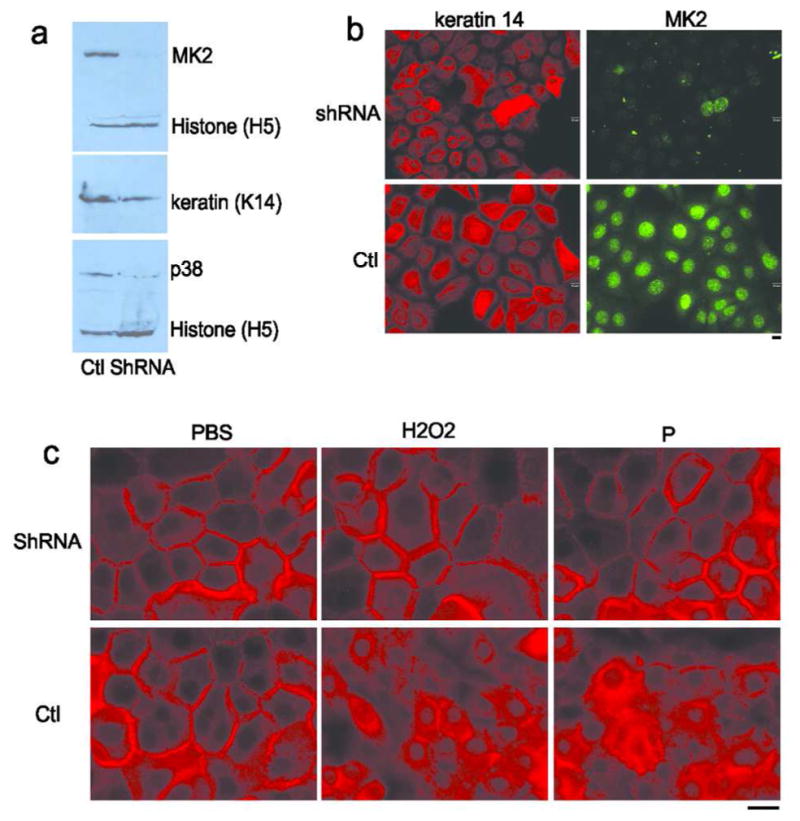
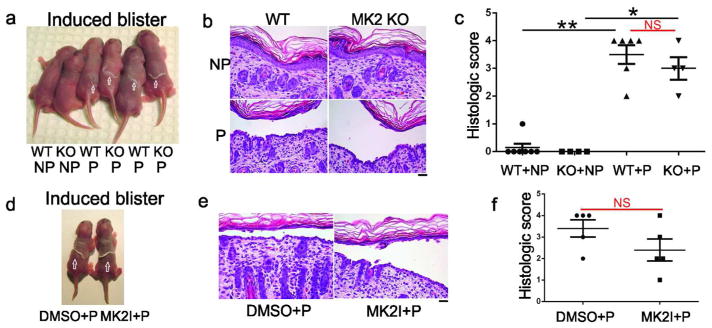
Pemphigus vulgaris (PV) is an autoimmune blistering disease characterized by autoantibodies to the keratinocyte adhesion protein desmoglein 3 (Dsg3). Previous studies suggest that PV pathogenesis involves p38 mitogen-activated protein kinase-dependent and -independent pathways. However, p38 is a difficult protein to study and therapeutically target because it has four isoforms and multiple downstream effectors. In this study, we identify MAPKAP (mitogen-activated protein kinase-activated protein) kinase 2 (MK2) as a downstream effector of p38 signaling in PV and describe MK2-dependent and -independent mechanisms of blister formation using passive transfer of human anti-Dsg IgG4 mAbs to neonatal mice. In human keratinocytes, PV mAbs activate MK2 in a dose-dependent manner. MK2 is also activated in human pemphigus skin blisters, causing translocation of MK2 from the nucleus to the cytosol. Small-molecule inhibition of MK2 and silencing of MK2 expression block PV mAb-induced Dsg3 endocytosis in human keratinocytes. In addition, small-molecule inhibition and genetic deletion of p38α and MK2 inhibit spontaneous but not induced suprabasal blisters by PV mAbs in mouse passive transfer models. Collectively, these data suggest that MK2 is a key downstream effector of p38 that can modulate PV autoantibody pathogenicity. MK2 inhibition may be a valuable adjunctive therapy for control of pemphigus blistering.
寻常型天疱疮(PV)是一种自身免疫性水疱病,其特征是针对角质形成细胞黏附蛋白桥粒芯糖蛋白 3(Dsg3)的自身抗体。先前的研究表明,PV 的发病机制涉及 p38 丝裂原活化蛋白激酶(MAPK)依赖性和非依赖性途径。然而,p38 是一种难以研究和治疗靶点的蛋白,因为它有四个同工型和多个下游效应物。在这项研究中,我们确定丝裂原激活蛋白激酶激活蛋白激酶 2(MK2)是 PV 中 p38 信号的下游效应物,并描述了使用人抗 Dsg IgG4 mAb 被动转移到新生小鼠中形成水疱的 MK2 依赖性和非依赖性机制。在人角质形成细胞中,PV mAb 以剂量依赖性方式激活 MK2。MK2 也在人天疱疮皮肤疱中被激活,导致 MK2 从核转位到细胞质。MK2 的小分子抑制和 MK2 表达的沉默可阻断 PV mAb 诱导的人角质形成细胞中 Dsg3 内吞作用。此外,p38α 和 MK2 的小分子抑制和基因缺失可抑制 PV mAb 在小鼠被动转移模型中诱导的但不诱导的超基底水疱的形成。总之,这些数据表明 MK2 是 p38 的关键下游效应物,可调节 PV 自身抗体的致病性。MK2 抑制可能是控制天疱疮水疱的有价值的辅助治疗方法。