Meyers Primary Care Institute, a joint endeavor of the University of Massachusetts Medical School, Fallon Community Health Plan, and Reliant Medical Group, Worcester, Massachusetts; Department of Pathology, University of Massachusetts Medical School, Worcester, Massachusetts.
Cancer Cytopathol. 2013 Oct;121(10):568-75. doi: 10.1002/cncy.21309. Epub 2013 May 8.
Papanicolaou (Pap) testing has transitioned from conventional preparations (CPs) to liquid-based preparations (LBPs) because of the perceived superiority of LBPs. Many studies conclude that LBPs reduce unsatisfactory Pap tests; however, some believe that the evidence substantiating this claim is weak. The authors studied the effect of the transition from CPs to LBPs on the proportion of unsatisfactory Pap tests in 4 health care systems in the United States participating in the National Institutes of Health-funded Screening Effectiveness and Research in Community-Based Healthcare (SEARCH) project.
The study cohort consisted of 548,174 women ages 21 to 65 years who had 1443,725 total Pap tests between 2000 and 2010. Segmented regression analysis was used to estimate the effect of adopting LBPs on the proportion of unsatisfactory Pap tests after adjusting for age.
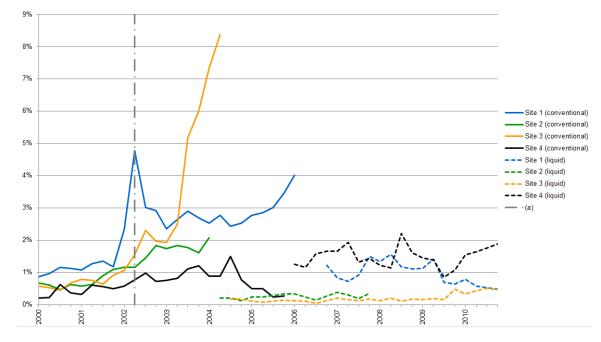
Three sites that implemented SurePath LBP experienced significant reductions in unsatisfactory Pap tests (estimated effect: site 1, -2.46%; 95% confidence interval [CI], -1.47%, -3.45%; site 2, -1.78%; 95% CI, -1.54%, -2.02%; site 3, -8.25%; 95% CI, -7.33%, -9.17%). The fourth site that implemented ThinPrep LBP did not experience a reduction in unsatisfactory Pap tests. The relative risk of an unsatisfactory Pap test in women aged ≥ 50 years increased after the transition to LBPs (SurePath: relative risk, 2.1; 95% CI, 1.9-2.2; ThinPrep: relative risk, 1.7; 95% CI, 1.5-2.0).
The observed changes in the proportion of unsatisfactory Pap tests varied across the participating sites and depended on the type of LBP technology, the age of women, and the rates before the implementation of this technology.
巴氏涂片检测(Pap 检测)已从传统制片(CP)过渡到液基制片(LBPs),因为人们认为 LBPs 更具优势。许多研究得出结论称,LBPs 降低了不满意的 Pap 检测结果;然而,一些人认为支持这一说法的证据是薄弱的。作者研究了在美国参与美国国立卫生研究院资助的社区保健中的筛查效果和研究(SEARCH)项目的 4 个医疗保健系统中,从 CP 过渡到 LBPs 对不满意的 Pap 检测比例的影响。
研究队列由 548174 名年龄在 21 至 65 岁之间的女性组成,她们在 2000 年至 2010 年期间共进行了 1443725 次 Pap 检测。采用分段回归分析,在调整年龄因素后,估计采用 LBPs 对不满意的 Pap 检测比例的影响。
实施了 SurePath LBP 的 3 个地点的不满意 Pap 检测结果显著减少(估计效果:地点 1,-2.46%;95%置信区间[CI],-1.47%,-3.45%;地点 2,-1.78%;95% CI,-1.54%,-2.02%;地点 3,-8.25%;95% CI,-7.33%,-9.17%)。实施了 ThinPrep LBP 的第四个地点的不满意 Pap 检测结果没有减少。在过渡到 LBPs 后,年龄≥50 岁的女性不满意 Pap 检测的相对风险增加(SurePath:相对风险,2.1;95% CI,1.9-2.2;ThinPrep:相对风险,1.7;95% CI,1.5-2.0)。
观察到的不满意 Pap 检测比例的变化在参与的地点之间有所不同,取决于 LBPs 技术的类型、女性的年龄以及实施该技术之前的比率。