Translational Cancer Therapeutics Laboratory, Cancer Research UK, London Research Institute, London WC2A 3LY, UK.
Curr Opin Pharmacol. 2013 Aug;13(4):497-503. doi: 10.1016/j.coph.2013.04.006. Epub 2013 May 7.
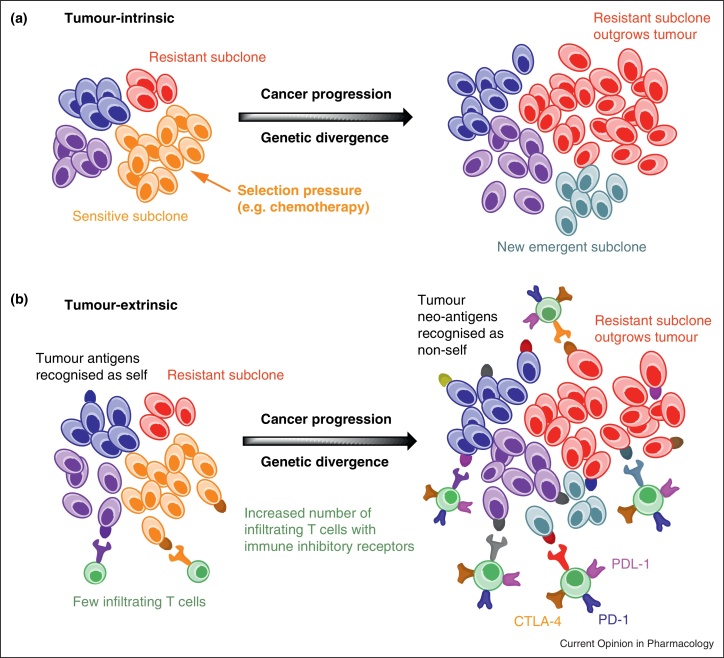
Recent advances in sequencing technologies have revealed extensive intratumour heterogeneity (ITH) both within individual tumours and between primary and metastatic tumours for different cancer types. Such genetic diversity may have clinical implications for both cancer diagnosis and treatment with increasing evidence linking ITH and therapeutic resistance. Nonetheless, whilst limiting the activity of targeted agents, tumour genetic heterogeneity may provide a new therapeutic opportunity through generation of neo-antigens that could be recognised and targeted by the patient's own immune system in response to immune-modulatory therapies. Longitudinal genomic studies assessing tumour clonal architecture and its correlation with the underlying immune response to cancer in each particular patient are needed to follow tumour evolutionary dynamics over time and through therapy, in order to further understand the mechanisms behind drug resistance and to inform the development of new combinatorial therapeutic strategies.
近年来,测序技术的进步揭示了不同癌症类型的单个肿瘤内以及原发性和转移性肿瘤之间广泛的肿瘤内异质性(ITH)。这种遗传多样性可能对癌症的诊断和治疗具有临床意义,越来越多的证据表明 ITH 与治疗耐药性有关。尽管如此,虽然靶向药物的活性受到限制,但肿瘤遗传异质性可能通过产生新抗原为新的治疗机会提供了可能,这些新抗原可以被患者自身的免疫系统识别并针对免疫调节治疗进行靶向。需要进行纵向基因组研究,评估肿瘤克隆结构及其与每个特定患者癌症潜在免疫反应的相关性,以跟踪肿瘤随时间和治疗的进化动态,从而进一步了解耐药背后的机制,并为新的组合治疗策略提供信息。