Venetian Institute of Molecular Medicine VIMM, Padova, Italy.
Int J Biochem Cell Biol. 2013 Oct;45(10):2121-9. doi: 10.1016/j.biocel.2013.04.023. Epub 2013 May 7.
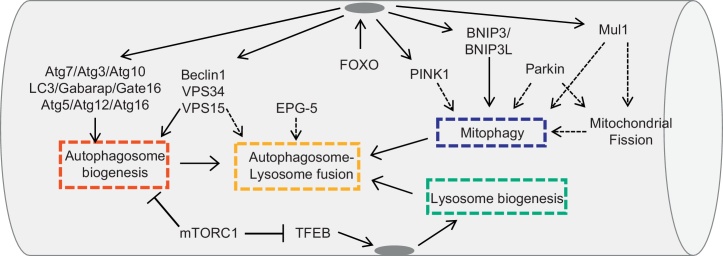
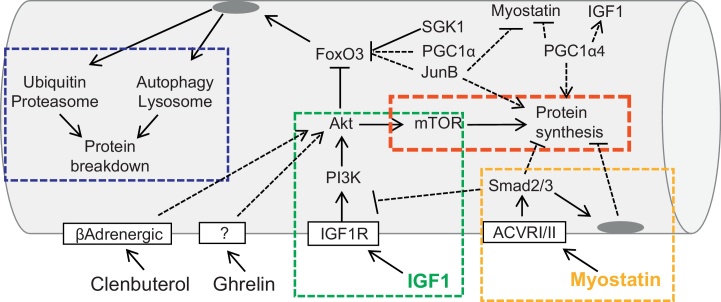
Skeletal muscle adapts its mass as consequence of physical activity, metabolism and hormones. Catabolic conditions or inactivity induce signaling pathways that regulate the process of muscle loss. Muscle atrophy in adult tissue occurs when protein degradation rates exceed protein synthesis. Two major protein degradation pathways, the ubiquitin-proteasome and the autophagy-lysosome systems, are activated during muscle atrophy and variably contribute to the loss of muscle mass. These degradation systems are controlled by a transcription dependent program that modulates the expression of rate-limiting enzymes of these proteolytic systems. The transcription factors FoxO, which are negatively regulated by Insulin-Akt pathway, and NF-κB, which is activated by inflammatory cytokines, were the first to be identified as critical for the atrophy process. In the last years a variety of pathways and transcription factors have been found to be involved in regulation of atrophy. This review will focus on the last progress in ubiquitin-proteasome and autophagy-lysosome systems and their involvement in muscle atrophy. This article is part of a Directed Issue entitled: Molecular basis of muscle wasting.
骨骼肌会根据身体活动、代谢和激素等因素来调整其质量。在分解代谢条件或不活动的情况下,会诱导调节肌肉损失过程的信号通路。当蛋白质降解速度超过蛋白质合成速度时,成年组织中的肌肉就会发生萎缩。在肌肉萎缩过程中,两种主要的蛋白质降解途径,即泛素-蛋白酶体系统和自噬-溶酶体系统,会被激活,并不同程度地导致肌肉质量的丧失。这些降解系统受到转录依赖的程序的控制,该程序调节这些蛋白水解系统的限速酶的表达。FoxO 转录因子受胰岛素-akt 通路的负调控,而 NF-κB 则受炎症细胞因子的激活,它们首先被确定为萎缩过程的关键因素。在过去的几年中,已经发现了多种途径和转录因子参与调节萎缩。这篇综述将重点介绍泛素-蛋白酶体系统和自噬-溶酶体系统的最新进展及其在肌肉萎缩中的作用。本文是主题为“肌肉消耗的分子基础”的专刊的一部分。