Department of Neurology, University Medical Center Groningen, University of Groningen, Groningen, The Netherlands.
PLoS One. 2013 May 7;8(5):e63701. doi: 10.1371/journal.pone.0063701. Print 2013.
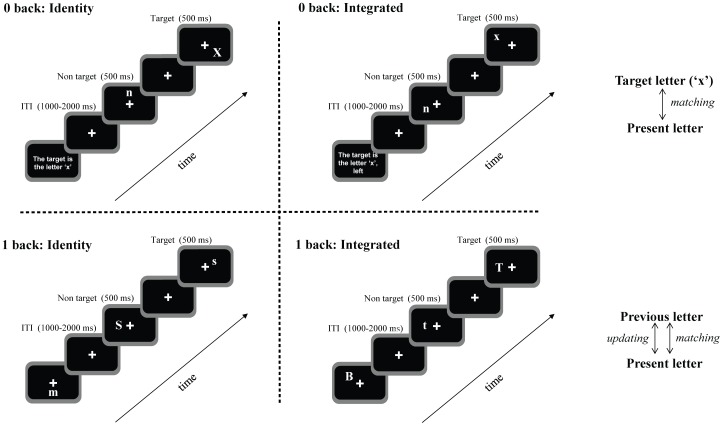
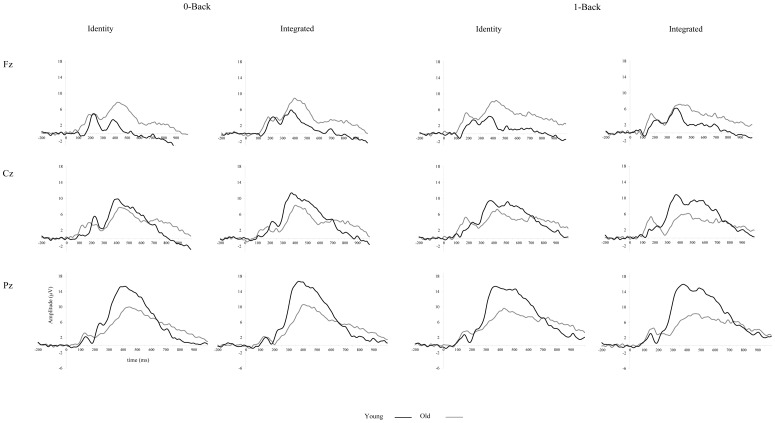
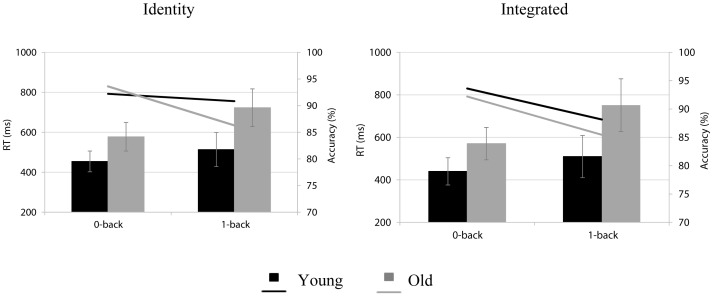
While some elderly show deteriorations in cognitive performance, others achieve performance levels comparable to young adults. To examine whether age-related changes in brain activity varied with working memory performance efficiency, we recorded electroencephalography (EEG) from young and older healthy adults during performance on an n-back task with two loads (0- and 1-back) and two versions (identity and integrated). Young adults showed a typical P3 amplitude pattern with a parietal-maximum. Compared to young adults, the P3 amplitude of older adults was characterized by frontal hyperactivity coupled with posterior hypoactivity. Moreover, P3 amplitude in young and older adults varied with working memory performance efficiency. Among young adults, more efficient performance correlated with a larger P3 amplitude at parietal sites. In contrast, a higher P3 amplitude at midline electrode sites in older adults correlated with less efficient performance. Particularly, the enhanced frontal midline EEG activity in older adults during working memory performance seems to reflect inefficient use of neural resources due to frontal lobe dysfunction.
虽然有些老年人的认知表现会下降,但也有一些老年人的表现水平与年轻人相当。为了研究大脑活动的年龄相关性变化是否与工作记忆表现效率有关,我们在年轻和老年健康成年人执行 n-回任务时记录了脑电图(EEG),该任务有两种负荷(0 回和 1 回)和两种版本(身份和整合)。年轻成年人表现出典型的 P3 振幅模式,具有顶叶最大值。与年轻成年人相比,老年人的 P3 振幅特征是额叶过度活跃,而后部活动不足。此外,年轻人和老年人的 P3 振幅与工作记忆表现效率有关。在年轻成年人中,更有效的表现与顶叶部位的 P3 振幅更大相关。相比之下,老年人大脑中线电极部位的 P3 振幅较高与表现效率较低相关。特别是,老年人在执行工作记忆任务时额叶中线的增强 EEG 活动似乎反映了由于额叶功能障碍而导致的神经资源使用效率低下。