Molecular Imaging Program, Department of Psychiatry and Radiology, New York University School of Medicine, New York, NY 10016, USA.
Mol Psychiatry. 2013 Sep;18(9):1034-40. doi: 10.1038/mp.2013.61. Epub 2013 May 14.
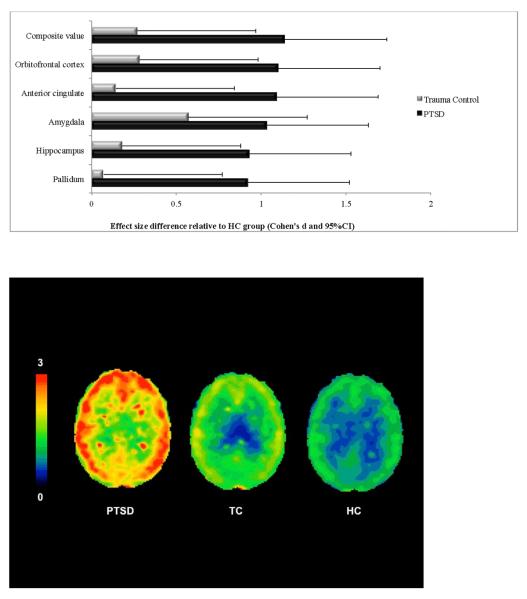
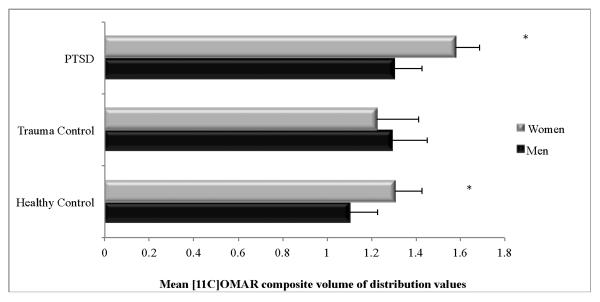
Endocannabinoids and their attending cannabinoid type 1 (CB1) receptor have been implicated in animal models of post-traumatic stress disorder (PTSD). However, their specific role has not been studied in people with PTSD. Herein, we present an in vivo imaging study using positron emission tomography (PET) and the CB1-selective radioligand [(11)C]OMAR in individuals with PTSD, and healthy controls with lifetime histories of trauma (trauma-exposed controls (TC)) and those without such histories (healthy controls (HC)). Untreated individuals with PTSD (N=25) with non-combat trauma histories, and TC (N=12) and HC (N=23) participated in a magnetic resonance imaging scan and a resting PET scan with the CB1 receptor antagonist radiotracer [(11)C]OMAR, which measures the volume of distribution (VT) linearly related to CB1 receptor availability. Peripheral levels of anandamide, 2-arachidonoylglycerol, oleoylethanolamide, palmitoylethanolamide and cortisol were also assessed. In the PTSD group, relative to the HC and TC groups, we found elevated brain-wide [(11)C]OMAR VT values (F(2,53)=7.96, P=0.001; 19.5% and 14.5% higher, respectively), which were most pronounced in women (F(1,53)=5.52, P=0.023). Anandamide concentrations were reduced in the PTSD relative to the TC (53.1% lower) and HC (58.2% lower) groups. Cortisol levels were lower in the PTSD and TC groups relative to the HC group. Three biomarkers examined collectively--OMAR VT, anandamide and cortisol--correctly classified nearly 85% of PTSD cases. These results suggest that abnormal CB1 receptor-mediated anandamide signaling is implicated in the etiology of PTSD, and provide a promising neurobiological model to develop novel, evidence-based pharmacotherapies for this disorder.
内源性大麻素及其相应的大麻素 1 型受体(CB1)已被发现在创伤后应激障碍(PTSD)的动物模型中起作用。然而,它们在 PTSD 患者中的具体作用尚未得到研究。在此,我们使用正电子发射断层扫描(PET)和 CB1 选择性放射性配体 [(11)C]OMAR 对 PTSD 患者、有创伤史的健康对照组(创伤暴露对照组(TC))和无创伤史的健康对照组(HC)进行了一项体内成像研究。未经治疗的 PTSD 患者(N=25)具有非战斗性创伤史,TC(N=12)和 HC(N=23)参加了磁共振成像扫描和静息 PET 扫描,使用 CB1 受体拮抗剂放射性示踪剂 [(11)C]OMAR,该示踪剂线性测量分布容积(VT)与 CB1 受体可用性相关。还评估了花生四烯酸乙醇酰胺、2-花生四烯酰甘油、油酰乙醇酰胺、棕榈酰乙醇酰胺和皮质醇的外周水平。在 PTSD 组中,与 HC 和 TC 组相比,我们发现大脑广泛的 [(11)C]OMAR VT 值升高(F(2,53)=7.96,P=0.001;分别高 19.5%和 14.5%),在女性中最为明显(F(1,53)=5.52,P=0.023)。与 TC(低 53.1%)和 HC(低 58.2%)组相比,PTSD 组中的花生四烯酸乙醇酰胺浓度降低。与 HC 组相比,PTSD 和 TC 组的皮质醇水平较低。联合检查的三种生物标志物--OMAR VT、花生四烯酸乙醇酰胺和皮质醇--可正确分类近 85%的 PTSD 病例。这些结果表明,异常的 CB1 受体介导的花生四烯酸乙醇酰胺信号传导与 PTSD 的发病机制有关,并为开发这种疾病的新的、基于证据的药物治疗方法提供了一个有前途的神经生物学模型。