Ross Jacob, Cuccurazzu Bruna, Delmar Dylan, Cortez Christian, Castillo Giovanni, Acheson Dean T, Baker Dewleen G, Risbrough Victoria B, Stout Daniel M
Department of Biological Sciences, University of California San Diego, San Diego, CA, USA.
Research Service, San Diego ORD VISN 22, VA San Diego Healthcare System, San Diego, CA, USA.
Npj Ment Health Res. 2025 Apr 24;4(1):13. doi: 10.1038/s44184-025-00126-w.
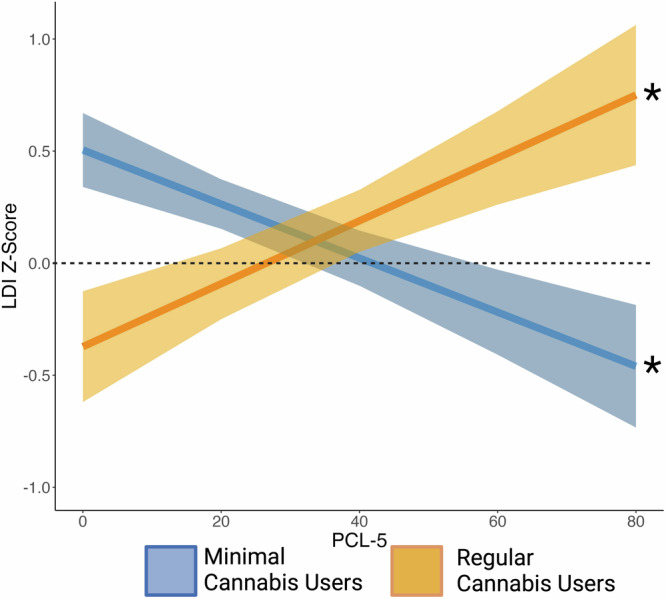
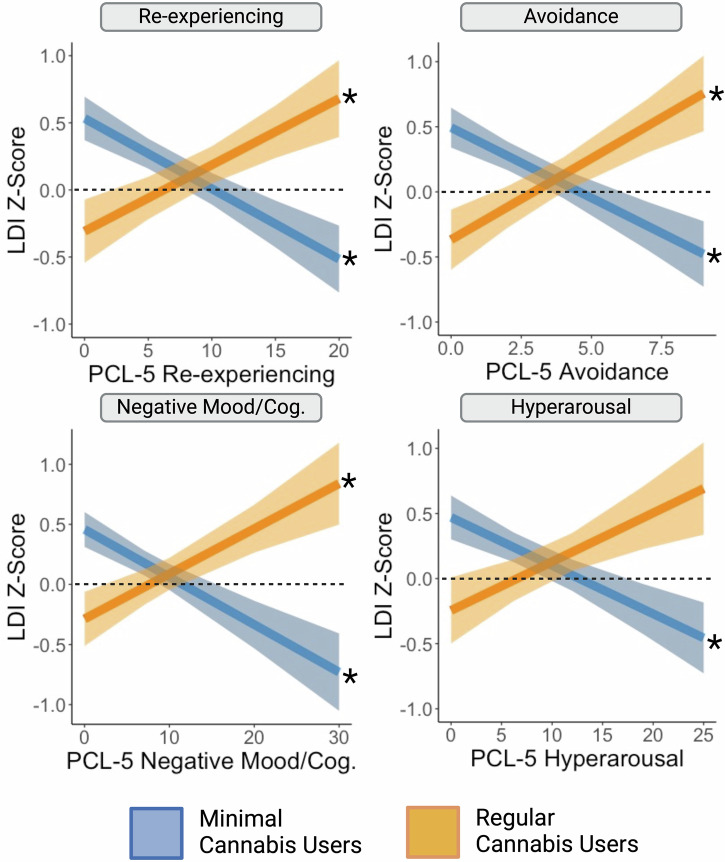
Posttraumatic stress disorder (PTSD) is associated with poor hippocampal function and disrupted pattern recognition. Cannabis use is highly prevalent in individuals with PTSD, yet the impact on these cognitive functions is poorly understood. Participants (n = 111) with a range of PTSD symptoms with and without regular cannabis use completed the mnemonic similarity task. We hypothesized that regular use would be associated with alterations in pattern separation ability in individuals with PTSD symptoms. High PTSD symptoms were associated with reduced pattern separation performance in minimal users. Regular users with high PTSD symptoms showed greater pattern separation, but reduced pattern separation with low PTSD symptoms. These results suggest that regular cannabis use may disrupt pattern separation and similar hippocampal-dependent processes, while it may improve pattern separation in individuals with high PTSD symptoms. These cross-sectional results require longitudinal follow-up studies to evaluate the causal effects of regular cannabis use on cognitive function in PTSD.
创伤后应激障碍(PTSD)与海马体功能不佳及模式识别紊乱有关。大麻使用在PTSD患者中极为普遍,但对这些认知功能的影响却知之甚少。有或无定期大麻使用习惯、患有一系列PTSD症状的参与者(n = 111)完成了记忆相似性任务。我们假设,定期使用大麻会与有PTSD症状个体的模式分离能力改变有关。在极少使用大麻的个体中,高PTSD症状与模式分离表现降低有关。有高PTSD症状的经常使用者表现出更强的模式分离能力,但低PTSD症状的经常使用者模式分离能力降低。这些结果表明,经常使用大麻可能会扰乱模式分离及类似的海马体依赖过程,而在有高PTSD症状的个体中,它可能会改善模式分离能力。这些横断面研究结果需要进行纵向随访研究,以评估定期使用大麻对PTSD患者认知功能的因果效应。