Graduate Institute of Epidemiology and Preventive Medicine, College of Public Health, National Taiwan University, 5F. No. 17, Hsu Chow Road, Zhongzheng District, Taipei City 100, Taiwan, ROC.
Br J Cancer. 2013 Jun 11;108(11):2241-9. doi: 10.1038/bjc.2013.202. Epub 2013 May 14.
We demonstrated how to comprehensively translate the existing and updated scientific evidence on genomic discovery, tumour phenotype, clinical features, and conventional risk factors in association with breast cancer to facilitate individually tailored screening for breast cancer.
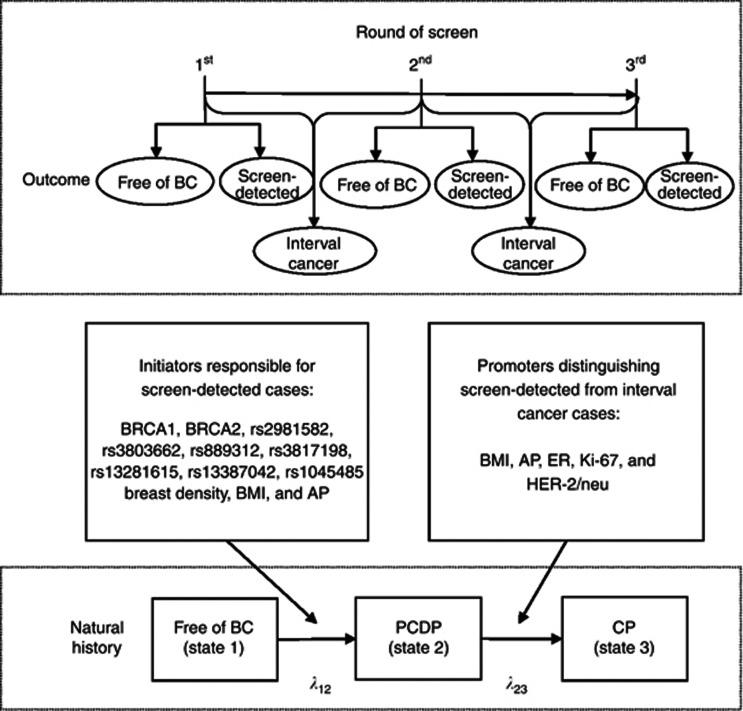
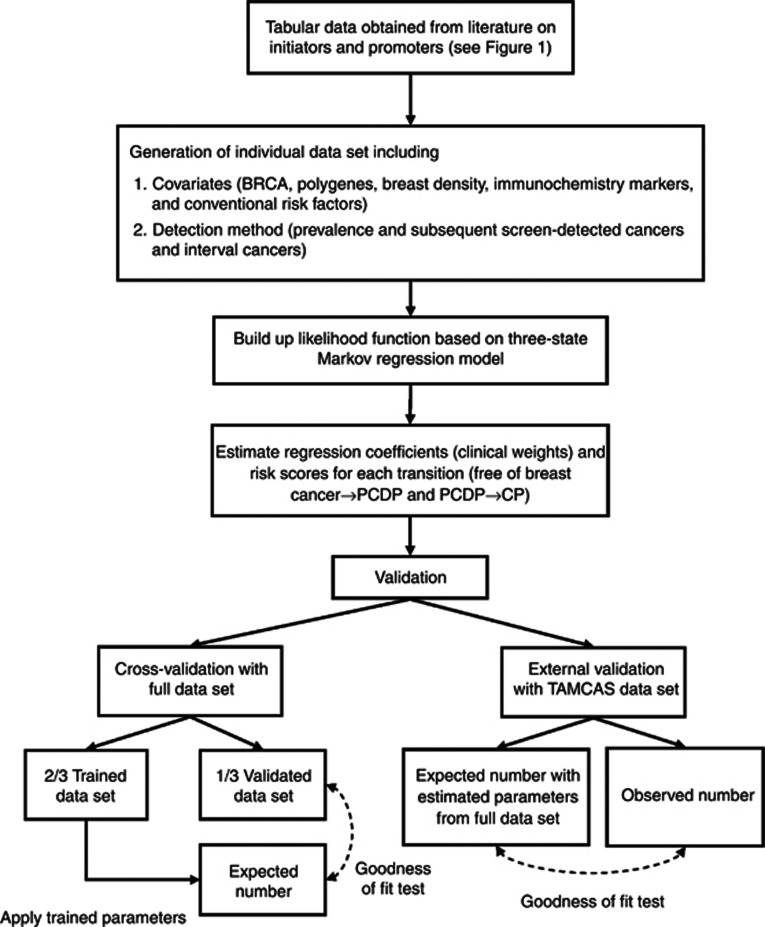
We proposed an individual-risk-score-based approach that translates state-of-the-art scientific evidence into the initiators and promoters affecting onset and subsequent progression of breast tumour underpinning a novel multi-variable three-state temporal natural history model. We applied such a quantitative approach to a population-based Taiwanese women periodical screening cohort.
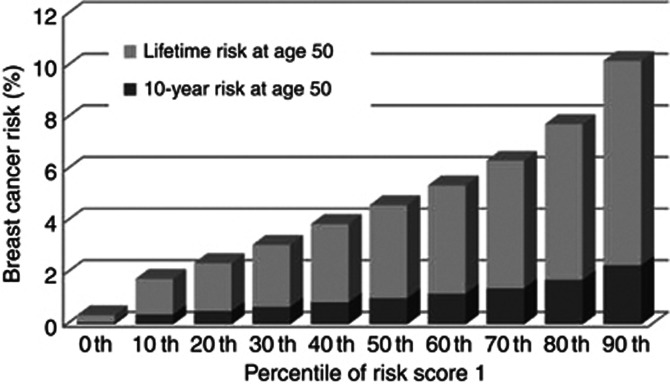
Risk prediction for pre-clinical detectable and clinical-detected breast cancer was made by the two risk scores to stratify the underlying population to assess the optimal age to begin screening and the inter-screening interval for each category and to ascertain which high-risk group requires an alternative image technique. The risk-score-based approach significantly reduced the interval cancer rate as a percentage of the expected rate in the absence of screening by 30% and also reduced 8.2% false positive cases compared with triennial universal screening.
We developed a novel quantitative approach following the principle of translational research to provide a roadmap with state-of-the-art genomic discovery and clinical parameters to facilitate individually tailored breast cancer screening.
我们展示了如何全面地将现有的和更新的关于基因组发现、肿瘤表型、临床特征和与乳腺癌相关的传统风险因素的科学证据转化为个体定制的乳腺癌筛查,以促进个体定制的乳腺癌筛查。
我们提出了一种基于个体风险评分的方法,将最先进的科学证据转化为影响乳腺癌肿瘤发生和随后进展的启动子和促进剂,为新型多变量三状态时间自然史模型提供了基础。我们将这种定量方法应用于基于人群的台湾妇女定期筛查队列。
通过两个风险评分对临床前可检测和临床可检测的乳腺癌进行风险预测,对潜在人群进行分层,以评估开始筛查的最佳年龄和每个类别之间的筛查间隔,并确定哪个高风险组需要替代成像技术。基于风险评分的方法显著降低了间隔期癌症率,与三年一次的普遍筛查相比,间隔期癌症率降低了 30%,假阳性病例也减少了 8.2%。
我们遵循转化研究的原则,开发了一种新的定量方法,为提供最先进的基因组发现和临床参数的个体化乳腺癌筛查提供了路线图。