Kumar Chandan, Gupta Anil Kumar, Nath Rohit, Ahmad Javed
Department of Orthopaedics, GSVM Medical College, Kanpur, India.
Indian J Orthop. 2013 Mar;47(2):156-60. doi: 10.4103/0019-5413.108903.
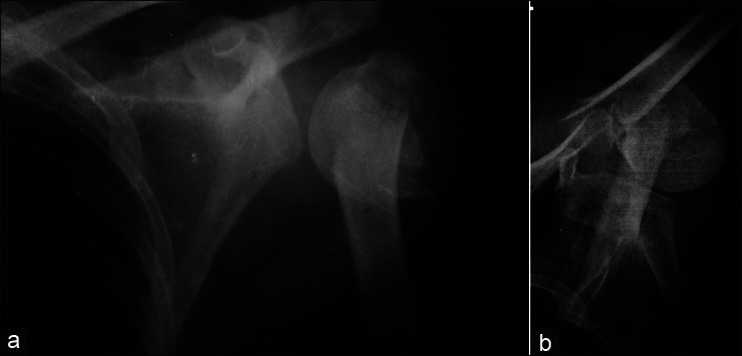
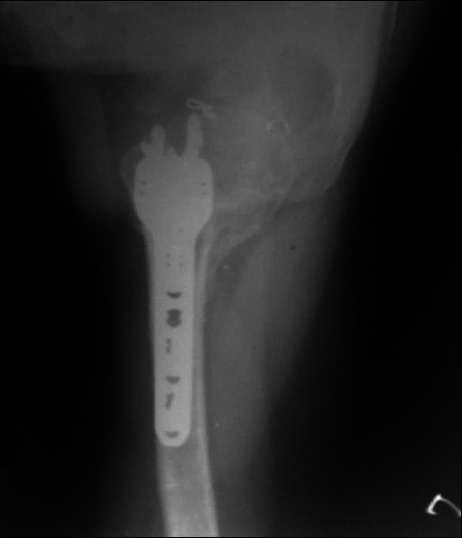
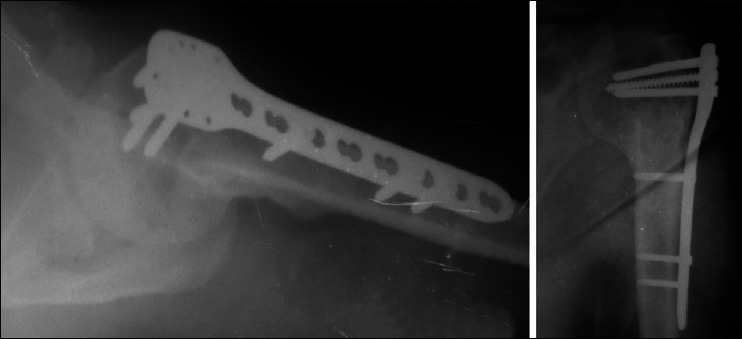
Treatment of proximal humerus fractures is controversial and various operative modalities have been tried in the literature. The aim of the present study was to evaluate functional outcome and complication rate after open reduction and internal fixation of displaced proximal humerus fractures by proximal humerus locking plate.
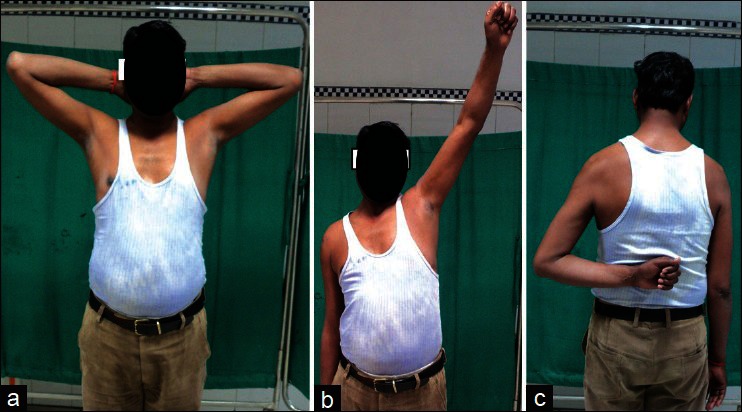
52 patients with displaced proximal humerus fractures treated with proximal humerus locking plate between May 2008 and October 2010 were included in the study. Fractures were classified according to Neer's classification into displaced 2-part, 3-part, and 4-part fractures. Patients were followed for a minimum period of 1 year. 11 patients had less than 1 year of followup and were not considered in the evaluation of final results. Forty one patients were considered for final evaluation. Functional evaluation was done according to the Constant-Murley scoring system. Constant score was compared between 2-part, 3-part, and 4-part fractures at final up and also between young (≤60 yrs) and old (>60 yrs).
11 patients had 2-part fractures, 22 patients had 3-part fractures, and 19 patients had 4-part fractures. The mean followup period was 15.21 ± 2.59 months. 65.8% (n = 27) patients had good to excellent result, 19.5% (n = 8) had fair, and 14.7% (n = 6) had poor result. Constant scores for 2-part (79.83 ± 6.95) and 3-part fractures (74.22 ± 12.53) were significantly superior to those of 4-part fractures (61.09 ± 14.29) (P value = 0.002 and 0.018, respectively). Difference between 2-part and 3-part fractures was not significant (P value = 0.623). There was no significant difference between younger (≤60) and older patients (>60). Complications encountered in this series were varus malreduction in 17% (n = 7), screw perforation in 10% (n = 4), plate impingement in 12% (n = 5), infection in 2% (n = 1), and nonunion in 2% (n = 1) of cases.
Proximal humerus locking plate gives reliable fixation for 2-part and 3-part fractures. Its use in more complicated fracture patterns of 4-part fractures is associated with poor clinical outcome.
肱骨近端骨折的治疗存在争议,文献中尝试了多种手术方式。本研究的目的是评估采用肱骨近端锁定钢板对移位的肱骨近端骨折进行切开复位内固定后的功能结果和并发症发生率。
本研究纳入了2008年5月至2010年10月期间采用肱骨近端锁定钢板治疗的52例移位肱骨近端骨折患者。骨折根据Neer分类法分为移位的二部分、三部分和四部分骨折。患者至少随访1年。11例患者随访时间不足1年,未纳入最终结果评估。41例患者纳入最终评估。根据Constant-Murley评分系统进行功能评估。在末次随访时比较二部分、三部分和四部分骨折之间以及年轻(≤60岁)和老年(>60岁)患者之间的Constant评分。
11例患者为二部分骨折,22例患者为三部分骨折,19例患者为四部分骨折。平均随访时间为15.21±2.59个月。65.8%(n = 27)的患者结果为良好至优秀,19.5%(n = 8)为中等,14.7%(n = 6)为差。二部分骨折(79.83±6.95)和三部分骨折(74.22±12.53)的Constant评分显著高于四部分骨折(61.09±14.29)(P值分别为0.002和0.018)。二部分和三部分骨折之间的差异不显著(P值 = 0.623)。年轻(≤60岁)和老年患者(>60岁)之间无显著差异。本系列中遇到的并发症包括17%(n = 7)的内翻畸形愈合、10%(n = 4)的螺钉穿孔、12%(n = 5)的钢板撞击、2%(n = 1)的感染和2%(n = 1)的骨不连。
肱骨近端锁定钢板对二部分和三部分骨折提供可靠的固定。其用于更复杂的四部分骨折模式与较差的临床结果相关。