Department of Oral Medicine and Traditional Chinese Medicine, School of Stomatology, Peking University, Beijing 100081, People's Republic of China.
Biosci Rep. 2013 Jul 16;33(4):e00051. doi: 10.1042/BSR20130022.
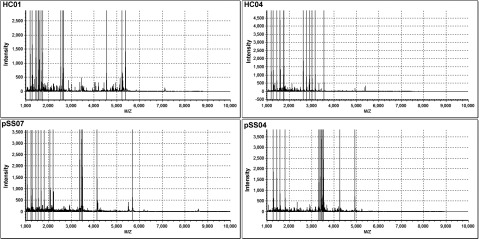
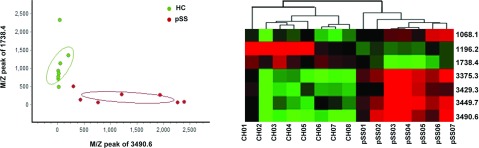
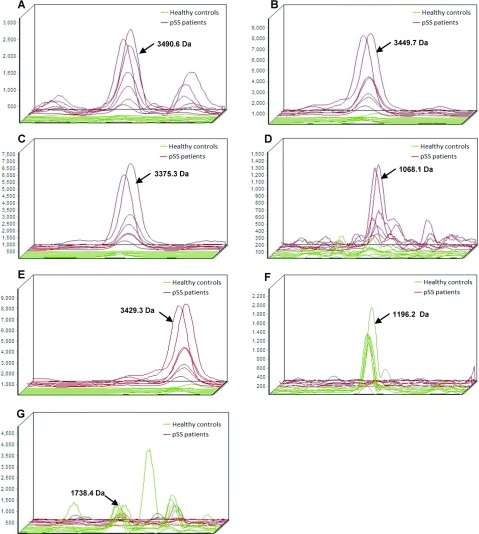
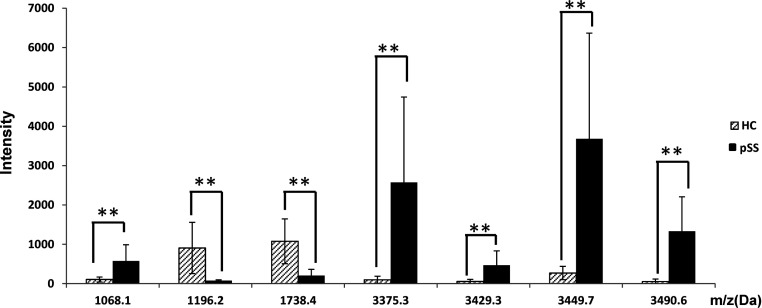
Saliva diagnostics has become an attractive field utilizing nanotechnology and molecular technologies for pSS (primary Sjögren's syndrome). However, no specific methods have been established. To refine the diagnostic power of the saliva peptide finger print for the early detection of pSS, we screened the expression spectrum of salivary peptides in pSS patients by using mass spectrometry MALDI-TOF-MS (matrix-assisted laser-desorption ionization-time-of-flight MS) combined with magnetic bead. The present study was comprised 12 pSS patients and 13 healthy controls and broken down to two different phases. In the initial 'exploratory phase', we enrolled seven pSS patients with eight age- and sex-matched healthy volunteers. Proteomics analysis of the unstimulated salivary samples was conducted to generate proportional peptide mass fingerprints. A diagnostic model was established. The testing cohort of the second 'validation phase' was represented by five pSS patients and five age- and sex-matched healthy controls. The diagnostic power of this diagnostic panel was then validated. The results showed seven m/z (mass-to-charge) ratio peaks with significant differences. Five peptides were up-regulated and two down-regulated in the pSS patients compared with matched healthy subjects. In the validation phase, four out of five pSS patients were diagnosed as pSS, and four of the five healthy controls were diagnosed as healthy controls, respectively. Potential biomarkers were also primarily predicted. The novel diagnostic proteomic model with m/z peaks 1068.1 Da, 1196.2 Da, 1738.4 Da, 3375.3 Da, 3429.3 Da, 3449.7 Da and 3490.6 Da is of certain value for early diagnosis of pSS.
唾液诊断已成为利用纳米技术和分子技术诊断原发性干燥综合征(pSS)的一个有吸引力的领域。然而,尚未建立特定的方法。为了提高唾液肽指纹图谱对 pSS 早期检测的诊断能力,我们使用基质辅助激光解吸电离飞行时间质谱(MALDI-TOF-MS)结合磁珠筛选了 pSS 患者唾液肽的表达谱。本研究包括 12 例 pSS 患者和 13 例健康对照者,并分为两个不同阶段。在最初的“探索性阶段”,我们招募了 7 名 pSS 患者和 8 名年龄和性别匹配的健康志愿者。对未刺激唾液样本进行蛋白质组学分析,以生成比例肽质量指纹图谱。建立诊断模型。第二个“验证阶段”的测试队列由 5 名 pSS 患者和 5 名年龄和性别匹配的健康对照者组成。然后验证了该诊断小组的诊断能力。结果显示有 7 个 m/z(质荷比)比值峰具有显著差异。与匹配的健康受试者相比,pSS 患者中有 5 个肽上调,2 个肽下调。在验证阶段,5 名 pSS 患者中有 4 名被诊断为 pSS,5 名健康对照者中有 4 名被诊断为健康对照者。还初步预测了潜在的生物标志物。m/z 峰 1068.1 Da、1196.2 Da、1738.4 Da、3375.3 Da、3429.3 Da、3449.7 Da 和 3490.6 Da 的新型诊断蛋白质组模型对 pSS 的早期诊断具有一定价值。