Departamento de Ciencias Naturales, Universidad Autónoma Metropolitana, Unidad Cuajimalpa, Artificios 40, Col, Hidalgo, México, D, F 01120, Mexico.
Mol Cancer. 2013 May 21;12:44. doi: 10.1186/1476-4598-12-44.
All-trans retinoic acid (ATRA) is currently being used in clinical trials for cancer treatment. The use of ATRA is limited because some cancers, such as lung cancer, show resistance to treatment. However, little is known about the molecular mechanisms that regulate resistance to ATRA treatment. Akt is a kinase that plays a key role in cell survival and cell invasion. Akt is often activated in lung cancer, suggesting its participation in resistance to chemotherapy. In this study, we explored the hypothesis that activation of the Akt pathway promotes resistance to ATRA treatment at the inhibition of cell survival and invasion in lung cancer. We aimed to provide guidelines for the proper use of ATRA in clinical trials and to elucidate basic biological mechanisms of resistance.
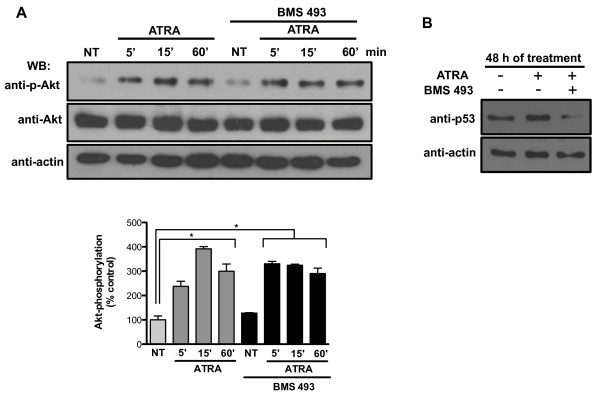
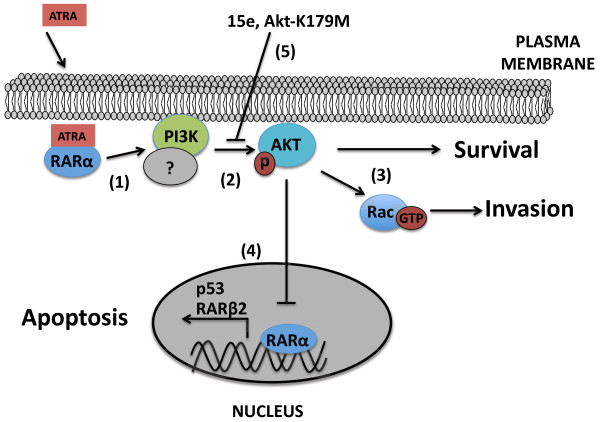
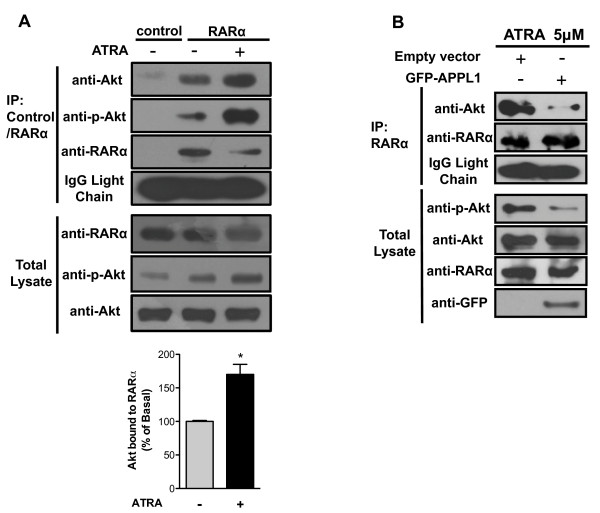
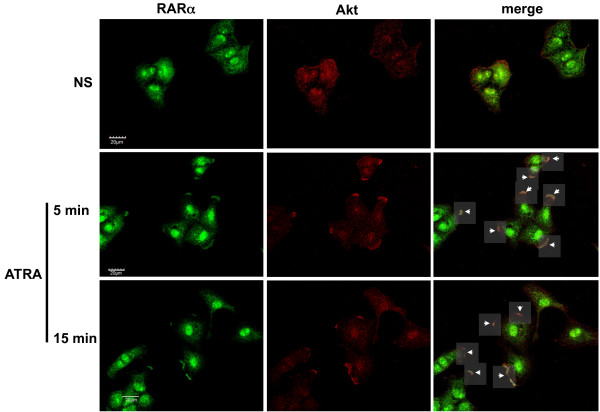
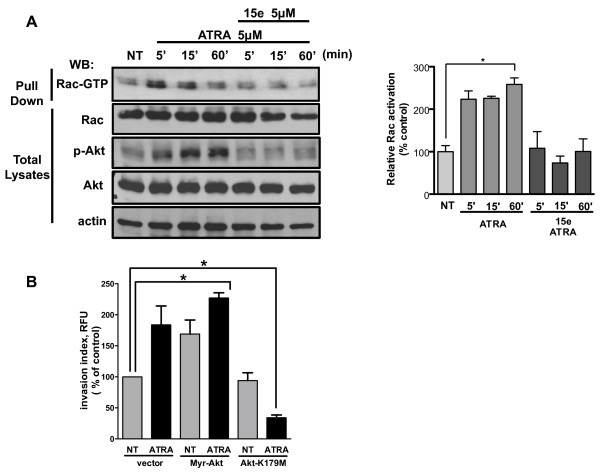
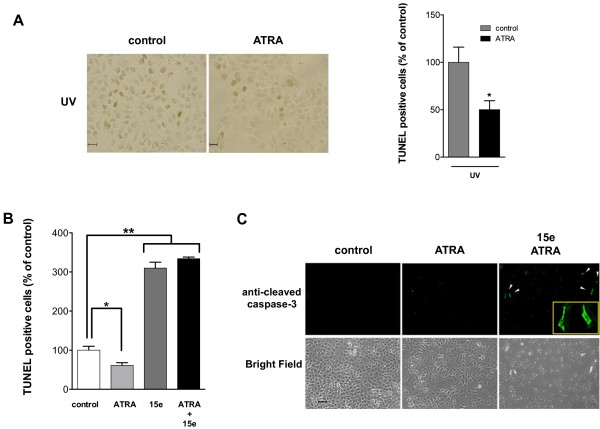
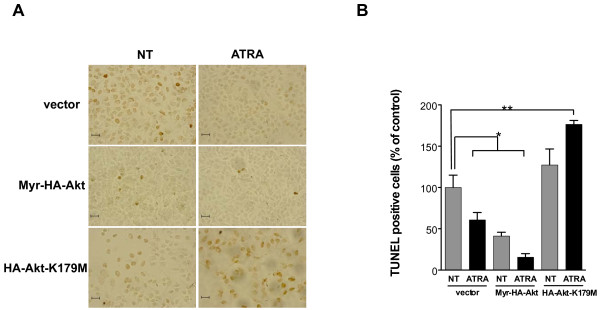
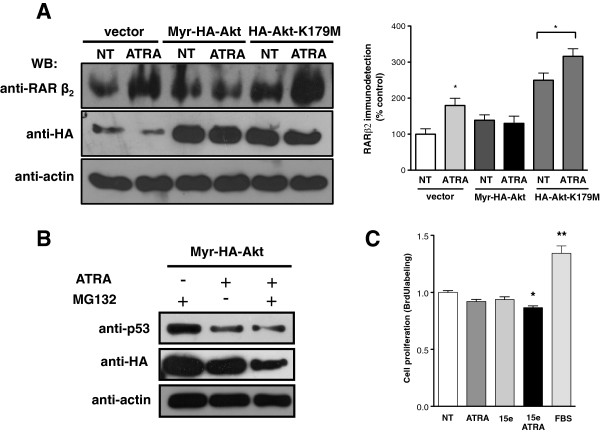
We performed experiments using the A549 human lung adenocarcinoma cell line. We found that ATRA treatment promotes PI3k-Akt pathway activation through transcription-independent mechanisms. Interestingly, ATRA treatment induces the translocation of RARα to the plasma membrane, where it colocalizes with Akt. Immunoprecipitation assays showed that ATRA promotes Akt activation mediated by RARα-Akt interaction. Activation of the PI3k-Akt pathway by ATRA promotes invasion through Rac-GTPase, whereas pretreatment with 15e (PI3k inhibitor) or over-expression of the inactive form of Akt blocks ATRA-induced invasion. We also found that treatment with ATRA induces cell survival, which is inhibited by 15e or over-expression of an inactive form of Akt, through a subsequent increase in the levels of the active form of caspase-3. Finally, we showed that over-expression of the active form of Akt significantly decreases expression levels of the tumor suppressors RARβ2 and p53. In contrast, over-expression of the inactive form of Akt restores RARβ2 expression in cells treated with ATRA, indicating that activation of the PI3k-Akt pathway inhibits the expression of ATRA target genes.
Our results demonstrate that rapid activation of Akt blocks transcription-dependent mechanism of ATRA, promotes invasion and cell survival and confers resistance to retinoic acid treatment in lung cancer cells. These findings provide an incentive for the design and clinical testing of treatment regimens that combine ATRA and PI3k inhibitors for lung cancer treatment.
全反式维甲酸(ATRA)目前正在临床试验中用于癌症治疗。由于某些癌症(如肺癌)对治疗有抗药性,因此限制了 ATRA 的使用。然而,目前对于调节 ATRA 治疗抗性的分子机制知之甚少。 Akt 是一种在细胞存活和细胞侵袭中起关键作用的激酶。在肺癌中,Akt 经常被激活,表明其参与了化疗耐药。在这项研究中,我们探讨了这样一个假设,即 Akt 通路的激活通过抑制细胞存活和侵袭促进肺癌对 ATRA 治疗的抗性。我们旨在为 ATRA 在临床试验中的正确使用提供指导,并阐明抗性的基本生物学机制。
我们使用 A549 人肺腺癌细胞系进行了实验。我们发现 ATRA 治疗通过转录非依赖性机制促进 PI3k-Akt 通路的激活。有趣的是,ATRA 治疗诱导 RARα 向质膜易位,在质膜中与 Akt 共定位。免疫沉淀实验表明,ATRA 通过 RARα-Akt 相互作用促进 Akt 的激活。ATRA 对 PI3k-Akt 通路的激活通过 Rac-GTPase 促进侵袭,而用 15e(PI3k 抑制剂)预处理或过表达 Akt 的无活性形式可阻断 ATRA 诱导的侵袭。我们还发现,ATRA 诱导的细胞存活通过随后增加 caspase-3 的活性形式水平而被 15e 或过表达 Akt 的无活性形式所抑制。最后,我们表明 Akt 的活性形式的过表达显著降低肿瘤抑制因子 RARβ2 和 p53 的表达水平。相反,在用 ATRA 处理的细胞中过表达 Akt 的无活性形式可恢复 RARβ2 的表达,表明 PI3k-Akt 通路的激活抑制了 ATRA 靶基因的表达。
我们的结果表明,Akt 的快速激活阻断了 ATRA 的转录依赖性机制,促进了侵袭和细胞存活,并赋予了肺癌细胞对维甲酸治疗的抗性。这些发现为设计和临床试验联合 ATRA 和 PI3k 抑制剂治疗肺癌的治疗方案提供了动力。