Keasey Matthew P, Kang Seong Su, Lovins Chiharu, Hagg Theo
Cell Commun Signal. 2013 May 21;11:35. doi: 10.1186/1478-811X-11-35.
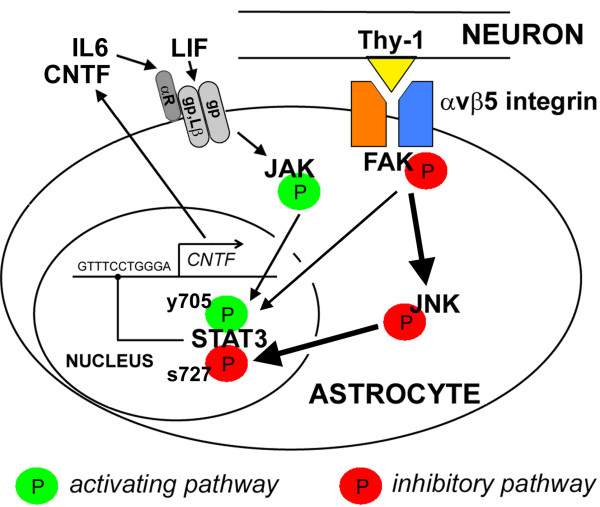
Ciliary neurotrophic factor (CNTF) expression is repressed in astrocytes by neuronal contact in the CNS and is rapidly induced by injury. Here, we defined an inhibitory integrin signaling pathway.
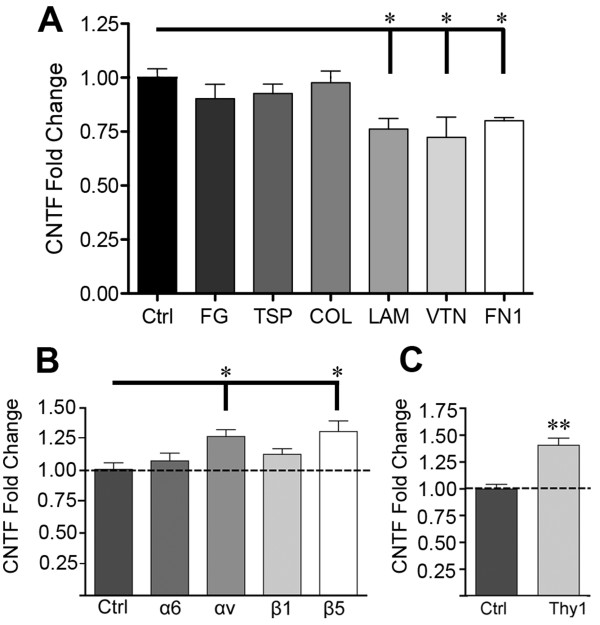
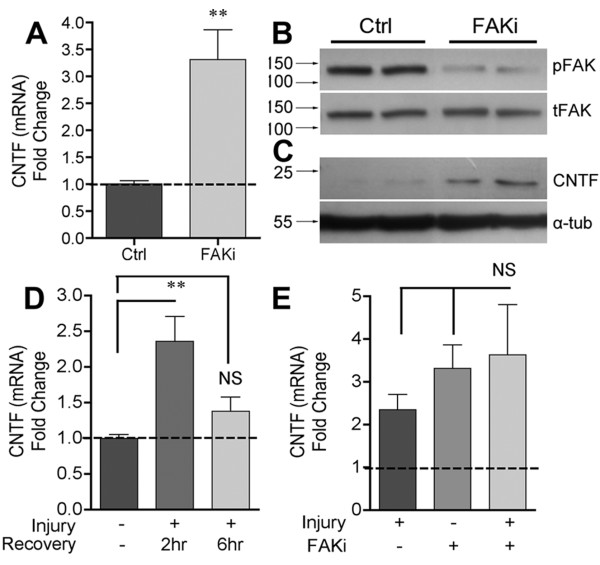
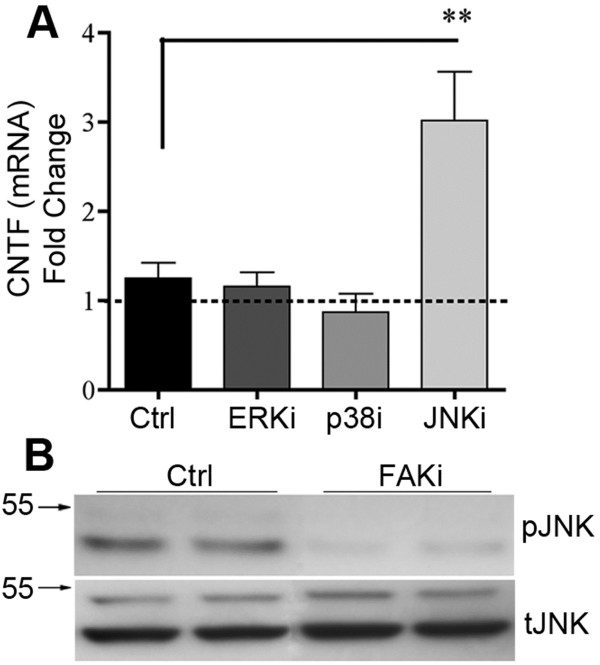
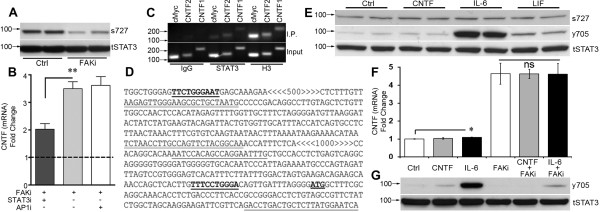
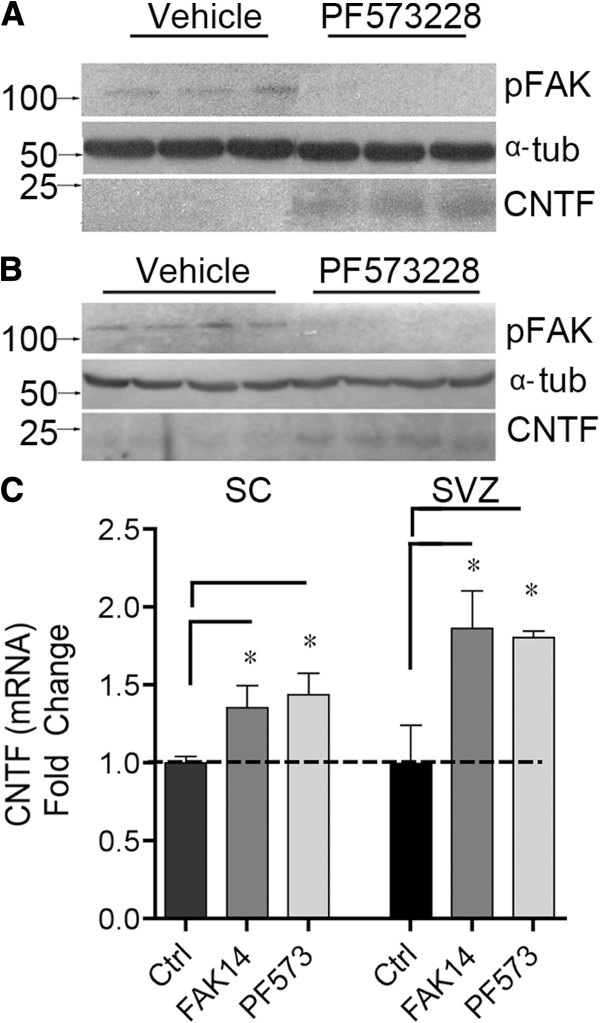
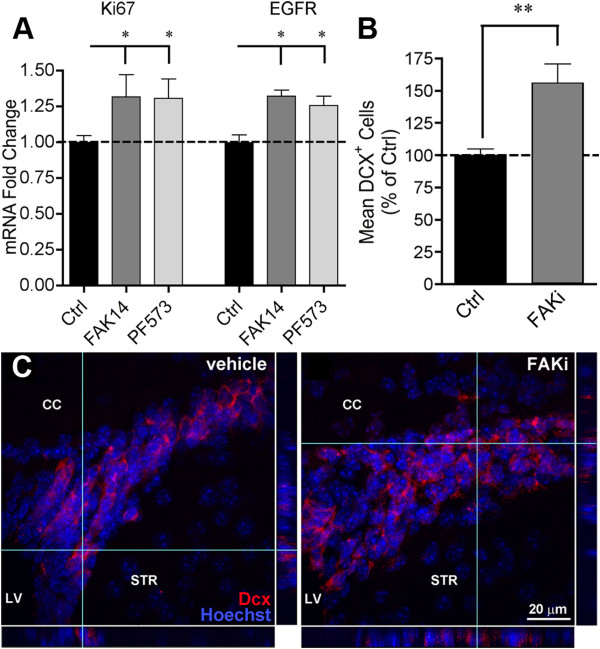
The integrin substrates laminin, fibronectin and vitronectin, but not collagen, thrombospondin or fibrinogen, reduced CNTF expression in C6 astroglioma cells. Antibodies against αv and β5, but not α6 or β1, integrin induced CNTF. Together, the ligand and antibody specificity suggests that CNTF is repressed by αvβ5 integrin. Antibodies against Thy1, an abundant neuronal surface protein whose function is unclear, induced CNTF in neuron-astrocyte co-cultures indicating that it is a neuroglial CNTF repressor. Inhibition of the integrin signaling molecule Focal Adhesion Kinase (FAK) or the downstream c-Jun N-terminal kinase (JNK), but not extracellular regulated kinase (ERK) or p38 MAPK, greatly induced CNTF mRNA and protein expression within 4 hours. This selective inhibitory pathway phosphorylated STAT3 on its inhibitory ser-727 residue interfering with activity of the pro-transcription Tyr-705 residue. STAT3 can activate CNTF transcription because it bound to its promoter and FAK antagonist-induced CNTF was reduced by blocking STAT3. Microinjection of FAK inhibitor directly into the brain or spinal cord in adult mice rapidly induced CNTF mRNA and protein expression. Importantly, systemic treatment with FAK inhibitors over 3 days induced CNTF in the subventricular zone and increased neurogenesis.
Neuron-astroglia contact mediated by integrins serves as a sensor to enable rapid neurotrophic responses and provides a new pharmacological avenue to exploit the neuroprotective properties of endogenous CNTF.
在中枢神经系统中,睫状神经营养因子(CNTF)的表达在星形胶质细胞中受神经元接触的抑制,并在损伤后迅速诱导表达。在此,我们确定了一条抑制性整合素信号通路。
整合素底物层粘连蛋白、纤连蛋白和玻连蛋白可降低C6星形胶质瘤细胞中CNTF的表达,但胶原蛋白、血小板反应蛋白或纤维蛋白原则无此作用。抗αv和β5整合素的抗体可诱导CNTF表达,而抗α6或β1整合素的抗体则无此作用。综合来看,配体和抗体的特异性表明CNTF受αvβ5整合素抑制。抗Thy1(一种功能不明的丰富神经元表面蛋白)的抗体可在神经元 - 星形胶质细胞共培养物中诱导CNTF表达,表明它是一种神经胶质CNTF抑制因子。抑制整合素信号分子粘着斑激酶(FAK)或下游的c - Jun氨基末端激酶(JNK),而非细胞外调节激酶(ERK)或p38丝裂原活化蛋白激酶(MAPK),可在4小时内极大地诱导CNTF mRNA和蛋白表达。这条选择性抑制通路使其抑制性丝氨酸 - 727位点的信号转导和转录激活因子3(STAT3)磷酸化,从而干扰其转录促进酪氨酸 - 705位点的活性。STAT3可激活CNTF转录,因为它与CNTF启动子结合,且阻断STAT3可降低FAK拮抗剂诱导的CNTF表达。将FAK抑制剂直接显微注射到成年小鼠的脑或脊髓中可迅速诱导CNTF mRNA和蛋白表达。重要的是,用FAK抑制剂进行3天的全身治疗可在脑室下区诱导CNTF表达并增加神经发生。
由整合素介导的神经元 - 星形胶质细胞接触作为一种传感器,可实现快速的神经营养反应,并为开发内源性CNTF的神经保护特性提供了一条新的药理学途径。