Department of Internal Medicine, Seoul National University Hospital, Seoul, Korea.
PLoS One. 2013 May 21;8(5):e64271. doi: 10.1371/journal.pone.0064271. Print 2013.
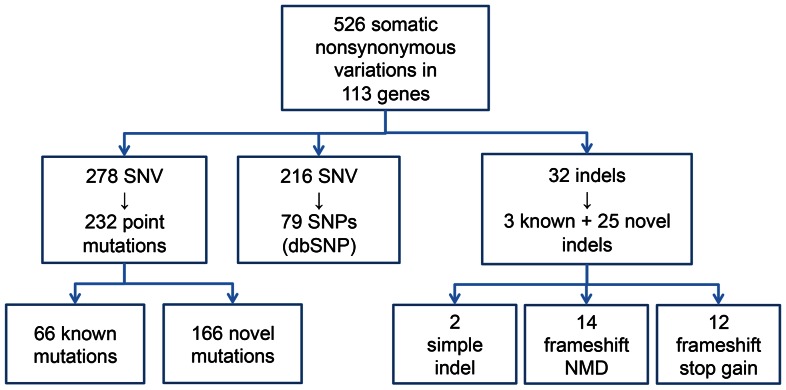
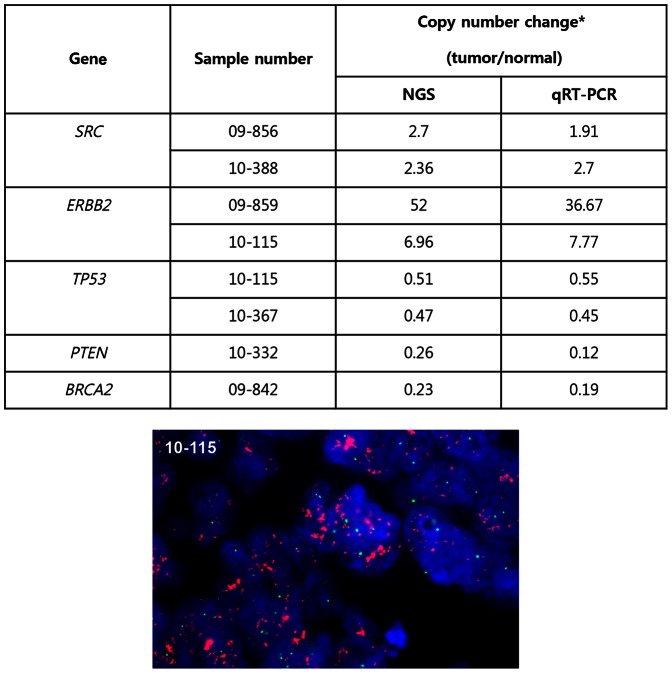
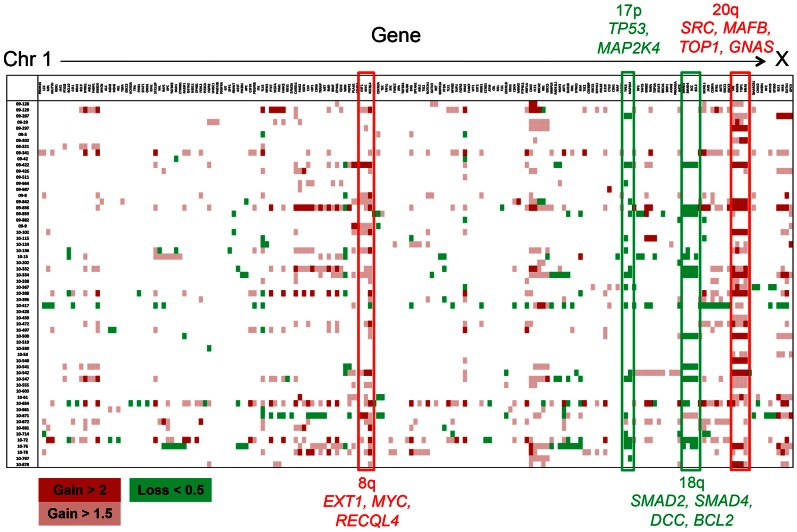
Recent advance in sequencing technology has enabled comprehensive profiling of genetic alterations in cancer. We have established a targeted sequencing platform using next-generation sequencing (NGS) technology for clinical use, which can provide mutation and copy number variation data. NGS was performed with paired-end library enriched with exons of 183 cancer-related genes. Normal and tumor tissue pairs of 60 colorectal adenocarcinomas were used to test feasibility. Somatic mutation and copy number alteration were analyzed. A total of 526 somatic non-synonymous sequence variations were found in 113 genes. Among these, 278 single nucleotide variations were 232 different somatic point mutations. 216 SNV were 79 known single nucleotide polymorphisms in the dbSNP. 32 indels were 28 different indel mutations. Median number of mutated gene per tumor was 4 (range 0-23). Copy number gain (>X2 fold) was found in 65 genes in 40 patients, whereas copy number loss (<X0.5 fold) was found in 103 genes in 39 patients. The most frequently altered genes (mutation and/or copy number alteration) were APC in 35 patients (58%), TP53 in 34 (57%), and KRAS in 24 (40%). Altered gene list revealed ErbB signaling pathway as the most commonly involved pathway (25 patients, 42%). Targeted sequencing platform using NGS technology is feasible for clinical use and provides comprehensive genetic alteration data.
近年来,测序技术的进步使得对癌症中的基因改变进行全面分析成为可能。我们已经建立了一个使用下一代测序(NGS)技术的靶向测序平台,该平台可提供突变和拷贝数变异数据。NGS 采用了经过外显子富集的靶向文库,覆盖了 183 个与癌症相关的基因。我们使用 60 对结直肠腺癌的正常和肿瘤组织对该平台进行了临床可行性测试。分析了体细胞突变和拷贝数改变。在 113 个基因中发现了 526 个体细胞非同义序列变异,其中 278 个为单核苷酸变异,包括 232 个不同的体细胞点突变和 79 个已知的 dbSNP 单核苷酸多态性。32 个插入缺失突变包括 28 个不同的插入缺失突变。每个肿瘤中突变基因的中位数为 4 个(范围 0-23)。在 40 名患者中发现了 65 个基因的拷贝数获得(>X2 倍),在 39 名患者中发现了 103 个基因的拷贝数丢失(<X0.5 倍)。最常改变的基因(突变和/或拷贝数改变)是 APC(35 名患者,58%)、TP53(34 名患者,57%)和 KRAS(24 名患者,40%)。改变基因列表揭示了 ErbB 信号通路是最常涉及的通路(25 名患者,42%)。使用 NGS 技术的靶向测序平台可用于临床,可提供全面的遗传改变数据。