Division of Pediatric Endocrinology, Cincinnati Children's Hospital Medical Center, Cincinnati, OH.
J Pediatr. 2013 Oct;163(4):1045-51. doi: 10.1016/j.jpeds.2013.04.002. Epub 2013 May 21.
To determine the incidence of pathology during routine screening of healthy short children, testing adherence to a consensus statement on the diagnosis and treatment of children with idiopathic short stature, and the cost per identified diagnosis resulting from comprehensive screening.
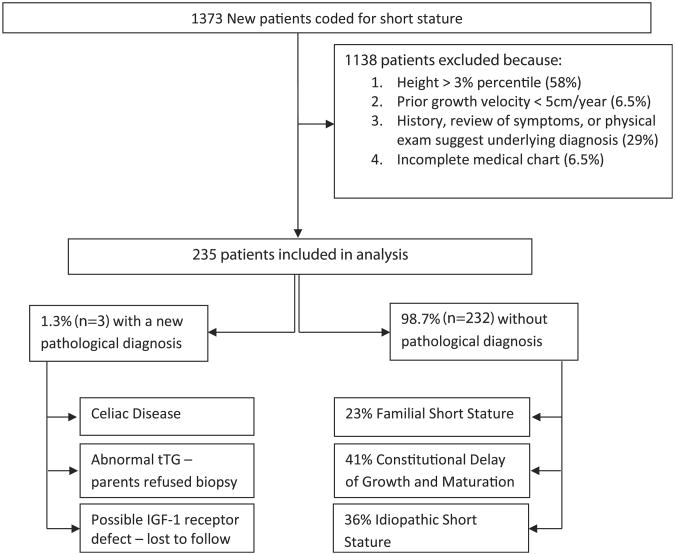
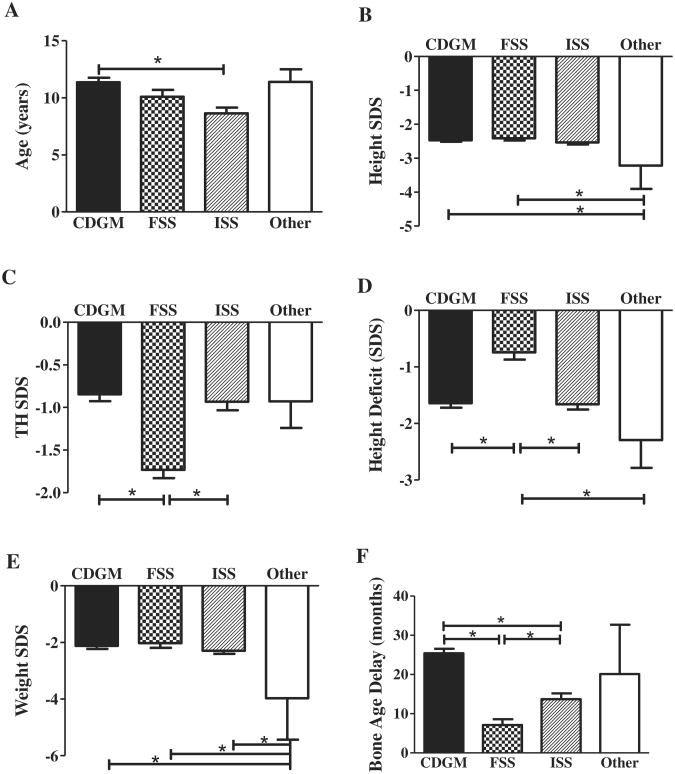
Retrospective chart review of 1373 consecutive short stature referrals evaluated at the Cincinnati Children's Hospital Medical Center Pediatric Endocrinology Clinic between 2008 and 2011. We identified 235 patients with a height of <3rd percentile, negative history and review of systems, and normal physical examination. Outcome measures were incidence of pathology detection, diagnostic group characteristics, clinicians' adherence to testing guidelines, and screening costs. ANOVA and χ(2) were used to analyze the data.
Nearly 99% of patients were diagnosed as possible variants of normal growth: 23% with familial short stature, 41% with constitutional delay of growth and maturation, and 36% with idiopathic short stature. The incidence of newly diagnosed pathology was 1.3%: 1 patient with biopsy-proved celiac disease, 1 with unconfirmed celiac disease, and 1 with potential insulin-like growth factor I receptor defect. On average, each patient had 64.3% of the recommended tests for age and sex; 2.1% of patients had all of the recommended testing. The total screening tests costs were $315321, yielding $105107 per new diagnosis entertained.
Healthy short children do not warrant nondirected, comprehensive screening. Future guidelines for evaluating short stature should include patient-specific testing.
确定在对健康矮小儿童进行常规筛查时病理的发生率,检验对特发性身材矮小儿童诊断和治疗共识声明的遵循情况,以及综合筛查带来的每个确诊病例的成本。
对 2008 年至 2011 年间在辛辛那提儿童医院医疗中心儿科内分泌科就诊的 1373 例连续矮小症患者进行回顾性图表审查。我们确定了 235 名身高<第 3 百分位数、无阳性病史和系统回顾且体格检查正常的患者。主要结局指标为病理检出率、诊断组特征、临床医生对检测指南的遵循情况和筛查成本。采用方差分析和卡方检验进行数据分析。
近 99%的患者被诊断为可能的正常生长变异:23%为家族性矮小,41%为生长和成熟延迟,36%为特发性矮小。新诊断疾病的发生率为 1.3%:1 例为经活检证实的乳糜泻,1 例为未确诊的乳糜泻,1 例为潜在的胰岛素样生长因子 I 受体缺陷。平均而言,每位患者接受了与年龄和性别相符的 64.3%的推荐检查;2.1%的患者接受了所有推荐的检查。总筛查测试费用为 315321 美元,每考虑一个新诊断的成本为 105107 美元。
健康矮小儿童不需要进行无定向的全面筛查。未来评估身材矮小的指南应包括针对患者的检测。