Department of Obstetrics and Gynecology, University of Utah School of Medicine, Salt Lake City, UT.
Am J Obstet Gynecol. 2013 Oct;209(4):375.e1-7. doi: 10.1016/j.ajog.2013.05.045. Epub 2013 May 23.
The objective of the study was to examine fetal/infant mortality by gestational age at term stratified by maternal age.
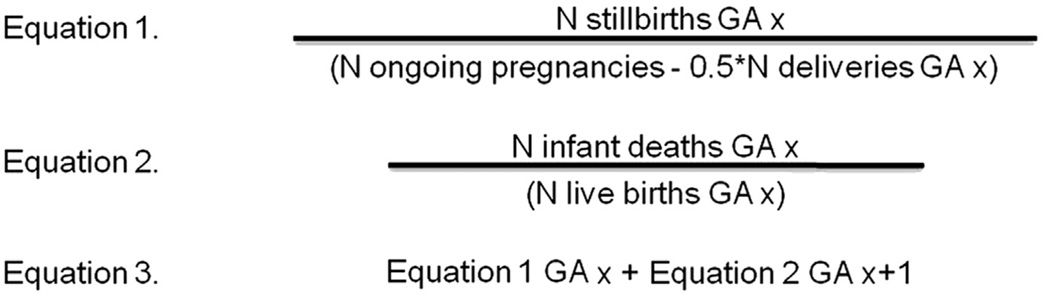
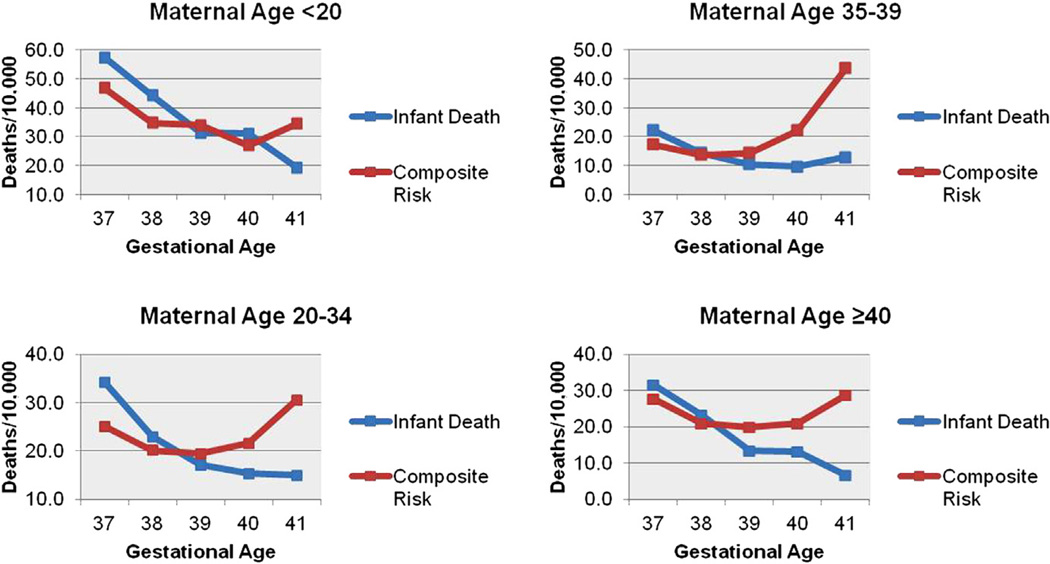
A retrospective cohort study was conducted using 2005 US national birth certificate data. For each week of term gestation, the risk of mortality associated with delivery was compared with composite mortality risk of expectant management. The expectant management measure included stillbirth and infant death. This expectant management risk was calculated to estimate the composite mortality risk with remaining pregnant an additional week by combining the risk of stillbirth during the additional week of pregnancy and infant death risk following delivery at the next week. Maternal age was stratified by 35 years or more compared with women younger than 35 years as well as subgroup analyses of younger than 20, 20-34, 35-39, or 40 years old or older.
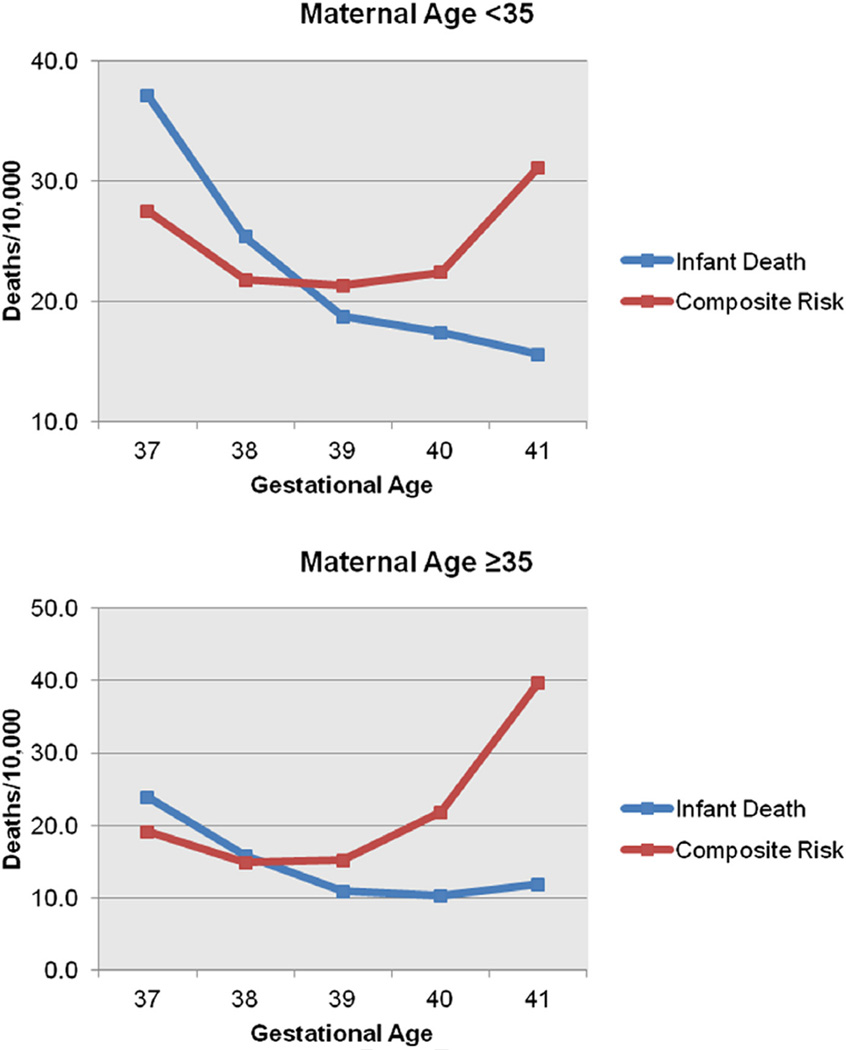
The fetal/infant mortality risk of expectant management is greater than the risk of infant death at 39 weeks' gestation in women 35 years old or older (15.2 vs 10.9 of 10,000, P < .05). In women younger than 35 years old, the risk of expectant management also exceeded that of infant death at 39 weeks (21.3 vs 18.8 of 10,000, P < .05). For women younger than 35 years old, the overall expectant management risk is influenced by higher infant death risk and does not rise significantly until 41 weeks compared with women 35 years old or older in which it increased at 40 weeks.
Risk varies by maternal age, and delivery at 39 weeks minimizes fetal/infant mortality for both groups, although the magnitude of the risk reduction is greater in older women.
本研究旨在探讨按产妇年龄分层的足月时胎龄相关的胎儿/婴儿死亡率。
本研究采用 2005 年美国全国出生证明数据进行回顾性队列研究。对于足月妊娠的每一周,与期待治疗相比,分娩相关的死亡率风险都有所不同。期待治疗措施包括死胎和婴儿死亡。通过在额外一周的妊娠期间计算死胎风险,并结合下一周分娩后的婴儿死亡风险,来估计剩余妊娠额外一周的复合死亡率风险,从而计算出期待治疗的风险。将产妇年龄分层为 35 岁及以上与 35 岁以下,以及年龄小于 20 岁、20-34 岁、35-39 岁或 40 岁及以上的亚组分析。
在 35 岁及以上的女性中,期待治疗的胎儿/婴儿死亡率风险高于 39 周妊娠的婴儿死亡风险(15.2/10000 与 10.9/10000,P<.05)。在 35 岁以下的女性中,期待治疗的风险也高于 39 周的婴儿死亡风险(21.3/10000 与 18.8/10000,P<.05)。对于 35 岁以下的女性,整体期待治疗风险受婴儿死亡风险的影响较大,与 35 岁及以上的女性相比,直到 41 周才显著上升,而后者的风险在 40 周时增加。
风险因产妇年龄而异,对于两组产妇,在 39 周分娩可使胎儿/婴儿死亡率最小化,尽管对于年龄较大的女性来说,风险降低的幅度更大。