Department of Medical Oncology and Hematology, Princess Margaret Cancer Centre, University Health Network, University of Toronto, Toronto, Ontario, Canada.
Blood Cancer J. 2013 May 24;3(5):e116. doi: 10.1038/bcj.2013.14.
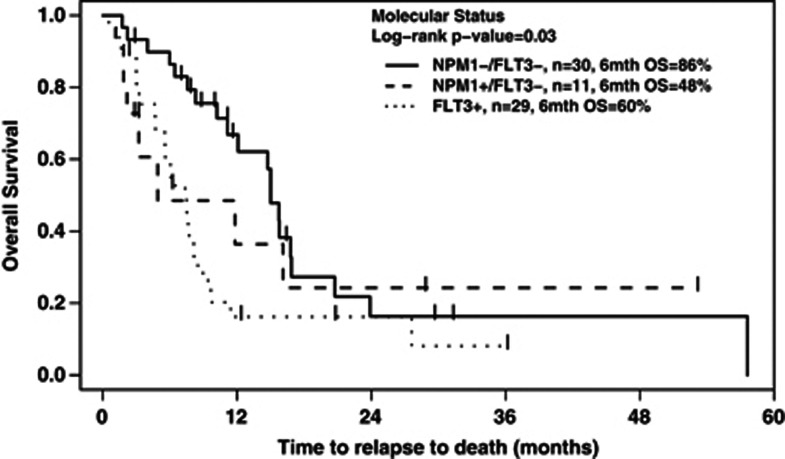
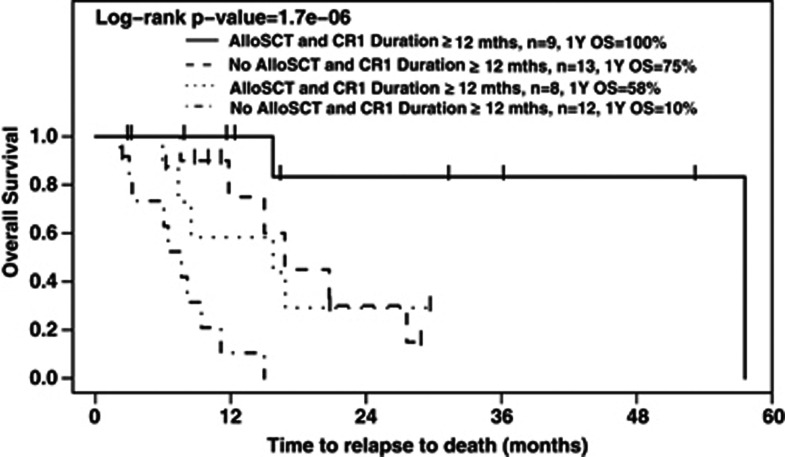
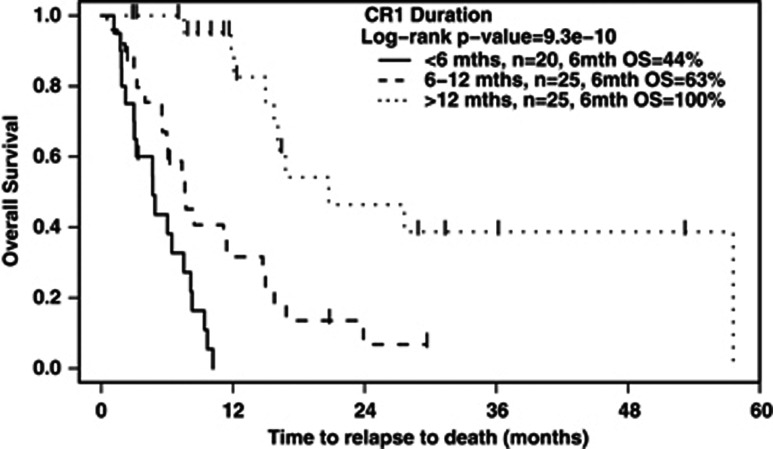
Internal tandem duplication of the fms-like tyrosine kinase-3 gene (FLT3-ITD) and nucleophosmin-1 (NPM1) mutations have prognostic importance in acute myeloid leukemia (AML) patients with intermediate-risk karyotype at diagnosis, but less is known about their utility to predict outcomes at relapse. We retrospectively analysed outcomes of 70 patients with relapsed, intermediate-risk karyotype AML who received a uniform reinduction regimen, with respect to FLT3-ITD and NPM1 mutation status and first complete remission (CR1) duration. CR1 duration, but not molecular status, was significantly correlated with CR2 rate. On univariate analysis, patients with mutated FLT3-ITD (FLT3+) had significantly worse overall survival (OS) compared with those with neither an NPM1 nor FLT3-ITD mutation (NPM1-/FLT3-). On multivariate analysis, shorter CR1 duration was significantly correlated with inferior OS at relapse (P<0.0001), while FLT3 and NPM1 mutation status and age were not significantly correlated with OS. Patients who subsequently underwent allogeneic stem cell transplant (alloSCT) had a superior OS regardless of CR1 duration, but outcomes were better in patients with CR1 duration>12 months. In intermediate-risk karyotype AML patients receiving reinduction, CR1 duration remains the most important predictor of OS at relapse; FLT3-ITD and NPM1 status are not independent predictors of survival.
内部串联重复的 fms 样酪氨酸激酶-3 基因(FLT3-ITD)和核仁磷酸蛋白-1(NPM1)突变在诊断时具有中间风险核型的急性髓系白血病(AML)患者中有预后意义,但关于它们在复发时预测结局的用途知之甚少。我们回顾性分析了 70 例接受统一再诱导方案治疗的复发、中间风险核型 AML 患者的结局,分析了 FLT3-ITD 和 NPM1 突变状态以及首次完全缓解(CR1)持续时间。CR1 持续时间而不是分子状态与 CR2 率显著相关。单因素分析显示,FLT3-ITD 突变(FLT3+)患者的总生存(OS)明显低于 NPM1 或 FLT3-ITD 均未突变的患者(NPM1-/FLT3-)。多因素分析显示,CR1 持续时间较短与复发时的 OS 较差显著相关(P<0.0001),而 FLT3 和 NPM1 突变状态和年龄与 OS 无显著相关性。无论 CR1 持续时间如何,随后接受异基因造血干细胞移植(alloSCT)的患者 OS 均较好,但 CR1 持续时间>12 个月的患者结局更好。在接受再诱导的中间风险核型 AML 患者中,CR1 持续时间仍然是复发时 OS 的最重要预测因素;FLT3-ITD 和 NPM1 状态不是生存的独立预测因素。