Postech-Catholic Biomedical Engineering Institute, Seoul St. Mary's Hospital, The Catholic University of Korea, 505 Banpo-daero, Seocho-gu, Seoul 137-701, Republic of Korea.
Biomed Res Int. 2013;2013:696738. doi: 10.1155/2013/696738. Epub 2013 Apr 22.
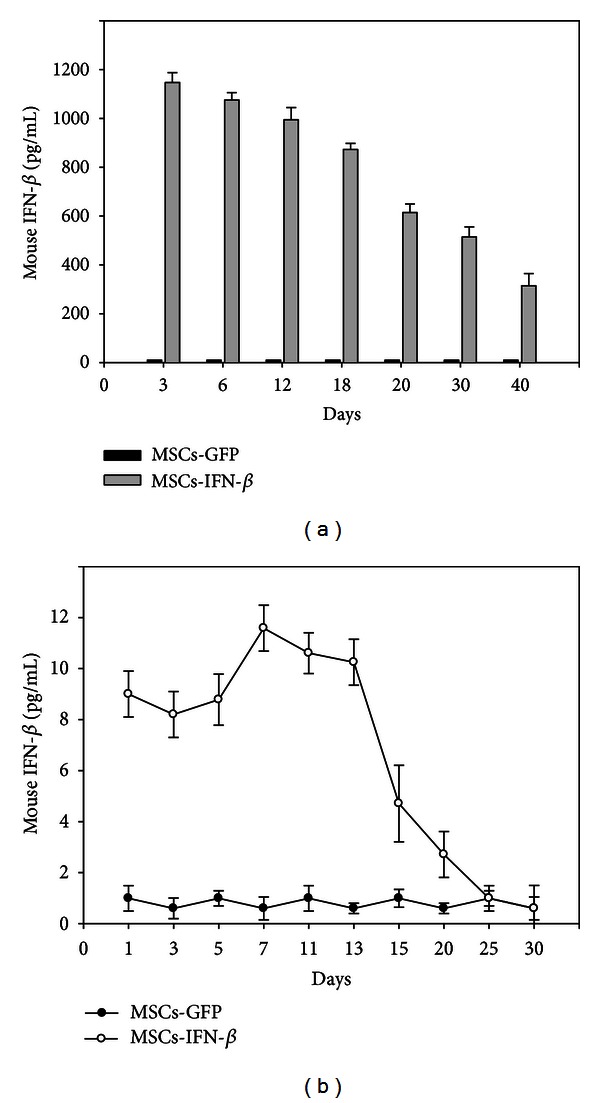
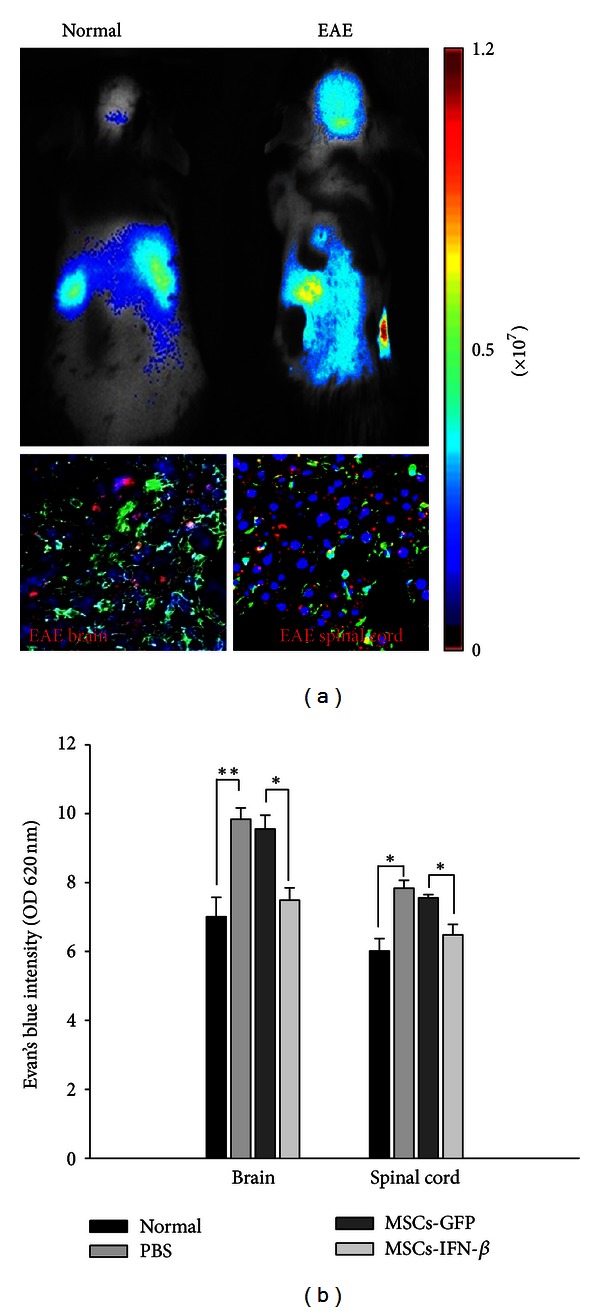
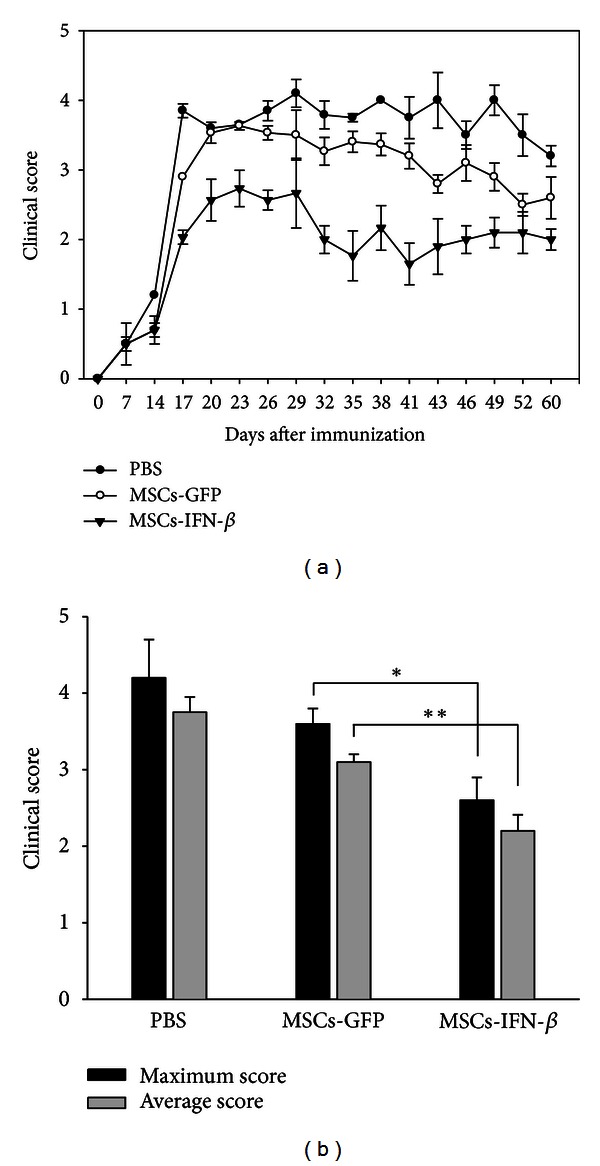
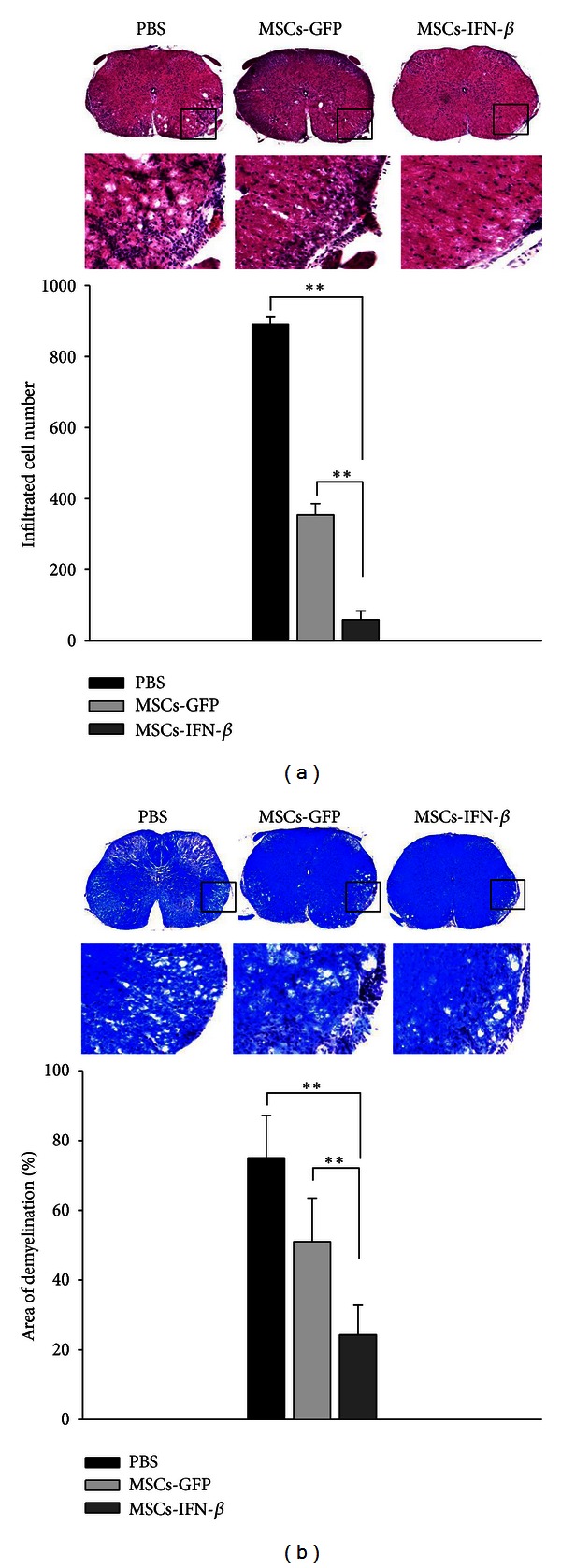
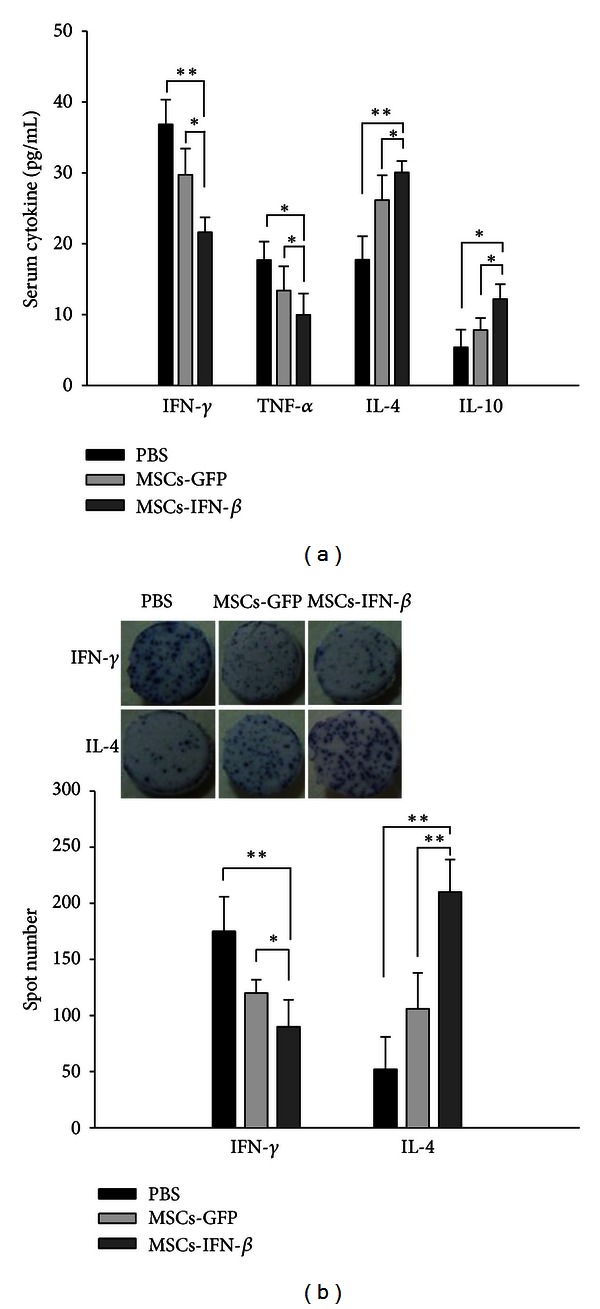
Interferon-beta (IFN- β ), a well-established standard treatment for multiple sclerosis (MS), has proved to exhibit clinical efficacy. In this study, we first evaluated the therapeutic effects for MS using human bone marrow-derived mesenchymal stem cells (hBM-MSCs) as delivery vehicles with lesion-targeting capability and IFN- β as therapeutic gene. We also engineered hBM-MSCs to secret IFN- β (MSCs-IFN β ) via adenoviral transduction and confirmed the secretory capacity of MSCs-IFN β by an ELISA assay. MSCs-IFN β -treated mice showed inhibition of experimental autoimmune encephalomyelitis (EAE) onset, and the maximum and average score for all animals in each group was significantly lower in the MSCs-IFN β -treated EAE mice when compared with the MSCs-GFP-treated EAE mice. Inflammatory infiltration and demyelination in the lumbar spinal cord also significantly decreased in the MSCs-IFN β -treated EAE mice compared to PBS- or MSCs-GFP-treated EAE mice. Moreover, MSCs-IFN β treatment enhanced the immunomodulatory effects, which suppressed proinflammatory cytokines (IFN-γ and TNF-α) and conversely increased anti-inflammatory cytokines (IL-4 and IL-10). Importantly, injected MSCs-IFN β migrated into inflamed CNS and significantly reduced further injury of blood-brain barrier (BBB) permeability in EAE mice. Thus, our results provide the rationale for designing novel experimental protocols to enhance the therapeutic effects for MS using hBM-MSCs as an effective gene vehicle to deliver the therapeutic cytokines.
干扰素-β(IFN-β)是一种经过验证的多发性硬化症(MS)的标准治疗方法,已被证明具有临床疗效。在这项研究中,我们首先使用具有病变靶向能力的人骨髓间充质干细胞(hBM-MSCs)作为递送载体,并使用 IFN-β作为治疗基因,评估了其对 MS 的治疗效果。我们还通过腺病毒转导工程化 hBM-MSCs 分泌 IFN-β(MSCs-IFNβ),并通过 ELISA 测定证实了 MSCs-IFNβ 的分泌能力。MSCs-IFNβ 治疗的小鼠表现出实验性自身免疫性脑脊髓炎(EAE)发病的抑制作用,与 MSCs-GFP 治疗的 EAE 小鼠相比,各组中所有动物的最大和平均评分均明显降低。与 PBS 或 MSCs-GFP 治疗的 EAE 小鼠相比,MSCs-IFNβ 治疗的 EAE 小鼠的腰椎脊髓中的炎症浸润和脱髓鞘也明显减少。此外,MSCs-IFNβ 治疗增强了免疫调节作用,抑制了促炎细胞因子(IFN-γ 和 TNF-α),并相反增加了抗炎细胞因子(IL-4 和 IL-10)。重要的是,注射的 MSCs-IFNβ 迁移到炎症性中枢神经系统,并显著减少了 EAE 小鼠血脑屏障(BBB)通透性的进一步损伤。因此,我们的研究结果为设计新的实验方案提供了依据,通过使用 hBM-MSCs 作为有效的基因载体来递送治疗性细胞因子,来增强 MS 的治疗效果。