Department of Biostatistics and Biomathematics, Division of Public Health Sciences, Fred Hutchinson Cancer Research Center, Seattle, Washington, USA.
Obesity (Silver Spring). 2013 Apr;21(4):835-46. doi: 10.1002/oby.20268.
Several genome-wide association studies (GWAS) have demonstrated that common genetic variants contribute to obesity. However, studies of this complex trait have focused on ancestrally European populations, despite the high prevalence of obesity in some minority groups.
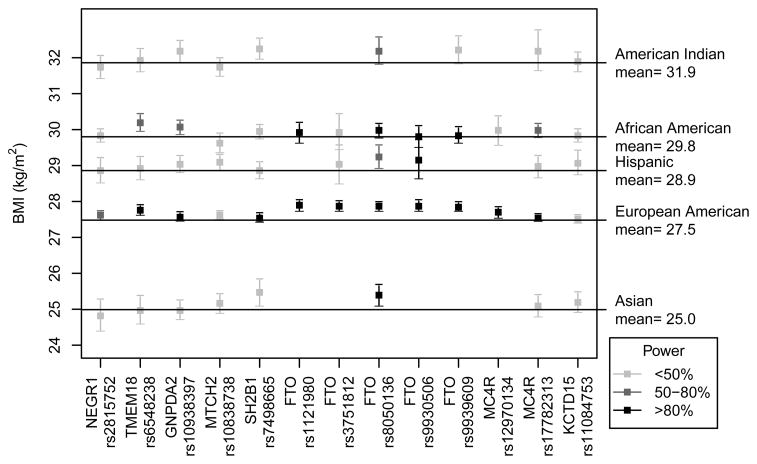
As part of the "Population Architecture using Genomics and Epidemiology (PAGE)" Consortium, we investigated the association between 13 GWAS-identified single-nucleotide polymorphisms (SNPs) and BMI and obesity in 69,775 subjects, including 6,149 American Indians, 15,415 African-Americans, 2,438 East Asians, 7,346 Hispanics, 604 Pacific Islanders, and 37,823 European Americans. For the BMI-increasing allele of each SNP, we calculated β coefficients using linear regression (for BMI) and risk estimates using logistic regression (for obesity defined as BMI ≥ 30) followed by fixed-effects meta-analysis to combine results across PAGE sites. Analyses stratified by racial/ethnic group assumed an additive genetic model and were adjusted for age, sex, and current smoking. We defined "replicating SNPs" (in European Americans) and "generalizing SNPs" (in other racial/ethnic groups) as those associated with an allele frequency-specific increase in BMI.
By this definition, we replicated 9/13 SNP associations (5 out of 8 loci) in European Americans. We also generalized 8/13 SNP associations (5/8 loci) in East Asians, 7/13 (5/8 loci) in African Americans, 6/13 (4/8 loci) in Hispanics, 5/8 in Pacific Islanders (5/8 loci), and 5/9 (4/8 loci) in American Indians.
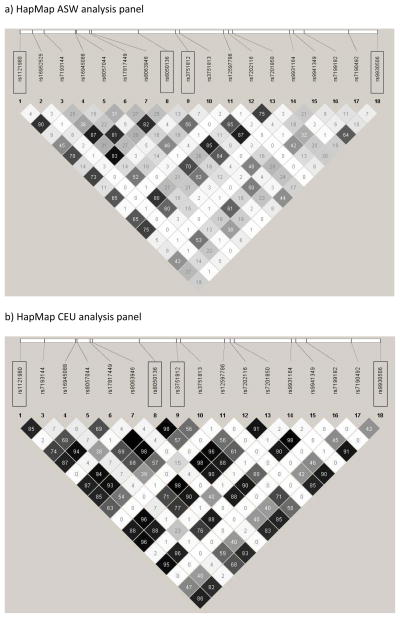
Linkage disequilibrium patterns suggest that tagSNPs selected for European Americans may not adequately tag causal variants in other ancestry groups. Accordingly, fine-mapping in large samples is needed to comprehensively explore these loci in diverse populations.
几项全基因组关联研究(GWAS)表明,常见的遗传变异与肥胖有关。然而,尽管一些少数群体的肥胖患病率很高,但对这种复杂特征的研究主要集中在祖先为欧洲人的人群中。
作为“使用基因组学和流行病学构建人群结构(PAGE)”联盟的一部分,我们调查了 13 个 GWAS 确定的单核苷酸多态性(SNP)与 69775 名受试者的 BMI 和肥胖之间的关联,其中包括 6149 名美洲印第安人、15415 名非裔美国人、2438 名东亚人、7346 名西班牙裔、604 名太平洋岛民和 37823 名欧洲裔美国人。对于每个 SNP 的 BMI 增加等位基因,我们使用线性回归计算β系数(用于 BMI)和使用逻辑回归计算风险估计(用于 BMI≥30 定义的肥胖),然后进行固定效应荟萃分析以合并 PAGE 站点的结果。按种族/族裔群体分层的分析假设了一种加性遗传模型,并根据年龄、性别和当前吸烟情况进行了调整。我们将“复制 SNP”(在欧洲裔美国人中)和“推广 SNP”(在其他种族/族裔群体中)定义为与 BMI 特定等位基因频率增加相关的 SNP。
按照这个定义,我们在欧洲裔美国人中复制了 9/13 SNP 关联(8 个基因座中的 5 个)。我们还在东亚人中推广了 8/13 SNP 关联(8 个基因座中的 5 个)、非裔美国人中的 7/13 SNP 关联(8 个基因座中的 5 个)、西班牙裔中的 6/13 SNP 关联(8 个基因座中的 4 个)、太平洋岛民中的 5/8 SNP 关联(8 个基因座中的 5 个)和美洲印第安人中的 5/9 SNP 关联(8 个基因座中的 4 个)。
连锁不平衡模式表明,为欧洲裔美国人选择的标签 SNP 可能不能充分标记其他祖先群体中的因果变异。因此,需要在大样本中进行精细映射,以在不同人群中全面探索这些基因座。