Division of Cardiovascular Medicine, Radcliffe Department of Medicine, University of Oxford, Headington, Oxford, United Kingdom.
Am J Physiol Endocrinol Metab. 2013 Jul 15;305(2):E263-70. doi: 10.1152/ajpendo.00637.2012. Epub 2013 May 28.
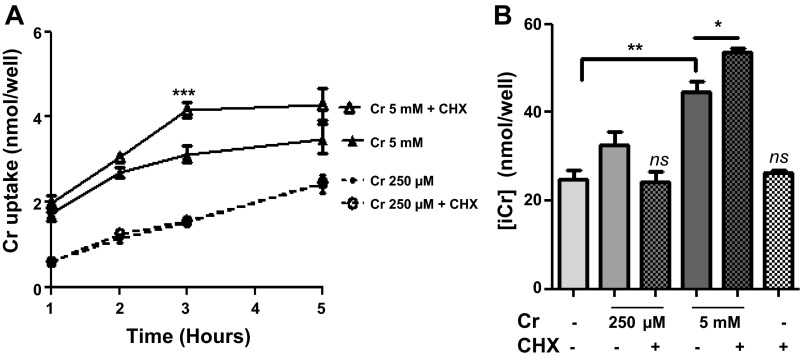
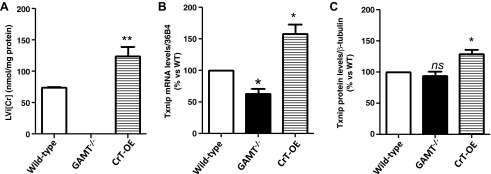
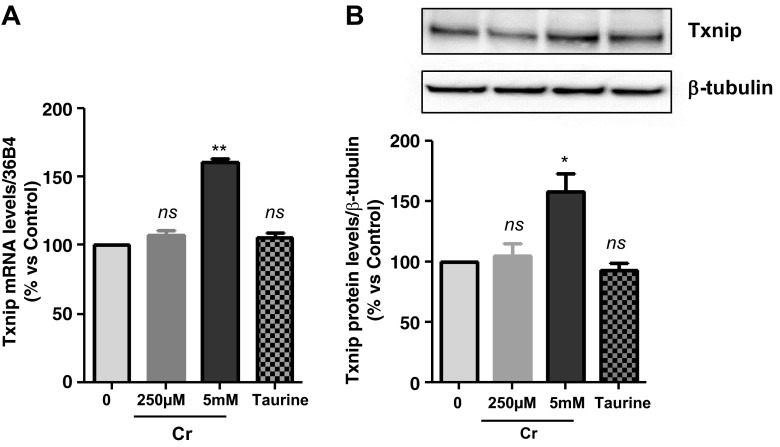
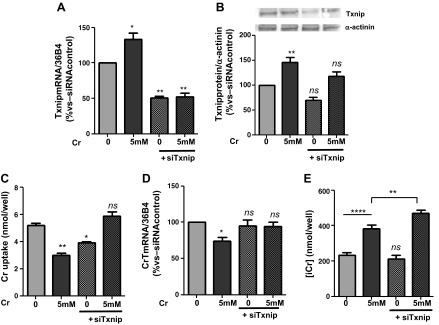
Creatine is important for energy metabolism, yet excitable cells such as cardiomyocytes do not synthesize creatine and rely on uptake via a specific membrane creatine transporter (CrT; SLC6A8). This process is tightly controlled with downregulation of CrT upon continued exposure to high creatine via mechanisms that are poorly understood. Our aim was to identify candidate endogenous CrT inhibitors. In 3T3 cells overexpressing the CrT, creatine uptake plateaued at 3 h in response to 5 mM creatine but peaked 33% higher (P < 0.01) in the presence of cycloheximide, suggesting CrT regulation depends on new protein synthesis. Global gene expression analysis identified thioredoxin-interacting protein (Txnip) as the only significantly upregulated gene (by 46%) under these conditions (P = 0.036), subsequently verified independently at mRNA and protein levels. There was no change in Txnip expression with exposure to 5 mM taurine, confirming a specific response to creatine rather than osmotic stress. Small-interfering RNA against Txnip prevented Txnip upregulation in response to high creatine, maintained normal levels of creatine uptake, and prevented downregulation of CrT mRNA. These findings were relevant to the in vivo heart since creatine-deficient mice showed 39.71% lower levels of Txnip mRNA, whereas mice overexpressing the CrT had 57.6% higher Txnip mRNA levels and 28.7% higher protein expression compared with wild types (mean myocardial creatine concentration 124 and 74 nmol/mg protein, respectively). In conclusion, we have identified Txnip as a novel negative regulator of creatine levels in vitro and in vivo, responsible for mediating substrate feedback inhibition and a potential target for modulating creatine homeostasis.
肌酸对能量代谢很重要,但像心肌细胞这样的兴奋细胞本身不能合成肌酸,只能通过特定的膜肌酸转运蛋白(CrT;SLC6A8)摄取。通过目前尚不清楚的机制,当细胞持续暴露于高浓度肌酸时,CrT 的表达会下调,从而对 CrT 的摄取进行严格的调控。我们的目的是鉴定潜在的内源性 CrT 抑制剂。在过表达 CrT 的 3T3 细胞中,当用 5 mM 肌酸孵育 3 小时后,肌酸摄取达到平台期,但在加入环己酰亚胺后,摄取量增加了 33%(P < 0.01),这表明 CrT 的调节依赖于新的蛋白质合成。全基因组表达分析发现,硫氧还蛋白相互作用蛋白(Txnip)是唯一在这些条件下显著上调的基因(上调 46%,P = 0.036),随后在 mRNA 和蛋白水平上独立验证。在暴露于 5 mM 牛磺酸时,Txnip 的表达没有变化,这证实了对肌酸而不是渗透压应激的特异性反应。针对 Txnip 的小干扰 RNA 可防止高肌酸诱导的 Txnip 上调,维持正常的肌酸摄取水平,并防止 CrT mRNA 的下调。这些发现与体内心脏有关,因为肌酸缺乏的小鼠 Txnip mRNA 水平低 39.71%,而过表达 CrT 的小鼠 Txnip mRNA 水平高 57.6%,蛋白表达高 28.7%,与野生型相比(心肌肌酸浓度分别为 124 和 74 nmol/mg 蛋白)。总之,我们已经确定 Txnip 是体外和体内肌酸水平的一种新的负调控因子,负责介导底物反馈抑制,是调节肌酸稳态的潜在靶点。