Department of Emergency Medicine, University of Kentucky , Lexington, Kentucky , USA.
PeerJ. 2013 May 21;1:e79. doi: 10.7717/peerj.79. Print 2013.
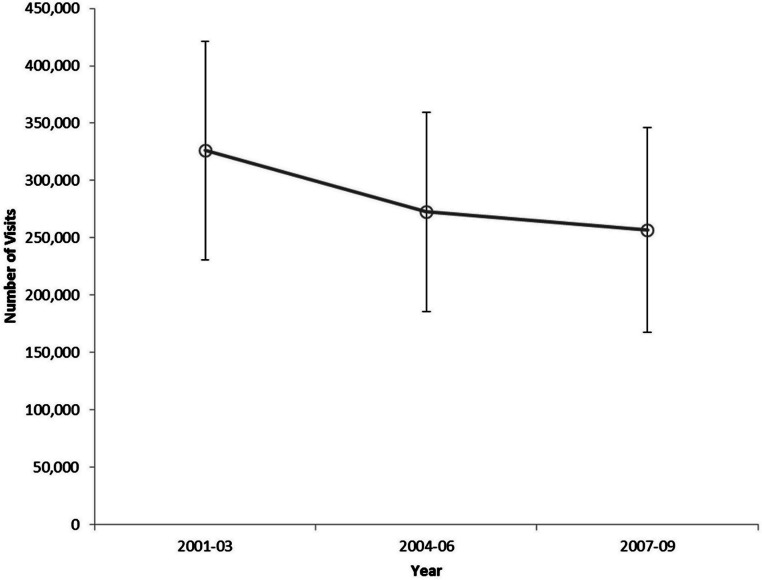
Objective. We sought to determine the characteristics of children presenting to United States (US) Emergency Departments (ED) with severe sepsis. Study design. Cross-sectional analysis using data from the National Hospital Ambulatory Medical Care Survey (NHAMCS). Using triage vital signs and ED diagnoses (defined by the International Classification of Diseases, Ninth Revision codes), we identified children <18 years old presenting with both infection (triage fever or ICD-9 infection) and organ dysfunction (triage hypotension or ICD-9 organ dysfunction). Results. Of 28.2 million pediatric patients presenting to US EDs each year, severe sepsis was present in 95,055 (0.34%; 95% CI: 0.29-0.39%). Fever and respiratory infection were the most common indicators of an infection. Hypotension and respiratory failure were the most common indicators of organ dysfunction. Most severe sepsis occurred in children ages 31 days-1 year old (32.1%). Most visits for pediatric severe sepsis occurred during winter months (37.4%), and only 11.1% of patients arrived at the ED by ambulance. Over half of severe sepsis cases were self-pay or insured by Medicaid. A large portion (44.1%) of pediatric severe sepsis ED visits occurred in the South census region. ED length of stay was over 3 h, and 16.5% were admitted to the hospital. Conclusion. Nearly 100,000 children annually present to US EDs with severe sepsis. The findings of this study highlight the unique characteristics of children treated in the ED for severe sepsis.
目的。我们旨在确定在美国(美国)急诊部(ED)就诊的患有严重脓毒症的儿童的特征。
研究设计。使用国家医院门诊医疗调查(NHAMCS)的数据进行横断面分析。使用分诊生命体征和 ED 诊断(由国际疾病分类,第九版代码定义),我们确定了<18 岁的儿童,他们既有感染(分诊发热或 ICD-9 感染)又有器官功能障碍(分诊低血压或 ICD-9 器官功能障碍)。
结果。在每年就诊于美国 ED 的 2820 万儿科患者中,有 95055 例(0.34%;95%CI:0.29-0.39%)患有严重脓毒症。发热和呼吸道感染是感染的最常见指标。低血压和呼吸衰竭是器官功能障碍的最常见指标。大多数严重脓毒症发生在 31 天至 1 岁的儿童(32.1%)。儿科严重脓毒症就诊大多发生在冬季(37.4%),只有 11.1%的患者乘坐救护车到达 ED。超过一半的严重脓毒症病例是自费或由 Medicaid 承保。严重脓毒症 ED 就诊的大部分病例(44.1%)发生在南部人口普查区。ED 停留时间超过 3 小时,16.5%的患者住院。
结论。每年约有 100,000 名儿童因严重脓毒症就诊于美国 ED。这项研究的结果突出了在 ED 接受严重脓毒症治疗的儿童的独特特征。