
寒武纪的蜕皮生态学:布尔吉斯页岩节肢动物的同步蜕皮。
Demecology in the Cambrian: synchronized molting in arthropods from the Burgess Shale.
机构信息
Zoological Institute and Museum, Department of Cytology and Evolutionary Biology, Soldmannstrasse 23, 17487 Greifswald, Germany.
出版信息
BMC Biol. 2013 May 30;11:64. doi: 10.1186/1741-7007-11-64.
BACKGROUND
The Burgess Shale is well known for its preservation of a diverse soft-bodied biota dating from the Cambrian period (Series 3, Stage 5). While previous paleoecological studies have focused on particular species (autecology) or entire paleocommunities (synecology), studies on the ecology of populations (demecology) of Burgess Shale organisms have remained mainly anecdotal.
RESULTS
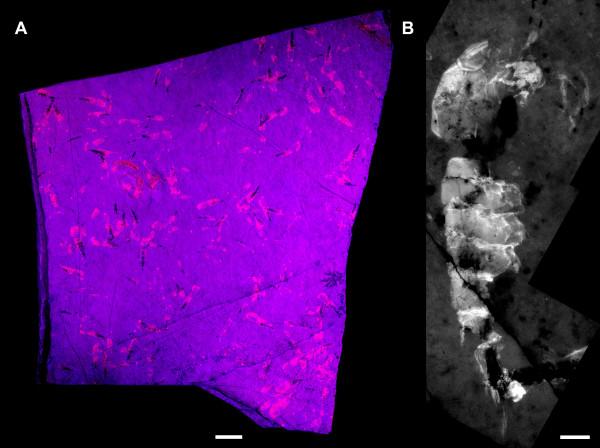
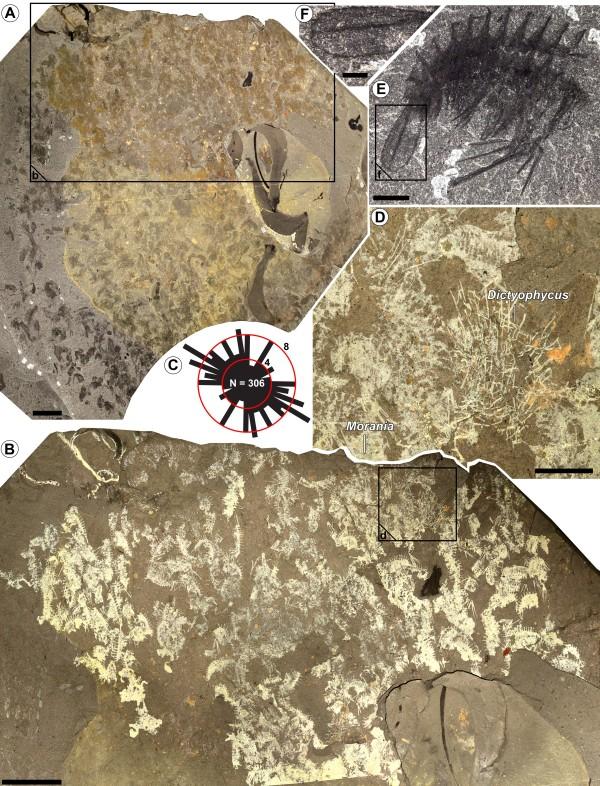
Here, we present evidence for mass molting events in two unrelated arthropods from the Burgess Shale Walcott Quarry, Canadaspis perfecta and a megacheiran referred to as Alalcomenaeus sp.
CONCLUSIONS
These findings suggest that the triggers for such supposed synchronized molting appeared early on during the Cambrian radiation, and synchronized molting in the Cambrian may have had similar functions in the past as it does today. In addition, the finding of numerous juvenile Alalcomenaeus sp. molts associated with the putative alga Dictyophycus suggests a possible nursery habitat. In this nursery habitat a population of this animal might have found a more protected environment in which to spend critical developmental phases, as do many modern species today.
背景
伯吉斯页岩以其保存的来自寒武纪时期(第三系列,第五阶段)的多样化软躯体生物群而闻名。虽然以前的古生态学研究集中在特定的物种(个体生态学)或整个古群落(系统生态学)上,但对伯吉斯页岩生物种群的生态学(种群生态学)的研究仍然主要是轶事性的。
结果
在这里,我们提供了来自加拿大伯吉斯页岩瓦尔科特采石场的两种无亲缘关系的节肢动物(Canadaspis perfecta 和一种被称为 Alalcomenaeus sp. 的巨型腕足类动物)大量蜕皮事件的证据。
结论
这些发现表明,这种所谓的同步蜕皮的触发因素似乎在寒武纪辐射早期就出现了,而寒武纪的同步蜕皮在过去和现在可能具有相似的功能。此外,与假定的藻类 Dictyophycus 相关的大量幼年 Alalcomenaeus sp. 蜕皮的发现表明可能存在一个苗圃栖息地。在这个苗圃栖息地中,这种动物的种群可能会发现一个更受保护的环境,在这个环境中度过关键的发育阶段,就像今天的许多现代物种一样。

 Zotero 插件