Izquierdo-López Alejandro, Caron Jean-Bernard
Department of Ecology and Evolutionary Biology, University of Toronto, 25 Willcocks Street, Toronto, ON M5S 3B2, Canada.
Department of Natural History, Palaeobiology, Royal Ontario Museum, 100 Queen's Park, Toronto, ON M5S 2C6, Canada.
iScience. 2022 Jun 25;25(7):104675. doi: 10.1016/j.isci.2022.104675. eCollection 2022 Jul 15.
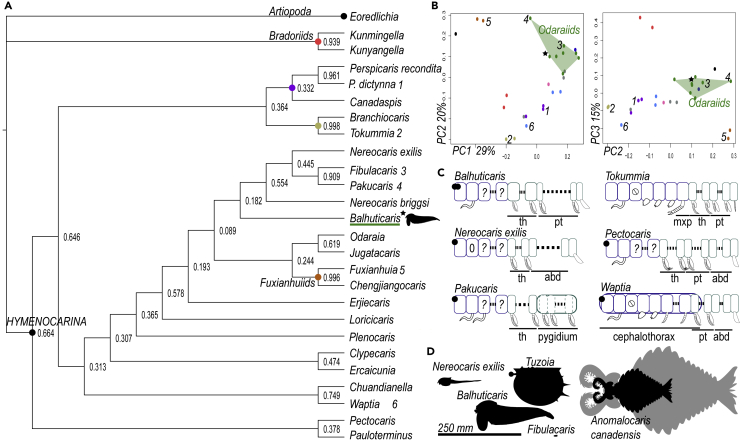
The origin of mandibulate arthropods can be traced back to the Cambrian period to several carapace-bearing arthropod groups, but their morphological diversity is still not well characterized. Here, we describe , a bivalved arthropod from the 506-million-year-old Burgess Shale (Marble Canyon, British Columbia, Canada). This species has an extremely elongated and multisegmented body bearing ca. 110 pairs of homonomous biramous limbs, the highest number among Cambrian arthropods, and, at 245 mm, it represents one of the largest Cambrian arthropods known. Its unusual carapace resembles an arch; it covers only the frontalmost section of the body but extends ventrally beyond the legs. had a complex sensory system and was probably an active swimmer thanks to its powerful paddle-shaped exopods and a long and flexible body. increases the ecological and functional diversity of bivalved arthropods and suggests that cases of gigantism occurred in more arthropod groups than previously recognized.
有颚节肢动物的起源可以追溯到寒武纪时期的几个带甲壳的节肢动物类群,但它们的形态多样性仍未得到很好的描述。在这里,我们描述了一种来自有着5.06亿年历史的布尔吉斯页岩(加拿大不列颠哥伦比亚省大理石峡谷)的双瓣节肢动物。该物种拥有极其细长且多节的身体,长有大约110对同律双枝型附肢,这在寒武纪节肢动物中数量最多,而且它体长245毫米,是已知最大的寒武纪节肢动物之一。其不同寻常的甲壳形似拱形;它仅覆盖身体最前端部分,但在腹侧延伸至腿部之外。该物种拥有复杂的感觉系统,可能因其有力的桨状外肢和长而灵活的身体而成为活跃的游泳者。这增加了双瓣节肢动物的生态和功能多样性,并表明巨型化现象在比之前认为的更多的节肢动物类群中出现过。