Department of Biology, McMaster University, 1280 Main St West, Hamilton, ON, L8S 4L8, Canada.
Plant Mol Biol. 2013 Oct;83(3):235-46. doi: 10.1007/s11103-013-0083-7. Epub 2013 May 31.
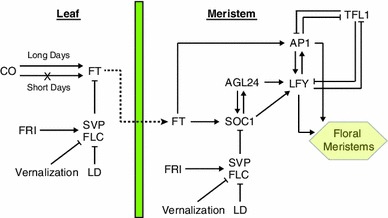
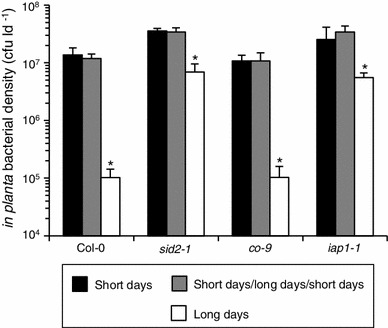
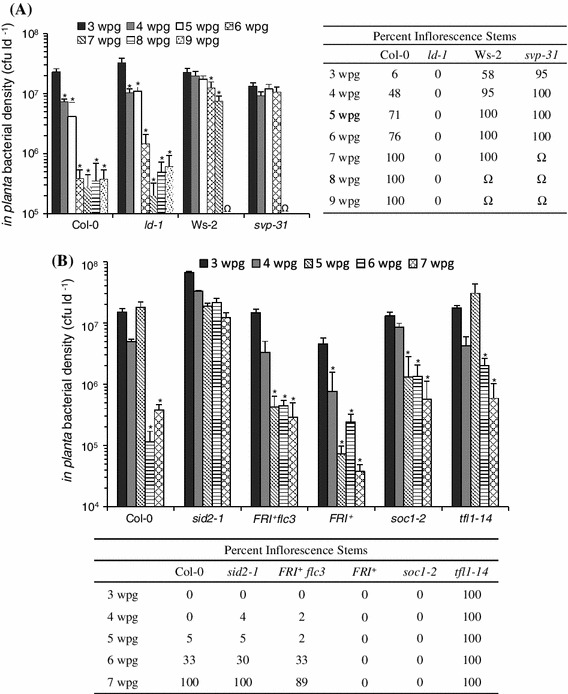
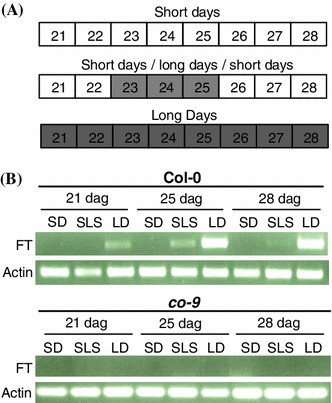
Age-related resistance (ARR) is a plant defense response characterized by enhanced resistance to certain pathogens in mature plants relative to young plants. In Arabidopsis thaliana the transition to flowering is associated with ARR competence, suggesting that this developmental event is the switch that initiates ARR competence in mature plants (Rusterucci et al. in Physiol Mol Plant Pathol 66:222-231, 2005). The association of ARR and the floral transition was examined using flowering-time mutants and photoperiod-induced flowering to separate flowering from other developmental events that occur as plants age. Under short-day conditions, late-flowering plant lines ld-1 (luminidependens-1), soc1-2 (suppressor of overexpression of co 1-2), and FRI (+) (FRIGIDA) displayed ARR before the transition to flowering occurred. Early-flowering svp-31, svp-32 (short vegetative phase), and Ws-2 were ARR-defective, whereas early-flowering tfl1-14 (terminal flower 1-14) displayed ARR at the same time as Col-0. While svp-31, svp-32 and Ws-2 produced few rosette leaves, tfl1-14 produced a rosette leaf number similar to Col-0, suggesting that the development of a minimum number of rosette leaves is necessary to initiate ARR competence under short-day conditions. Photoperiod-induced transient expression of FT (FLOWERING LOCUS T) caused precocious flowering in short-day-grown Col-0 but this was not associated with ARR competence. Under long-day conditions co-9 (constans-9) mutants did not flower but displayed an ARR response at the same time as Col-0. This study suggests that SVP is required for the ARR response and that the floral transition is not the developmental event that regulates ARR competence.
年龄相关抗性(ARR)是一种植物防御反应,其特征是成熟植物对某些病原体的抗性增强,相对于年轻植物。在拟南芥中,向开花的过渡与 ARR 能力有关,这表明这一发育事件是启动成熟植物 ARR 能力的开关(Rusterucci 等人在 Physiol Mol Plant Pathol 66:222-231, 2005)。ARR 与开花过渡的关系是通过开花时间突变体和光周期诱导开花来研究的,以将开花与植物衰老时发生的其他发育事件分开。在短日照条件下,晚花系 ld-1(luminidependens-1)、soc1-2(co 1-2 过表达的抑制剂)和 FRI(+)(FRIGIDA)在向开花过渡发生之前表现出 ARR。早花系 svp-31、svp-32(短营养期)和 Ws-2 表现出 ARR 缺陷,而早花系 tfl1-14(终端花 1-14)与 Col-0 同时表现出 ARR。虽然 svp-31、svp-32 和 Ws-2 产生的莲座叶很少,但 tfl1-14 产生的莲座叶数量与 Col-0 相似,这表明在短日照条件下,启动 ARR 能力需要形成最小数量的莲座叶。FT(FLOWERING LOCUS T)的光周期诱导瞬时表达导致短日照生长的 Col-0 提前开花,但这与 ARR 能力无关。在长日照条件下,co-9(constans-9)突变体不开花,但与 Col-0 同时表现出 ARR 反应。这项研究表明,SVP 是 ARR 反应所必需的,而开花过渡不是调节 ARR 能力的发育事件。