Unité Mixte de Recherche (UMR) Centre National de la Recherche Scientifique (CNRS)-UM2- Institut français de recherche pour l'exploitation de la mer (IFREMER)-Institute for Research and Development (IRD) 5119 ECOSYM, Université Montpellier 2 cc 093, Montpellier, France.
PLoS Biol. 2013;11(5):e1001569. doi: 10.1371/journal.pbio.1001569. Epub 2013 May 28.
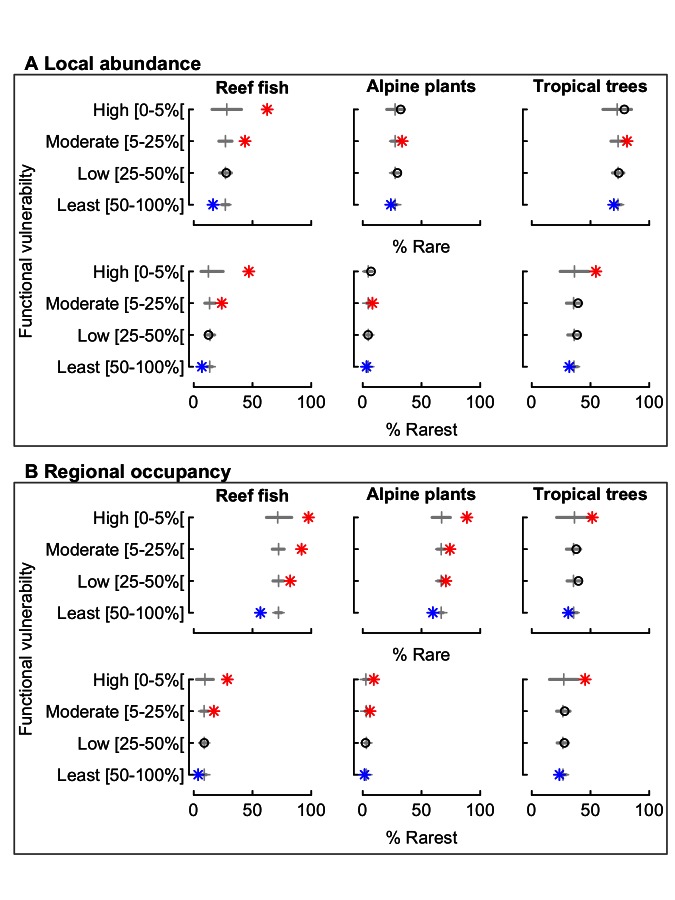
Around the world, the human-induced collapses of populations and species have triggered a sixth mass extinction crisis, with rare species often being the first to disappear. Although the role of species diversity in the maintenance of ecosystem processes has been widely investigated, the role of rare species remains controversial. A critical issue is whether common species insure against the loss of functions supported by rare species. This issue is even more critical in species-rich ecosystems where high functional redundancy among species is likely and where it is thus often assumed that ecosystem functioning is buffered against species loss. Here, using extensive datasets of species occurrences and functional traits from three highly diverse ecosystems (846 coral reef fishes, 2,979 alpine plants, and 662 tropical trees), we demonstrate that the most distinct combinations of traits are supported predominantly by rare species both in terms of local abundance and regional occupancy. Moreover, species that have low functional redundancy and are likely to support the most vulnerable functions, with no other species carrying similar combinations of traits, are rarer than expected by chance in all three ecosystems. For instance, 63% and 98% of fish species that are likely to support highly vulnerable functions in coral reef ecosystems are locally and regionally rare, respectively. For alpine plants, 32% and 89% of such species are locally and regionally rare, respectively. Remarkably, 47% of fish species and 55% of tropical tree species that are likely to support highly vulnerable functions have only one individual per sample on average. Our results emphasize the importance of rare species conservation, even in highly diverse ecosystems, which are thought to exhibit high functional redundancy. Rare species offer more than aesthetic, cultural, or taxonomic diversity value; they disproportionately increase the potential breadth of functions provided by ecosystems across spatial scales. As such, they are likely to insure against future uncertainty arising from climate change and the ever-increasing anthropogenic pressures on ecosystems. Our results call for a more detailed understanding of the role of rarity and functional vulnerability in ecosystem functioning.
在全球范围内,人类引发的物种灭绝已经引发了第六次大规模灭绝危机,稀有物种往往是第一批消失的物种。尽管物种多样性在维持生态系统过程中的作用已经得到了广泛的研究,但稀有物种的作用仍然存在争议。一个关键问题是,常见物种是否能防止稀有物种所支持的功能丧失。在物种丰富的生态系统中,这个问题更加关键,因为物种之间的功能冗余度很高,因此人们通常认为生态系统功能可以免受物种损失的影响。在这里,我们利用来自三个高度多样化生态系统(846 种珊瑚鱼、2979 种高山植物和 662 种热带树木)的广泛物种出现和功能特征数据集,证明了最独特的特征组合主要由稀有物种来支持,无论是在局部丰度还是区域占有率方面。此外,在所有三个生态系统中,具有低功能冗余性且可能支持最脆弱功能的物种,而没有其他物种具有类似的特征组合,其稀有程度都超出了随机预期。例如,在珊瑚礁生态系统中,有 63%和 98%的可能支持高度脆弱功能的鱼类物种分别是局部和区域上的稀有物种。对于高山植物,分别有 32%和 89%的此类物种是局部和区域上的稀有物种。值得注意的是,在珊瑚礁生态系统中,有 47%的鱼类物种和 55%的热带树木物种可能支持高度脆弱的功能,平均每个样本只有一个个体。我们的研究结果强调了保护稀有物种的重要性,即使在高度多样化的生态系统中,这些生态系统被认为具有较高的功能冗余性。稀有物种不仅提供了美学、文化或分类多样性的价值;它们还不成比例地增加了生态系统在跨空间尺度上提供功能的潜在广度。因此,它们可能会防止未来因气候变化和不断增加的人类对生态系统的压力而产生的不确定性。我们的研究结果呼吁对稀有物种和功能脆弱性在生态系统功能中的作用有更深入的了解。