School of Geographical and Earth Sciences, University of Glasgow, Glasgow, United Kingdom.
PLoS One. 2013 May 28;8(5):e64651. doi: 10.1371/journal.pone.0064651. Print 2013.
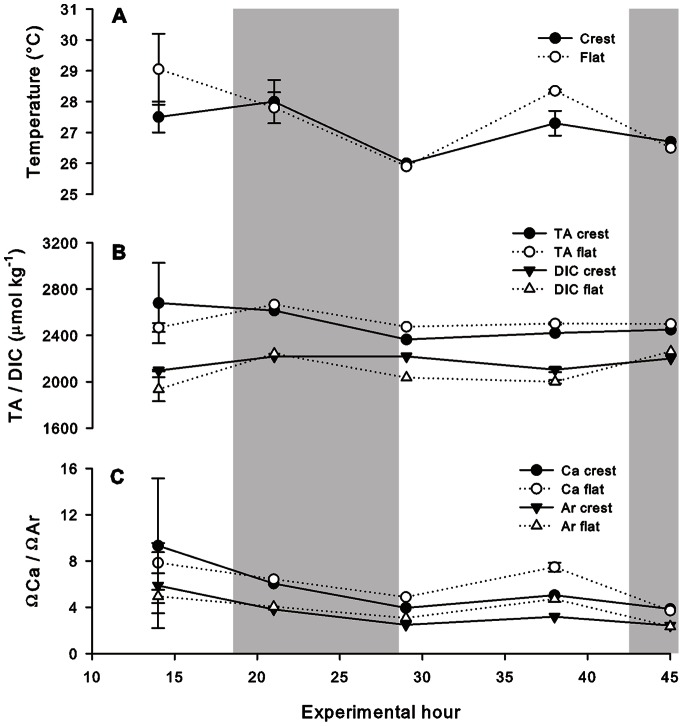
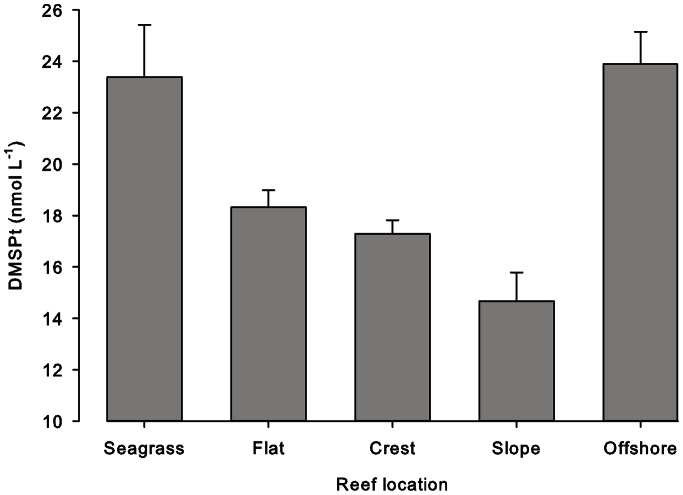
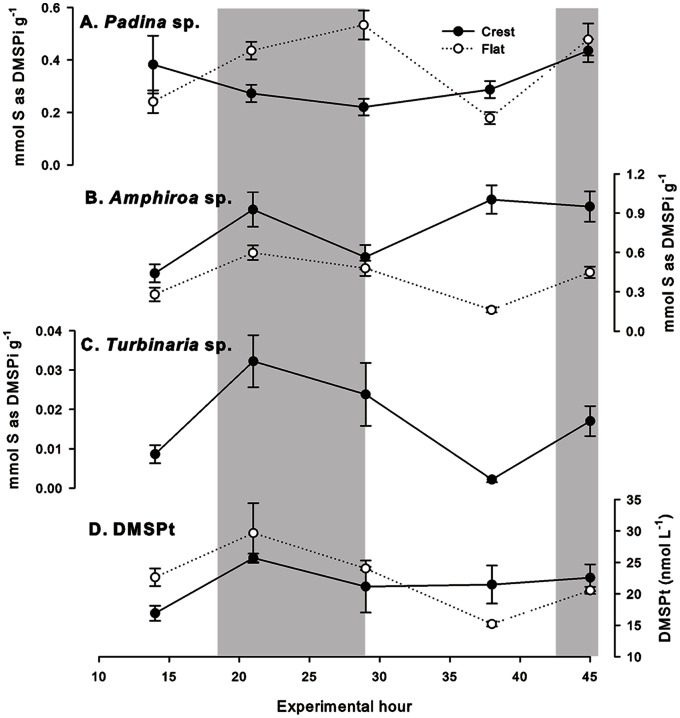
Oceanic pH is projected to decrease by up to 0.5 units by 2100 (a process known as ocean acidification, OA), reducing the calcium carbonate saturation state of the oceans. The coastal ocean is expected to experience periods of even lower carbonate saturation state because of the inherent natural variability of coastal habitats. Thus, in order to accurately project the impact of OA on the coastal ocean, we must first understand its natural variability. The production of dimethylsulphoniopropionate (DMSP) by marine algae and the release of DMSP's breakdown product dimethylsulphide (DMS) are often related to environmental stress. This study investigated the spatiotemporal response of tropical macroalgae (Padina sp., Amphiroa sp. and Turbinaria sp.) and the overlying water column to natural changes in reefal carbonate chemistry. We compared macroalgal intracellular DMSP and water column DMSP+DMS concentrations between the environmentally stable reef crest and environmentally variable reef flat of the fringing Suleman Reef, Egypt, over 45-hour sampling periods. Similar diel patterns were observed throughout: maximum intracellular DMSP and water column DMS/P concentrations were observed at night, coinciding with the time of lowest carbonate saturation state. Spatially, water column DMS/P concentrations were highest over areas dominated by seagrass and macroalgae (dissolved DMS/P) and phytoplankton (particulate DMS/P) rather than corals. This research suggests that macroalgae may use DMSP to maintain metabolic function during periods of low carbonate saturation state. In the reef system, seagrass and macroalgae may be more important benthic producers of dissolved DMS/P than corals. An increase in DMS/P concentrations during periods of low carbonate saturation state may become ecologically important in the future under an OA regime, impacting larval settlement and increasing atmospheric emissions of DMS.
预计到 2100 年,海洋的 pH 值将下降 0.5 个单位(这一过程被称为海洋酸化,OA),从而降低海洋的碳酸钙饱和度。由于沿海生境固有的自然变异性,预计沿海海洋将经历更低的碳酸盐饱和度时期。因此,为了准确预测海洋酸化对沿海海洋的影响,我们必须首先了解其自然变异性。海洋藻类产生二甲基巯基丙酸(DMSP),并释放 DMSP 的分解产物二甲基硫(DMS),这通常与环境压力有关。本研究调查了热带大型藻类(Padina sp.、Amphiroa sp. 和 Turbinaria sp.)和上层水层对珊瑚礁碳酸盐化学自然变化的时空响应。我们比较了埃及边缘的苏尔曼礁环境稳定的礁顶和环境多变的礁坪上大型藻类的细胞内 DMSP 和水柱 DMSP+DMS 浓度,采样时间超过 45 小时。整个过程中观察到相似的昼夜模式:最大的细胞内 DMSP 和水柱 DMS/P 浓度出现在夜间,与碳酸钙饱和度最低的时间一致。从空间上看,水柱 DMS/P 浓度在以海草和大型藻类(溶解 DMS/P)和浮游植物(颗粒 DMS/P)为主的区域最高,而不是珊瑚。这项研究表明,在碳酸钙饱和度较低的时期,大型藻类可能会使用 DMSP 来维持其代谢功能。在珊瑚系统中,海草和大型藻类可能比珊瑚更重要,是溶解 DMS/P 的底栖生产者。在 OA 制度下,未来低碳酸钙饱和度时期 DMS/P 浓度的增加可能会变得具有生态重要性,从而影响幼虫的定殖并增加 DMS 的大气排放。