Park Sang-Jin, Jung Eun Hye, Ryu Ran-Suk, Kang Hyun Woong, Chung He Doo, Kang Ho-Young
MG MED, Inc,, 60-24, Gasan-dong, Seoul, Korea.
Mol Cytogenet. 2013 Jun 1;6(1):21. doi: 10.1186/1755-8166-6-21.
Array comparative genomic hybridization (CGH) is a powerful tool for detecting unbalanced chromosomal alterations. To validate the usefulness of array CGH in newborn screening, we examined 20,126 unselected infants. In addition, the number of newborns analyzed with array CGH is the largest one ever reported.
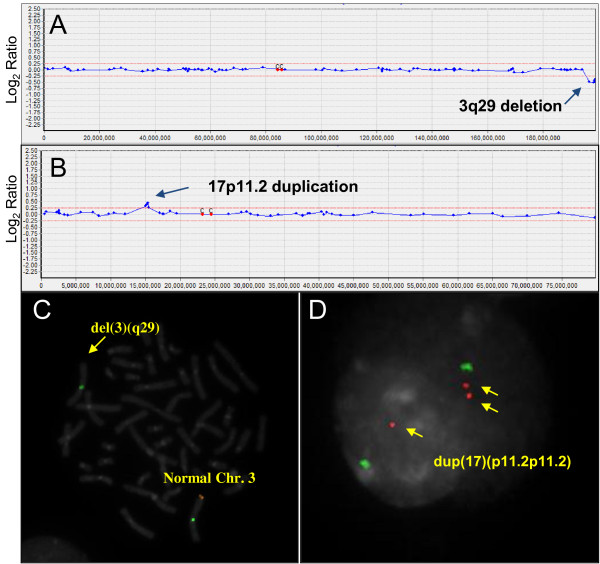
A total of 20,126 unselected newborns were investigated with array CGH and cytogenetic analyses. The analyses revealed 87 cases with chromosome abnormalities. Of these, 53 cases had significant chromosome aneuploidies, including trisomy 13, trisomy 21, 47,XXY or 45,X, and the other 34 cases presented partial chromosomal deletions or duplications.
In this study, we show that array CGH is an appropriate tool for the screening of chromosomal abnormalities in newborns, especially for the infants without distinct clinical features.
阵列比较基因组杂交(array CGH)是检测染色体不平衡改变的有力工具。为验证阵列CGH在新生儿筛查中的实用性,我们检查了20126名未经挑选的婴儿。此外,使用阵列CGH分析的新生儿数量是迄今报道的最多的。
对20126名未经挑选的新生儿进行了阵列CGH和细胞遗传学分析。分析发现87例染色体异常病例。其中,53例有明显的染色体非整倍体,包括13三体、21三体、47,XXY或45,X,另外34例表现为部分染色体缺失或重复。
在本研究中,我们表明阵列CGH是筛查新生儿染色体异常的合适工具,特别是对于没有明显临床特征的婴儿。