Laboratory of Molecular Biology, Institute of Medical Laboratory Sciences, Jinling Hospital, School of Medicine Nanjing University, Nanjing 210002, P R China.
BMC Infect Dis. 2013 May 31;13:253. doi: 10.1186/1471-2334-13-253.
The yeast Candida is one of the most frequent pathogens isolated from bloodstream infections and is associated with significant morbidity and mortality. Problems with clinical and microbiological diagnosis of invasive candidiasis (IC) have prompted the development of non-culture-based laboratory methods. Previous reports suggest that serological detection of antibodies might be useful for diagnosing systemic candidiasis.
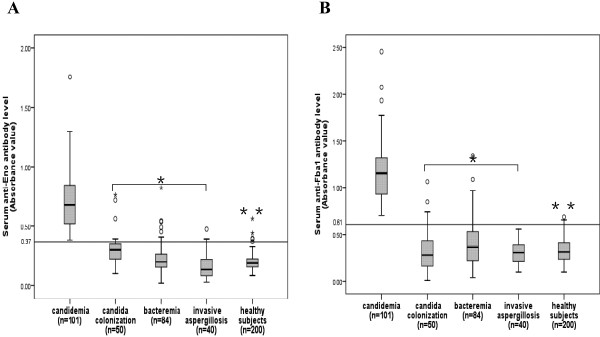
Diagnosis of IC using antibodies against recombinant Candida albicans enolase (Eno) and fructose-bisphosphate aldolase (Fba1) was evaluated. Using recombinant Eno and Fba1 as coating antigens, enzyme-linked immunosorbent assays (ELISAs) were used to analyze sera from patients with candidemia (n = 101), Candida colonization (n = 50), bacteremia (n = 84), invasive aspergillosis (n = 40); and from healthy controls (n = 200).
The results demonstrated that ELISA detection of anti-Eno and anti-Fba1 IgG distinguished IC from other pathogenic infections in patients and healthy individuals. The sensitivity, specificity, and positive and negative predictive values were 72.3%, 94.7%, 78.5% and 93% for anti-Eno, and 87.1%, 92.8%, 76.5% and 96.4% for anti-Fba1 antibodies, respectively. Combining these two tests improved sensitivity up to 90.1% and negative predictive value up to 97.1%, with specificity and positive predictive values of 90.6% and 72.2%. The tests were specific to the Candida genus and antibody titers were higher for candidemia patients than for controls. Positive antibody tests were obtained before blood culture results for 42.2% of patients for anti-Eno and 51.1% for anti-Fba1.
These data suggest that tests that detect IgG antibodies against Candida enolase and fructose-bisphosphate aldolase, especially when used in combination, could be a powerful tool for diagnosing IC.
酵母念珠菌是从血流感染中分离出的最常见病原体之一,与较高的发病率和死亡率相关。侵袭性念珠菌病(IC)的临床和微生物学诊断存在问题,促使开发了非培养为基础的实验室方法。先前的报告表明,针对系统性念珠菌病的抗体检测可能具有诊断价值。
使用针对重组白念珠菌烯醇酶(Eno)和果糖-1,6-二磷酸醛缩酶(Fba1)的抗体,评估 IC 的诊断。使用重组 Eno 和 Fba1 作为包被抗原,通过酶联免疫吸附试验(ELISA)分析念珠菌血症患者(n=101)、念珠菌定植患者(n=50)、菌血症患者(n=84)、侵袭性曲霉病患者(n=40)和健康对照者(n=200)的血清。
结果表明,ELISA 检测抗 Eno 和抗 Fba1 IgG 可将 IC 与患者和健康个体中的其他致病性感染区分开来。抗 Eno 的灵敏度、特异性、阳性预测值和阴性预测值分别为 72.3%、94.7%、78.5%和 93%,抗 Fba1 抗体分别为 87.1%、92.8%、76.5%和 96.4%。联合这两种检测方法可将灵敏度提高至 90.1%,将阴性预测值提高至 97.1%,特异性和阳性预测值分别为 90.6%和 72.2%。这些检测方法针对念珠菌属具有特异性,且念珠菌血症患者的抗体滴度高于对照组。针对 Eno 的抗体检测在 42.2%的患者中先于血培养结果出现阳性,针对 Fba1 的抗体检测在 51.1%的患者中先于血培养结果出现阳性。
这些数据表明,检测针对 Candida enolase 和 fructose-bisphosphate aldolase 的 IgG 抗体,特别是联合检测时,可能是诊断 IC 的有力工具。