McKay Orthopaedic Research Laboratory, Department of Orthopaedic Surgery, Perelman School of Medicine, University of Pennsylvania, Philadelphia, PA 19104, USA.
Bone. 2013 Sep;56(1):83-90. doi: 10.1016/j.bone.2013.05.014. Epub 2013 May 28.
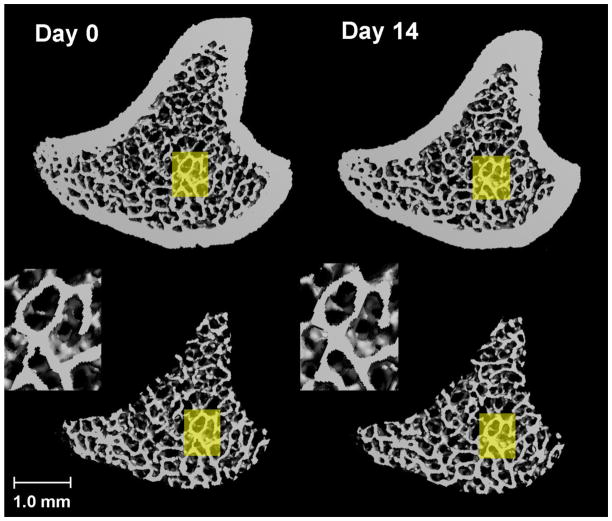
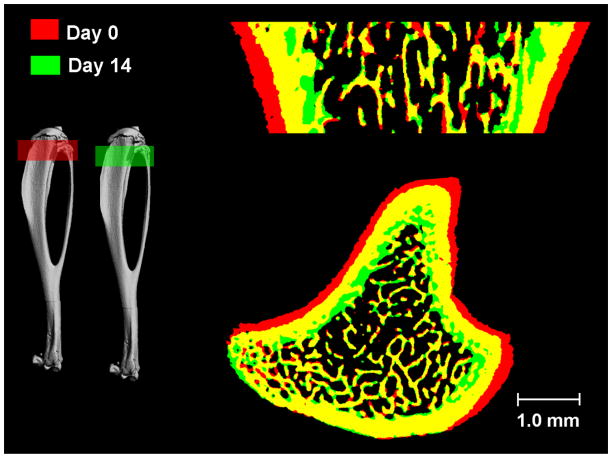
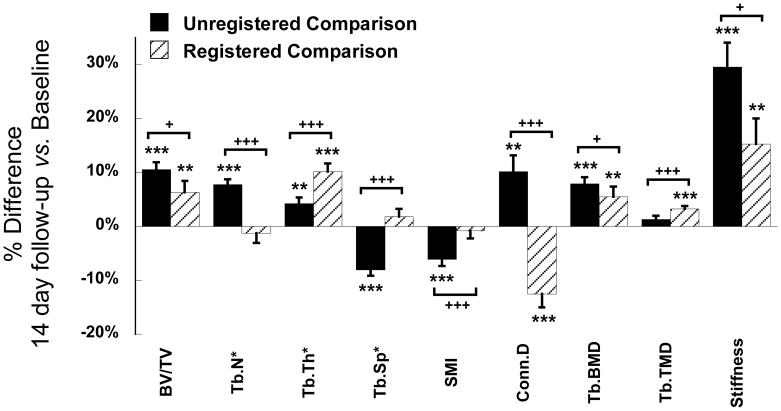
In the recent decade, in vivo μCT scanners have become available to monitor temporal changes in rodent bone in response to diseases and treatments. We investigated short-term and long-term precision of in vivo μCT measurements of trabecular bone density, microstructure and stiffness of rat tibiae and tested whether they can be improved by 3D image registration. Rats in the short-term precision group underwent baseline and follow-up scans within the same day (n = 15) and those in the long-term precision group were scanned at day 0 and day 14 (n = 16) at 10.5 μm voxel size. A 3D image-registration scheme was applied to register the trabecular bone compartments of baseline and follow-up scans. Prior to image registration, short-term precision ranged between 0.85% and 2.65% in bone volume fraction (BV/TV), trabecular number, thickness, and spacing (Tb.N*, Tb.Th*, Tb.Sp*), trabecular bone mineral density and tissue mineral density (Tb.BMD, and Tb.TMD), and was particularly high in structure model index (SMI), connectivity density (Conn.D), and stiffness (4.29%-8.83%). Image registration tended to improve the short-term precision, but the only statistically significant improvement was in Tb.N*, Tb.TMD, and stiffness. On the other hand, unregistered comparisons between day-0 and day-14 scans suggested significant increases in BV/TV, Tb.N*, Tb.Th*, Conn.D, and Tb.BMD and decrease in Tb.Sp* and SMI. However, the percent change in each parameter from registered comparisons was significantly different from unregistered comparisons. Registered results suggested a significant increase in BV/TV, Tb.BMD, and stiffness over 14 days, primarily caused by increased Tb.Th* and Tb.TMD. Due to the continuous growth of rodents, the direct comparisons between the unregistered baseline and follow-up scans were driven by changes due to global bone modeling instead of local remodeling. Our results suggested that 3D image registration is critical for detecting changes due to bone remodeling activities in rodent trabecular bone by in vivo μCT imaging.
在最近的十年中,活体 μCT 扫描仪已经可以用于监测疾病和治疗对啮齿动物骨骼的时间变化。我们研究了活体 μCT 测量胫骨小梁骨密度、微结构和刚度的短期和长期精度,并测试了 3D 图像配准是否可以提高这些精度。短期精度组的大鼠在同一天内进行基线和随访扫描(n=15),而长期精度组的大鼠在第 0 天和第 14 天(n=16)以 10.5μm 体素大小进行扫描。应用 3D 图像配准方案对基线和随访扫描的小梁骨区进行配准。在图像配准之前,短期精度范围在骨体积分数(BV/TV)、小梁数量、厚度和间隔(Tb.N*、Tb.Th*、Tb.Sp*)、小梁骨密度和组织骨密度(Tb.BMD 和 Tb.TMD)的 0.85%-2.65%之间,结构模型指数(SMI)、连通密度(Conn.D)和刚度(4.29%-8.83%)的精度尤其高。图像配准往往会提高短期精度,但唯一具有统计学意义的提高是在 Tb.N*、Tb.TMD 和刚度方面。另一方面,未配准的第 0 天和第 14 天扫描之间的比较表明,BV/TV、Tb.N*、Tb.Th*、Conn.D 和 Tb.BMD 显著增加,而 Tb.Sp和 SMI 则减少。然而,从已配准的比较中得到的每个参数的百分比变化与未配准的比较明显不同。已配准的结果表明,14 天内 BV/TV、Tb.BMD 和刚度显著增加,主要是由于 Tb.Th和 Tb.TMD 的增加。由于啮齿动物的持续生长,未配准的基线和随访扫描之间的直接比较是由全局骨建模引起的变化驱动的,而不是由局部重塑引起的变化。我们的结果表明,3D 图像配准对于通过活体 μCT 成像检测啮齿动物小梁骨中由于骨重塑活动引起的变化至关重要。