Department of Orofacial Sciences and Program in Craniofacial and Mesenchymal Biology, University of California San Francisco, San Francisco, California 94143, USA.
Nat Cell Biol. 2013 Jul;15(7):846-52. doi: 10.1038/ncb2766. Epub 2013 Jun 2.
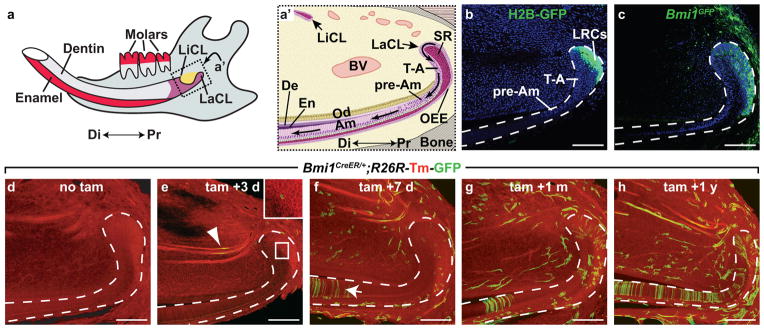
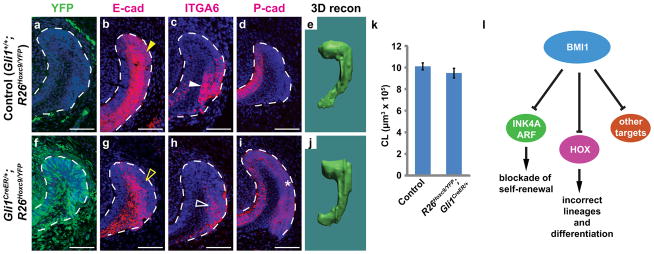
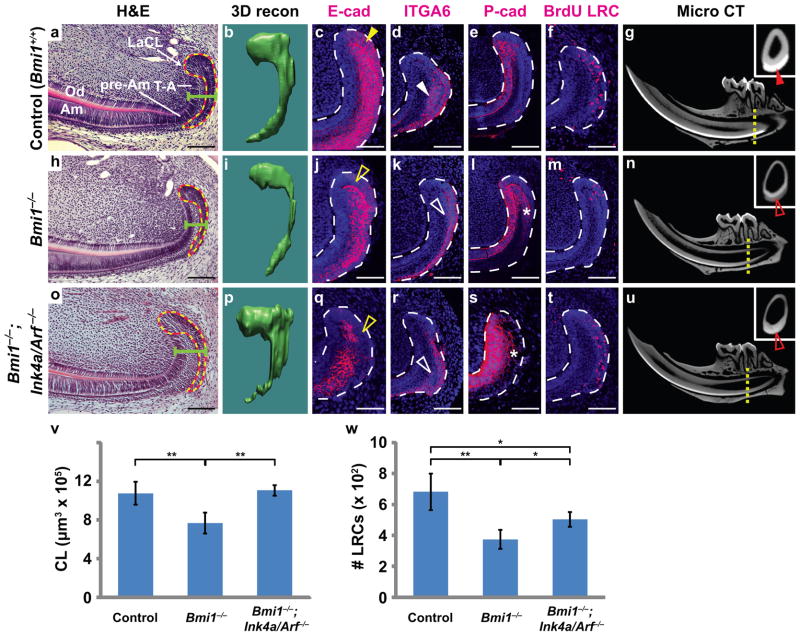
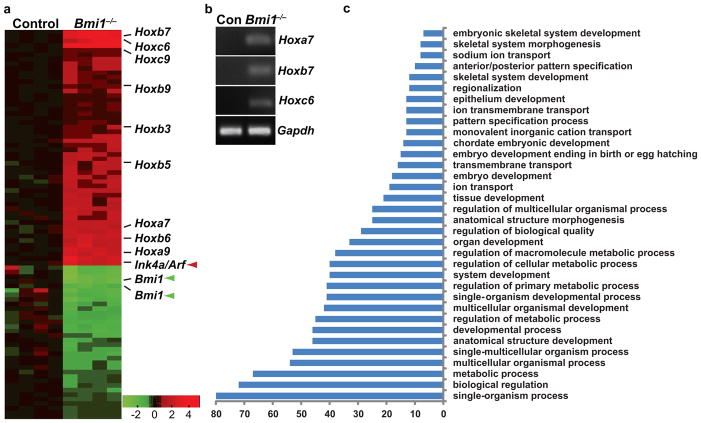
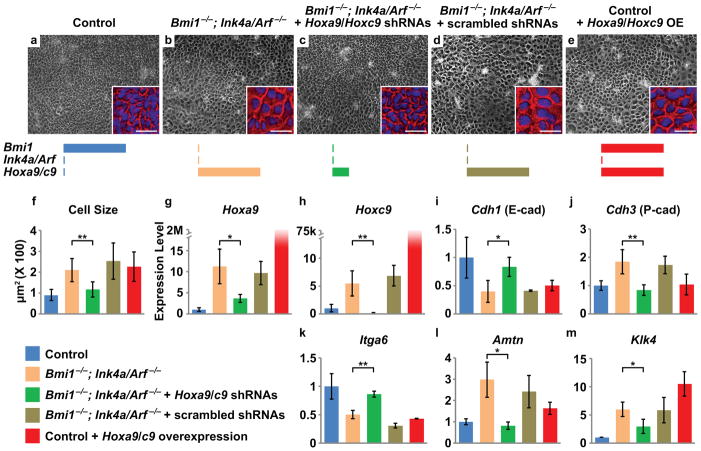
The polycomb group gene Bmi1 is required for maintenance of adult stem cells in many organs. Inactivation of Bmi1 leads to impaired stem cell self-renewal due to deregulated gene expression. One critical target of BMI1 is Ink4a/Arf, which encodes the cell-cycle inhibitors p16(Ink4a) and p19(Arf). However, deletion of Ink4a/Arf only partially rescues Bmi1-null phenotypes, indicating that other important targets of BMI1 exist. Here, using the continuously growing mouse incisor as a model system, we report that Bmi1 is expressed by incisor stem cells and that deletion of Bmi1 resulted in fewer stem cells, perturbed gene expression and defective enamel production. Transcriptional profiling revealed that Hox expression is normally repressed by BMI1 in the adult, and functional assays demonstrated that BMI1-mediated repression of Hox genes preserves the undifferentiated state of stem cells. As Hox gene upregulation has also been reported in other systems when Bmi1 is inactivated, our findings point to a general mechanism whereby BMI1-mediated repression of Hox genes is required for the maintenance of adult stem cells and for prevention of inappropriate differentiation.
多梳组基因 Bmi1 是许多器官中维持成体干细胞所必需的。Bmi1 的失活导致由于基因表达失调而导致干细胞自我更新受损。BMI1 的一个关键靶标是 Ink4a/Arf,它编码细胞周期抑制剂 p16(Ink4a)和 p19(Arf)。然而,Ink4a/Arf 的缺失仅部分挽救了 Bmi1 缺失表型,表明 BMI1 存在其他重要靶标。在这里,我们使用不断生长的小鼠切牙作为模型系统,报告 Bmi1 由切牙干细胞表达,并且 Bmi1 的缺失导致更少的干细胞、基因表达失调和釉质产生缺陷。转录谱分析显示,Hox 表达在成年时通常被 BMI1 抑制,功能测定表明 BMI1 介导的 Hox 基因抑制维持了干细胞的未分化状态。由于当 Bmi1 失活时,其他系统中也报道了 Hox 基因的上调,我们的发现指出了一种普遍机制,即 BMI1 介导的 Hox 基因抑制对于维持成体干细胞和防止不当分化是必需的。