Department of Pharmacology and Toxicology, Medical College of Wisconsin, Milwaukee, WI, USA.
Biol Chem. 2013 Sep;394(9):1205-12. doi: 10.1515/hsz-2012-0348.
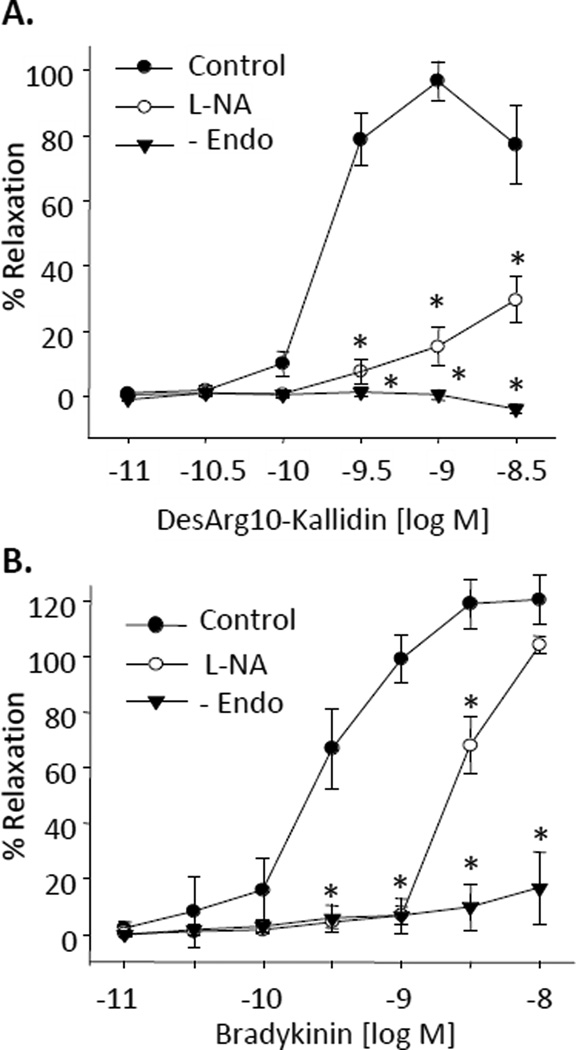
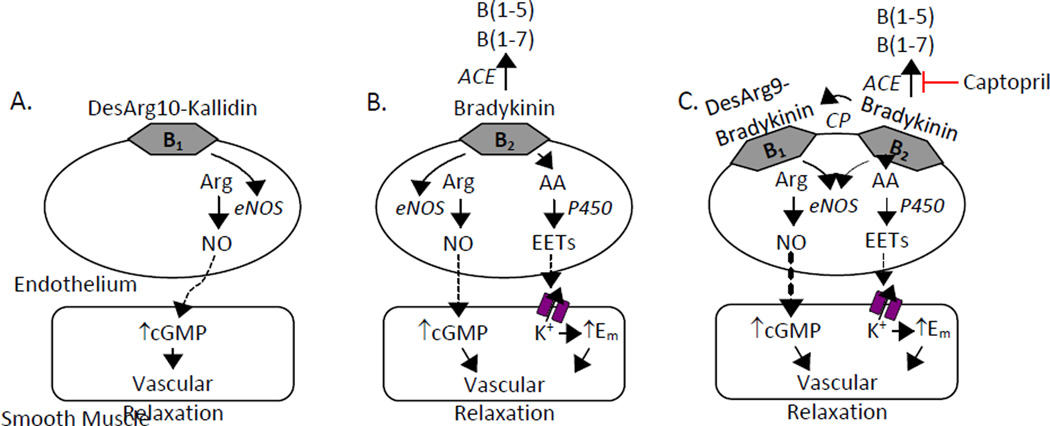
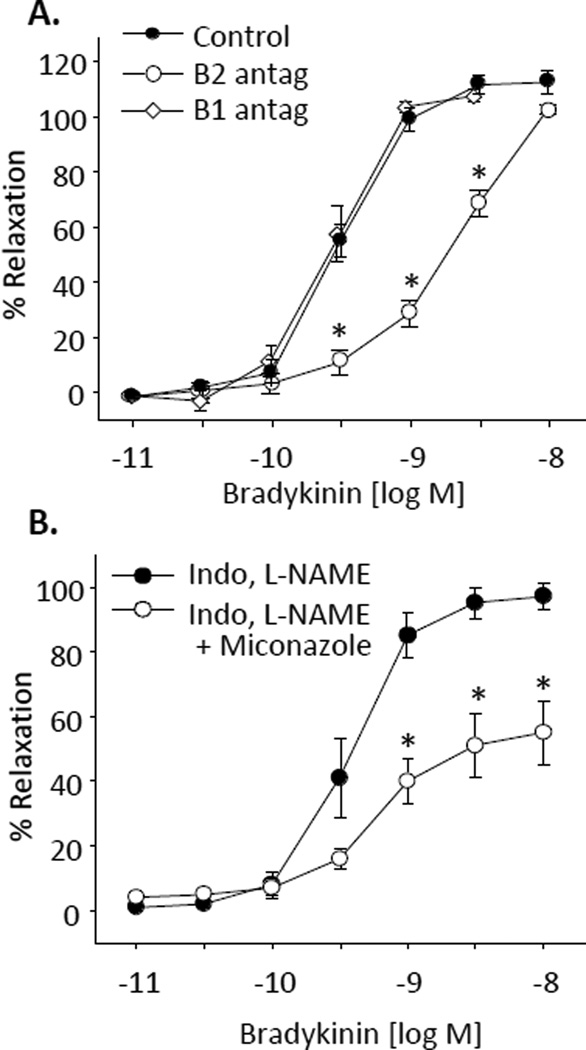
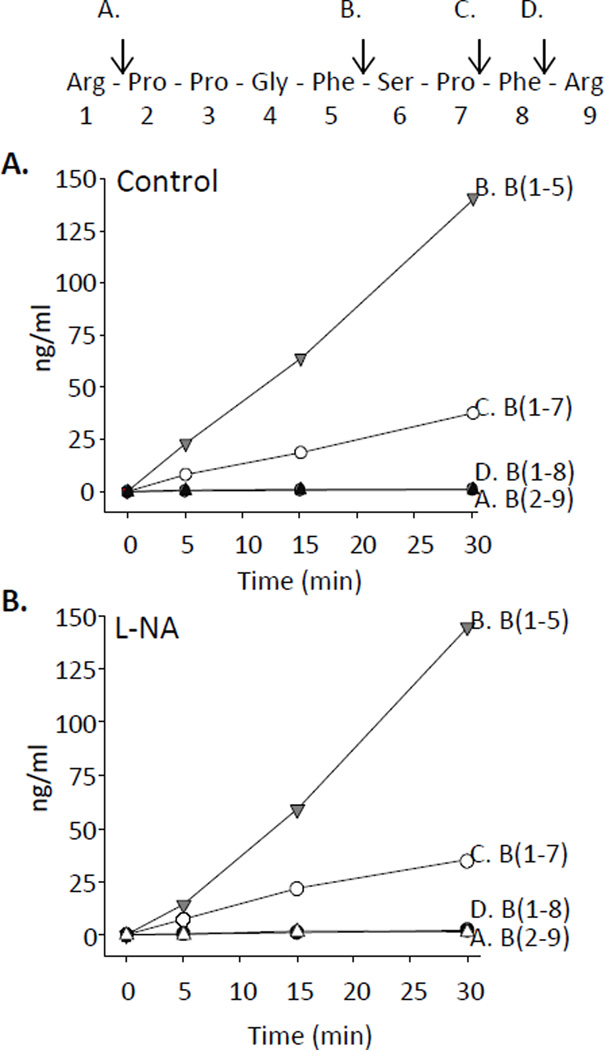
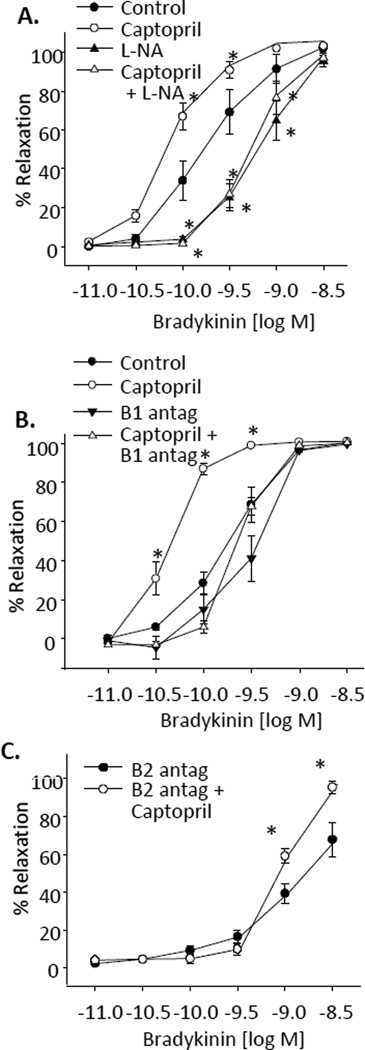
Bradykinin causes vascular relaxations through release of endothelial relaxing factors including prostacyclin, nitric oxide (NO) and epoxyeicosatrienoic acids (EETs). Bradykinin is metabolized by angiotensin converting enzyme (ACE) and ACE inhibition enhances bradykinin relaxations. Our goal was to characterize the role of bradykinin receptors and endothelial factors in ACE inhibitor-enhanced relaxations in bovine coronary arteries. In U46619 preconstricted arteries, bradykinin (10-11-10-8m) caused concentration-dependent relaxations (maximal relaxation ≥100%, log EC50=-9.8±0.1). In the presence of the NO synthase inhibitor, N-nitro-L-arginine (L-NA, 30 μm) and the cyclooxygenase inhibitor, indomethacin (10 μm), relaxations were reduced by an inhibitor of EET synthesis, miconazole (10 μm) (maximal relaxation=55±10%). Bradykinin relaxations were inhibited by the bradykinin 2 (B2) receptor antagonist, D-Arg0-Hyp3-Thi5,8-D-Phe7-bradykinin (1 μm) (log EC50=-8.5±0.1) but not altered by the B1 receptor antagonist, des-Arg9[Leu8]bradykinin (1 μm). Mass spectrometric analysis of bovine coronary artery bradykinin metabolites revealed a time-dependent increase in bradykinin (1-5) and (1-7) suggesting metabolism by ACE. ACE inhibition with captopril (50 μm) enhanced bradykinin relaxations (log EC50=-10.3±0.1). The enhanced relaxations were eliminated by L-NA or the B1 receptor antagonist but not the B2 receptor antagonist. Our results demonstrate that ACE inhibitor-enhanced bradykinin relaxations of bovine coronary arteries occur through endothelial cell B1 receptor activation and NO.
缓激肽通过释放内皮舒张因子(包括前列环素、一氧化氮 (NO) 和环氧二十碳三烯酸 (EETs))引起血管舒张。缓激肽被血管紧张素转换酶 (ACE) 代谢,而 ACE 抑制可增强缓激肽的舒张作用。我们的目标是确定缓激肽受体和内皮因子在 ACE 抑制剂增强牛冠状动脉舒张中的作用。在 U46619 预收缩的动脉中,缓激肽(10-11-10-8m)引起浓度依赖性舒张(最大舒张≥100%,logEC50=-9.8±0.1)。在一氧化氮合酶抑制剂 N-硝基-L-精氨酸 (L-NA,30 μm) 和环氧化酶抑制剂吲哚美辛 (10 μm) 的存在下,缓激肽的舒张作用被 EET 合成抑制剂咪康唑 (10 μm) 减少(最大舒张=55±10%)。缓激肽舒张被缓激肽 2 (B2) 受体拮抗剂 D-Arg0-Hyp3-Thi5,8-D-Phe7-bradykinin(1 μm)(logEC50=-8.5±0.1)抑制,但不受 B1 受体拮抗剂 des-Arg9[Leu8]bradykinin(1 μm)的影响。牛冠状动脉缓激肽代谢物的质谱分析显示,缓激肽(1-5)和(1-7)的含量随时间增加,提示 ACE 代谢。用卡托普利(50 μm)抑制 ACE 增强了缓激肽的舒张作用(logEC50=-10.3±0.1)。这种增强的舒张作用被 L-NA 或 B1 受体拮抗剂消除,但不受 B2 受体拮抗剂的影响。我们的结果表明,ACE 抑制剂增强牛冠状动脉缓激肽舒张作用是通过内皮细胞 B1 受体激活和 NO 实现的。