
顺行性动脉内注射尿激酶挽救游离腓骨瓣
Anterograde intra-arterial urokinase injection for salvaging fibular free flap.
作者信息
Lee Dae-Sung, Jung Sun-Il, Kim Deok-Woo, Dhong Eun-Sang
机构信息
Department of Plastic and Reconstructive Surgery, Korea University Guro Hospital, Korea University College of Medicine, Seoul, Korea.
出版信息
Arch Plast Surg. 2013 May;40(3):251-5. doi: 10.5999/aps.2013.40.3.251. Epub 2013 May 16.
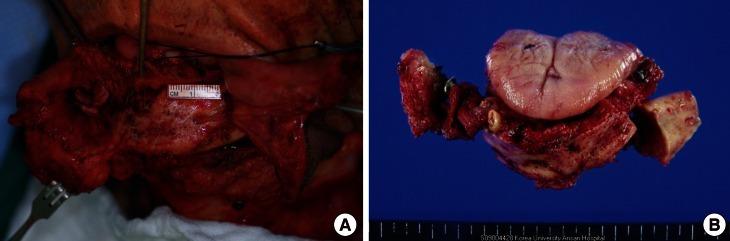
We present a case of a 57-year-old male patient who presented with squamous cell carcinoma on his mouth floor with cervical and mandibular metastases. Wide glossectomy with intergonial mandibular ostectomy, and sequential reconstruction using fibular osteomyocutaneous free flap were planned. When the anastomosis between the peroneal artery of the fibular free flap and the right lingual artery was performed, no venous flow was observed at the vena comitans. Then re-anastomosis followed by topical application of papaverine and lidocaine was attempted. However, the blood supply was not recovered. Warm saline irrigation over 30 minutes was also useless. Microvascular thromboses of donor vessels were clinically suspected, so a solution of 100,000 units of urokinase was infused once through a 26-gauge angiocatheter inserted into the recipient artery just at the arterial anastomotic site, until the solution gushed out through the flap vena comitans. Immediately after the application of urokinase, arterial flow and venous return were restored. There were no complications during the follow-up period of 11 months. We believe that vibrating injuries from the reciprocating saw during osteotomies and flap insetting might be the cause of microvascular thromboses. The use of urokinase may provide a viable option for the treatment of suspicious intraoperative arterial thrombosis.
我们报告一例57岁男性患者,其口底出现鳞状细胞癌并伴有颈部和下颌转移。计划进行广泛舌切除术并联合下颌角截骨术,随后使用腓骨骨肌皮游离皮瓣进行序贯重建。在进行腓骨游离皮瓣的腓动脉与右侧舌动脉吻合时,伴行静脉未见血流。随后尝试重新吻合,并局部应用罂粟碱和利多卡因。然而,血供仍未恢复。30分钟的温盐水冲洗也无济于事。临床上怀疑供体血管发生微血管血栓形成,于是通过插入动脉吻合部位受区动脉的26号血管造影导管,一次性注入100,000单位尿激酶溶液,直至溶液从皮瓣伴行静脉喷出。应用尿激酶后,动脉血流和静脉回流立即恢复。在11个月的随访期内未出现并发症。我们认为,截骨术和皮瓣植入过程中往复锯产生的振动损伤可能是微血管血栓形成的原因。尿激酶的使用可能为术中可疑动脉血栓形成的治疗提供一种可行的选择。



 Zotero 插件