Department of Infectious Diseases, Virology, University Hospital Heidelberg, Im Neuenheimer Feld 324, 69120 Heidelberg, Germany.
Cell Res. 2013 Jul;23(7):876-85. doi: 10.1038/cr.2013.74. Epub 2013 Jun 4.
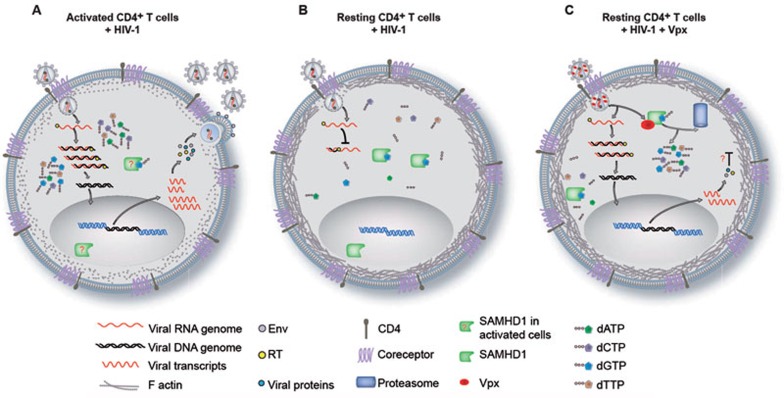
CD4(+) T lymphocytes represent the main target cell population of human immunodeficiency virus (HIV). In an activated state, CD4(+) T cells residing in lymphoid organs are a major reservoir of ongoing HIV-1 replication in infected individuals. In contrast, resting CD4(+) T cells are highly resistant to productive HIV-1 infection, yet are massively depleted during disease progression and represent a substantial latent reservoir for the virus in vivo. Barriers preventing replication of HIV-1 in resting CD4(+) T cells include a rigid layer of cortical actin and, early after HIV-1 entry, a block that limits reverse transcription of incoming viral RNA genomes. Defining the molecular bases of these restrictions has remained one of the central open questions in HIV research. Recent advances unraveled mechanisms by which HIV-1 bypasses the entry block and established the host cell restriction factor SAMHD1, a deoxynucleoside triphosphate triphosphohydrolase, as a central determinant of the cellular restriction to HIV-1 reverse transcription in resting CD4(+) T cells. This review summarizes our current molecular and pathophysiological understanding of the multi-faceted interactions of HIV-1 with resting CD4(+) T lymphocytes.
CD4(+) T 淋巴细胞是人类免疫缺陷病毒(HIV)的主要靶细胞群。在激活状态下,淋巴器官中的 CD4(+) T 细胞是感染个体中 HIV-1 复制的主要储存库。相比之下,静止的 CD4(+) T 细胞对 HIV-1 的有效感染具有很强的抵抗力,但在疾病进展过程中会大量消耗,并且在体内是病毒的一个重要潜伏储存库。阻止 HIV-1 在静止的 CD4(+) T 细胞中复制的障碍包括一层坚硬的皮质肌动蛋白层,以及 HIV-1 进入后早期限制传入病毒 RNA 基因组逆转录的障碍。定义这些限制的分子基础一直是 HIV 研究中的核心开放性问题之一。最近的进展揭示了 HIV-1 绕过进入障碍的机制,并确定了宿主细胞限制因子 SAMHD1(脱氧核苷三磷酸三磷酸水解酶)作为静止 CD4(+) T 细胞中 HIV-1 逆转录的细胞限制的主要决定因素。本文综述了我们目前对 HIV-1 与静止的 CD4(+) T 淋巴细胞的多方面相互作用的分子和病理生理学理解。