Pain Research and Nuffield Division of Anaesthetics, University of Oxford, UK.
Eur J Pain. 2014 Jan;18(1):67-75. doi: 10.1002/j.1532-2149.2013.00341.x. Epub 2013 Jun 3.
Duloxetine has been studied in four distinct chronic pain conditions - osteoarthritis (OA), fibromyalgia, chronic low back pain (CLBP) and diabetic peripheral neuropathic pain (DPNP). These trials have involved large numbers of patients with at least moderate pain, and have used similar methods for recording pain intensity, over about 12 weeks.
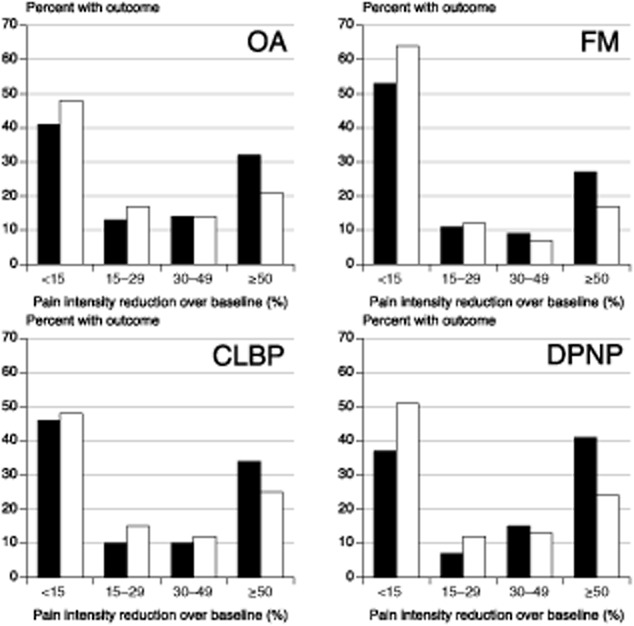
Data from the trials were pooled according to painful condition, and reanalysed at the level of the individual patient and using increasing levels of pain intensity reduction (<15%, 15-29%, 30-49%, ≥ 50%), with different imputation methods on withdrawal.
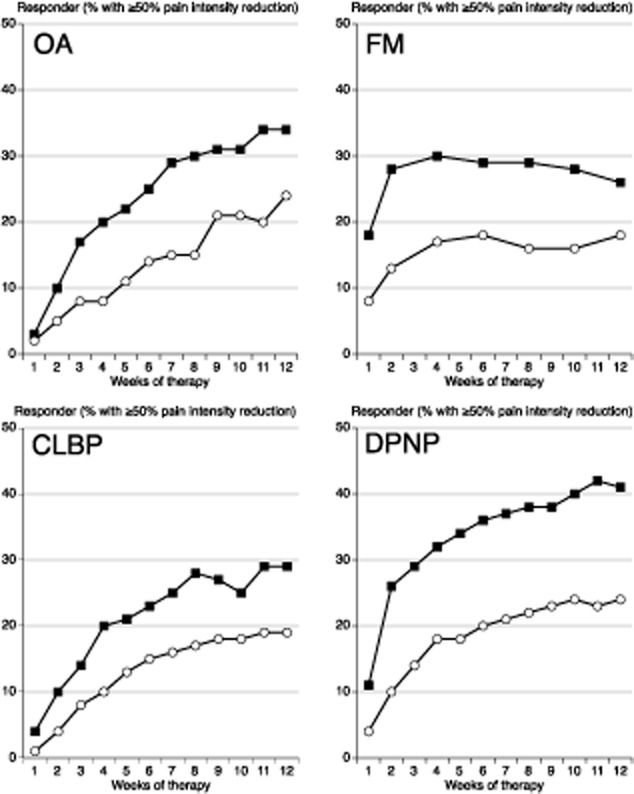
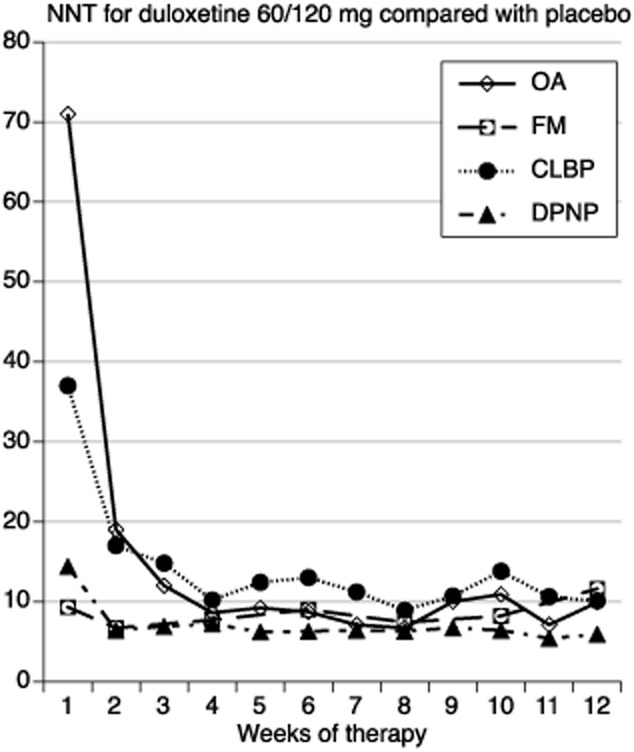
The proportion of patients recording at least 50% pain intensity reduction plateaued after 2-6 weeks in fibromyalgia, and 8-12 weeks in other conditions. The duloxetine-specific benefit [number needed to treat (NNT) for at least 50% pain intensity reduction] was fairly constant after about 2 weeks for DPNP and fibromyalgia and after about 4 or 5 weeks for OA and CLBP. In all conditions, responses were bimodal, with patients generally experiencing either very good or very poor pain relief. Last-observation-carried-forward imputation produced numerically and occasionally statistically better (lower) NNTs than use of baseline-observation-carried-forward (true response).
Baseline-observation-carried-forward (true response), which combines the success of high levels of pain relief with the failure to experience pain relief on withdrawal of the drug is conservative and probably reflective of clinical practice experience. The distribution of effect was not normal; few patients had the average response and averages are not an appropriate descriptor for these data.
度洛西汀已经在四种不同的慢性疼痛疾病中进行了研究 - 骨关节炎(OA),纤维肌痛,慢性腰痛(CLBP)和糖尿病周围神经病理性疼痛(DPNP)。这些试验涉及至少有中度疼痛的大量患者,并使用类似的方法记录疼痛强度,大约 12 周。
根据疼痛状况对试验数据进行分组,并根据个体患者和使用不同的剔除方法进行分析,使用增加的疼痛强度减轻水平(<15%,15-29%,30-49%,≥50%)进行重新分析。
在纤维肌痛中,在 2-6 周后,记录至少 50%疼痛强度减轻的患者比例趋于平稳,而在其他情况下,8-12 周后趋于平稳。在 DPNP 和纤维肌痛中,大约 2 周后,度洛西汀的特异性益处[至少 50%疼痛强度减轻的需要治疗人数(NNT)]相当稳定,OA 和 CLBP 则大约在 4 或 5 周后。在所有情况下,反应呈双峰型,患者通常经历非常好或非常差的疼痛缓解。最后观察前进的推断比基线观察前进的推断(真实反应)产生了数字上和偶尔统计学上更好(更低)的 NNT。
基线观察前进(真实反应),将高水平的疼痛缓解成功与药物停药后无法缓解疼痛结合起来,保守且可能反映了临床实践经验。效应的分布不正常;很少有患者具有平均反应,平均值不适用于这些数据。