PenCLAHRC, National Institute for Health Research, Plymouth University Peninsula Schools of Medicine and Dentistry, N6 ITTC Building, Tamar Science Park, Derriford, Plymouth PL6 8BX, UK.
BMC Health Serv Res. 2013 Jun 4;13:203. doi: 10.1186/1472-6963-13-203.
Venous thromboembolism (VTE) is a major cause of morbidity and mortality in hospitalised patients. VTE prevention has been identified as a major health need internationally to improve patient safety. A National Institute for Health and Clinical Excellence (NICE) guideline was issued in February 2010. Its key priorities were to assess patients for risk of VTE on admission to hospital, assess patients for bleeding risk and evaluate the risks and benefits of prescribing VTE prophylaxis. The aim of this study was to evaluate the implementation of NICE guidance and its impact on patient safety.
A before-after observational design was used to investigate changes in VTE risk assessment documentation and inappropriate prescribing of prophylaxis between the year prior to (2009) and the year following (2010) the implementation of NICE guidance, using data from a 3-week period during each year. A total of 408 patients were sampled in each year across four hospitals in the NHS South region.
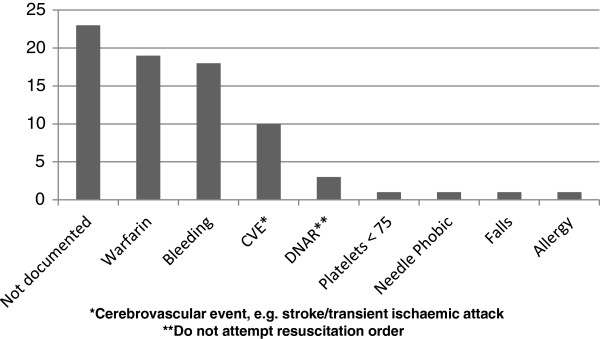
Implementation strategies such as audit, education and training were used. The percentage of patients for whom a VTE risk assessment was documented increased from 51.5% (210/408) in 2009 to 79.2% (323/408) in 2010; difference 27.7% (95% CI: 21.4% to 33.9%; p < 0.001). There was little evidence of change in the percentage who were prescribed prophylaxis amongst patients without a risk assessment (71.7% (142/198) in 2009 and 68.2% (58/85) in 2010; difference -3.5% (95% CI: -15.2% to 8.2%; p =0.56) nor the percentage who were prescribed low molecular weight heparin amongst patients with a contraindication (14% (4/28) in 2009 and 15% (6/41) in 2010; RD = 0.3% (95% CI: -16.5% to 17.2%; p =0.97).
The documentation of risk assessment improved following the implementation of NICE guidance; it is questionable, however, whether this led to improved patient safety with respect to prescribing appropriate prophylaxis.
静脉血栓栓塞症(VTE)是住院患者发病率和死亡率的主要原因。国际上已确定预防 VTE 是改善患者安全的主要健康需求。国家卫生与临床优化研究所(NICE)于 2010 年 2 月发布了指南。其主要重点是评估患者入院时的 VTE 风险,评估患者的出血风险,并评估处方 VTE 预防的风险和益处。本研究旨在评估 NICE 指南的实施情况及其对患者安全的影响。
采用前后观察设计,在 NICE 指南实施前一年(2009 年)和实施后一年(2010 年),使用每年三周的数据,调查 VTE 风险评估文件记录和预防措施不当的变化情况。在 NHS 南部地区的四家医院中,每年对 408 名患者进行抽样。
实施策略包括审计、教育和培训。进行 VTE 风险评估的患者比例从 2009 年的 51.5%(210/408)增加到 2010 年的 79.2%(323/408);差异为 27.7%(95%CI:21.4%至 33.9%;p<0.001)。对于没有风险评估的患者,处方预防措施的比例几乎没有变化(2009 年为 71.7%(142/198),2010 年为 68.2%(58/85);差异为-3.5%(95%CI:-15.2%至 8.2%;p=0.56),对于有禁忌症的患者,处方低分子肝素的比例也没有变化(2009 年为 14%(4/28),2010 年为 15%(6/41);RD=0.3%(95%CI:-16.5%至 17.2%;p=0.97)。
在实施 NICE 指南后,风险评估的文件记录得到了改善;然而,这是否能提高预防适当预防措施的患者安全性值得怀疑。