Department of Chemistry and Biochemistry, University of Delaware, Newark, Delaware 19716, USA.
J Am Chem Soc. 2013 Jun 19;135(24):8798-801. doi: 10.1021/ja4033549. Epub 2013 Jun 4.
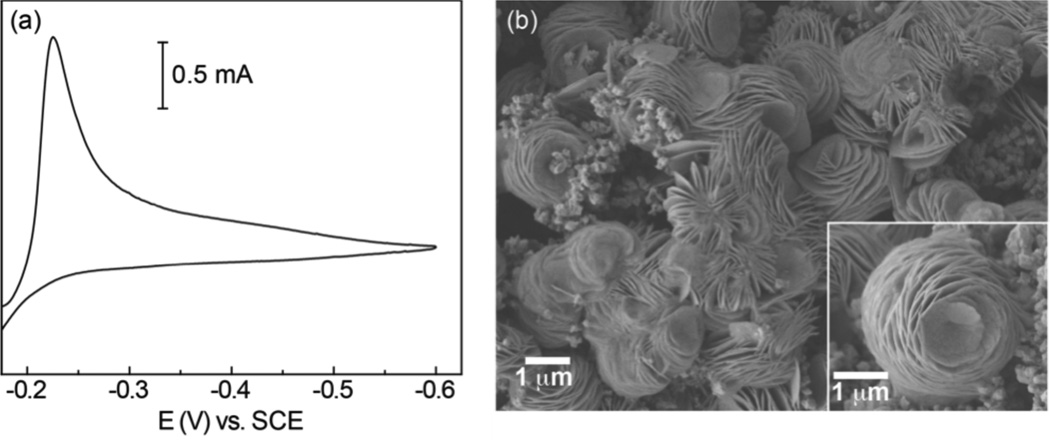
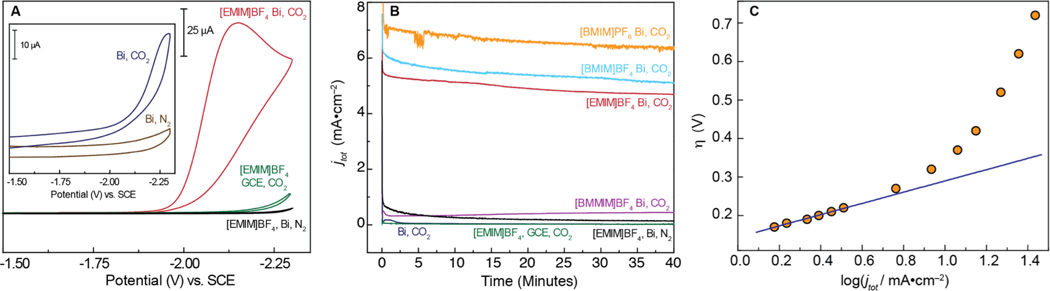
The wide-scale implementation of solar and other renewable sources of electricity requires improved means for energy storage. An intriguing strategy in this regard is the reduction of CO2 to CO, which generates an energy-rich commodity chemical that can be coupled to liquid fuel production. In this work, we report an inexpensive bismuth-carbon monoxide evolving catalyst (Bi-CMEC) that can be formed upon cathodic polarization of an inert glassy carbon electrode in acidic solutions containing Bi(3+) ions. This catalyst can be used in conjunction with ionic liquids to effect the electrocatalytic conversion of CO2 to CO with appreciable current density at overpotentials below 0.2 V. Bi-CMEC is selective for production of CO, operating with a Faradaic efficiency of approximately 95%. When taken together, these correspond to a high-energy efficiency for CO production, on par with that which has historically only been observed using expensive silver and gold cathodes.
大规模应用太阳能和其他可再生电力资源需要改进的储能手段。在这方面,一种引人注目的策略是将二氧化碳还原为一氧化碳,这会生成一种富含能量的商品化学品,可与液体燃料生产相结合。在这项工作中,我们报告了一种廉价的铋-一氧化碳析催化剂(Bi-CMEC),它可以在酸性溶液中通过 Bi(3+)离子的阴极极化形成。该催化剂可与离子液体结合使用,以实现 CO2在过电势低于 0.2 V 的条件下以可观的电流密度进行电催化转化为 CO。Bi-CMEC 对 CO 的生成具有选择性,法拉第效率约为 95%。综合考虑,这对应于 CO 生产的高能效,与历史上仅使用昂贵的银和金阴极才能观察到的效率相当。