Hong Daqing, Wu Shukun, Pu Lei, Wang Fang, Wang Junru, Wang Zhengtong, Gao Hui, Zhang Yue, Deng Fei, Li Guisen, He Qiang, Wang Li
BMC Nephrol. 2013 Jun 5;14:120. doi: 10.1186/1471-2369-14-120.
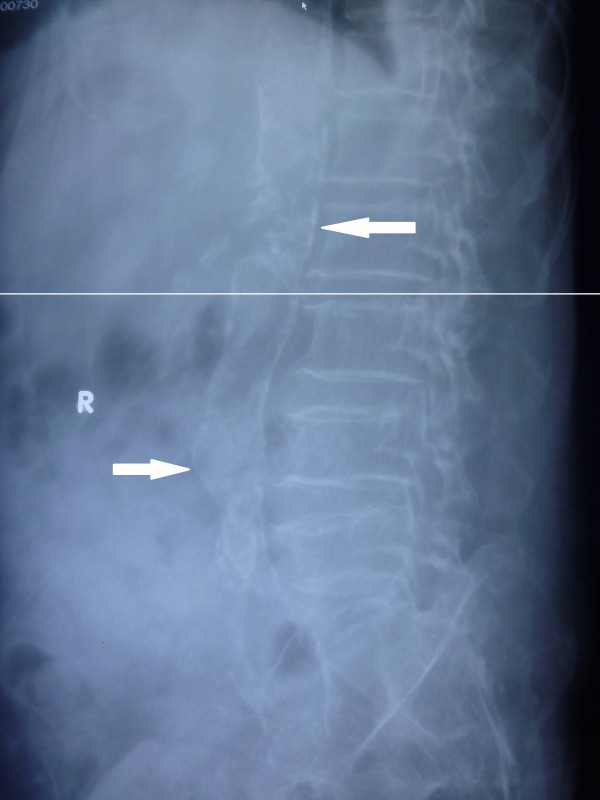
KDIGO (Kidney Disease: Improving Global Outcomes) guidelines recommend that a lateral abdominal radiograph should be performed to assess vascular calcification (VC) in dialysis patients. However, abdominal aortic calcification is a prevalent finding, and it remains unclear whether other anatomical areas of VC can predict mortality more accurately.
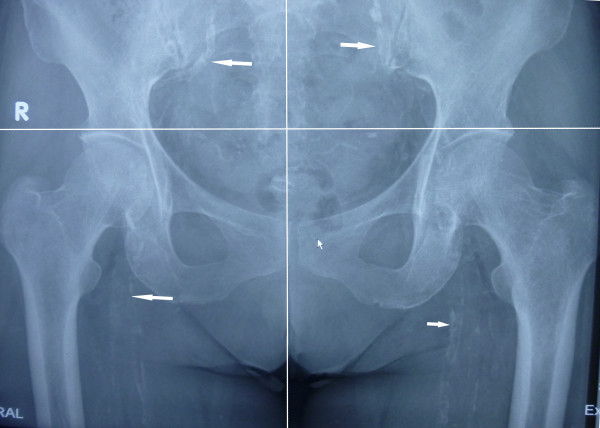
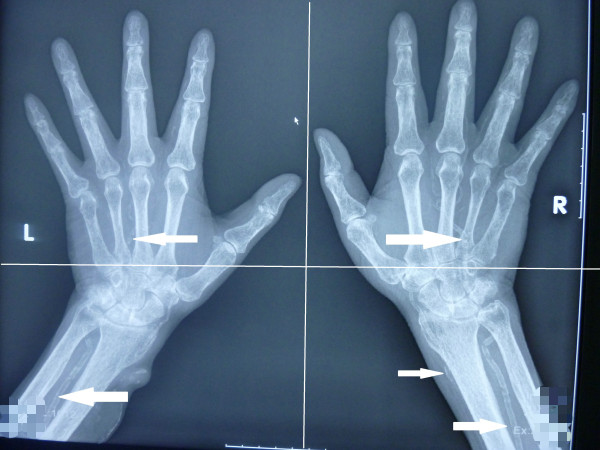
A total of 217 maintenance hemodialysis patients were enrolled at the Sichuan Provincial People's Hospital between July 2010 and March 2011. Radiographs of the abdomen, pelvis and hands were evaluated by a radiologist to evaluate the presence of VC. The correlation between different areas of VC and all-cause or cardiovascular mortality was analyzed using univariate and multivariate models.
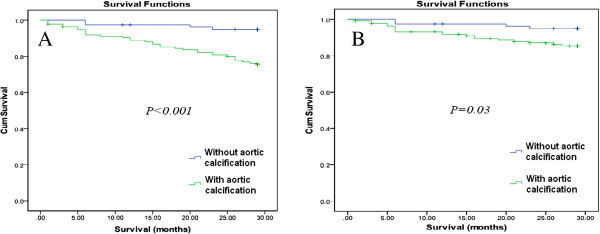
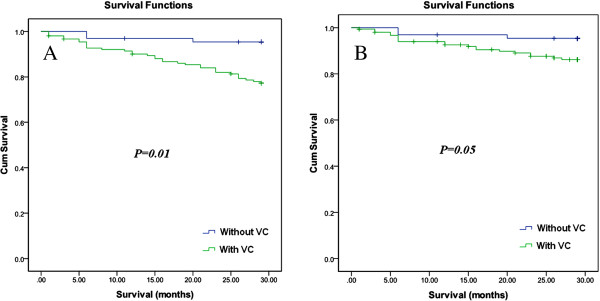
The prevalence of VC was 70.0% (152 patients), and most had abdominal aortic calcification (90.1%). During 26 ± 7 months of follow-up, 37 patients died. The VC score was independently associated with patient mortality. VC observed on abdominal radiographs (abdominal aortic calcification) was associated with all-cause mortality in models adjusted for cardiovascular risk factors (HR, 4.69; 95%CI, 1.60-13.69) and dialysis factors (HR, 3.38; 95%CI, 1.18-9.69). VC in the pelvis or hands was associated with all-cause mortality in the model adjusted for dialysis factors. When three combinations of VC in different radiographs were included in models, the presence of abdominal VC was only significantly associated with all-cause mortality in the integrated model. VC in the abdomen and pelvis was associated with all-cause mortality in the model adjusted for cardiovascular factors and the integrated model, but neither was significantly associated with cardiovascular mortality. VC in all radiographs was significantly associated with a more than 6-fold risk of all-cause mortality and a more than 5-fold risk of cardiovascular mortality compared to patients without VC.
VC in different arteries as shown on radiographs is associated with different levels of risk for mortality. The lateral abdominal radiograph may not be superior to other radiographs for predicting patient outcomes. Further research is needed to elucidate the effects of difference burdens of VC on patient outcomes.
KDIGO(改善全球肾脏病预后组织)指南建议,应对透析患者进行腹部侧位X线片检查以评估血管钙化(VC)情况。然而,腹主动脉钙化是一种常见表现,目前尚不清楚VC的其他解剖区域是否能更准确地预测死亡率。
2010年7月至2011年3月期间,四川省人民医院共纳入217例维持性血液透析患者。由放射科医生对腹部、骨盆和手部的X线片进行评估,以判断VC的存在情况。使用单因素和多因素模型分析不同区域VC与全因死亡率或心血管死亡率之间的相关性。
VC的患病率为70.0%(152例患者),大多数患者存在腹主动脉钙化(90.1%)。在26±7个月的随访期间,37例患者死亡。VC评分与患者死亡率独立相关。在针对心血管危险因素进行校正的模型(HR,4.69;95%CI,1.60 - 13.69)和针对透析因素进行校正的模型(HR,3.38;95%CI,1.18 - 9.69)中,腹部X线片上观察到的VC(腹主动脉钙化)与全因死亡率相关。在针对透析因素进行校正的模型中,骨盆或手部的VC与全因死亡率相关。当将不同X线片中VC的三种组合纳入模型时,在综合模型中,腹部VC的存在仅与全因死亡率显著相关。在针对心血管因素进行校正的模型和综合模型中,腹部和骨盆的VC与全因死亡率相关,但两者均与心血管死亡率无显著相关性。与无VC的患者相比,所有X线片中的VC均与全因死亡率超过6倍的风险以及心血管死亡率超过5倍的风险显著相关。
X线片显示的不同动脉中的VC与不同程度的死亡风险相关。腹部侧位X线片在预测患者预后方面可能并不优于其他X线片。需要进一步研究以阐明不同VC负荷对患者预后的影响。