*Charles F. and Joanne Knight Alzheimer's Disease Research Center †Department of Neurology ∥Department of Pathology and Immunology ¶Program on Physical Therapy #Program on Occupational Therapy ‡Division of Biostatistics §Department of Psychology, Washington University School of Medicine, St. Louis, MO.
Alzheimer Dis Assoc Disord. 2014 Jan-Mar;28(1):50-7. doi: 10.1097/WAD.0b013e31829628d4.
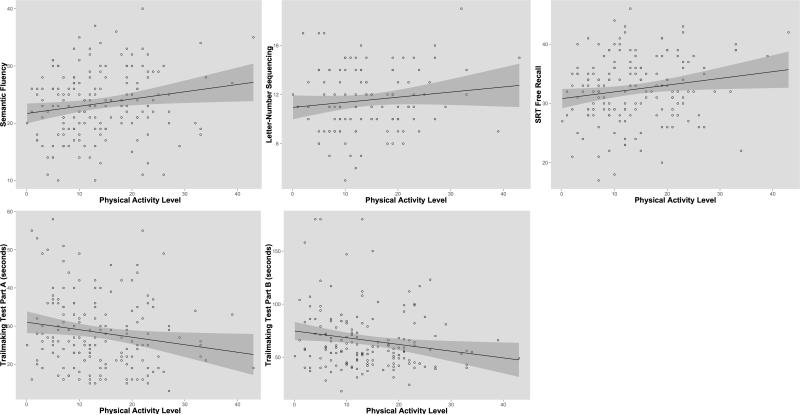
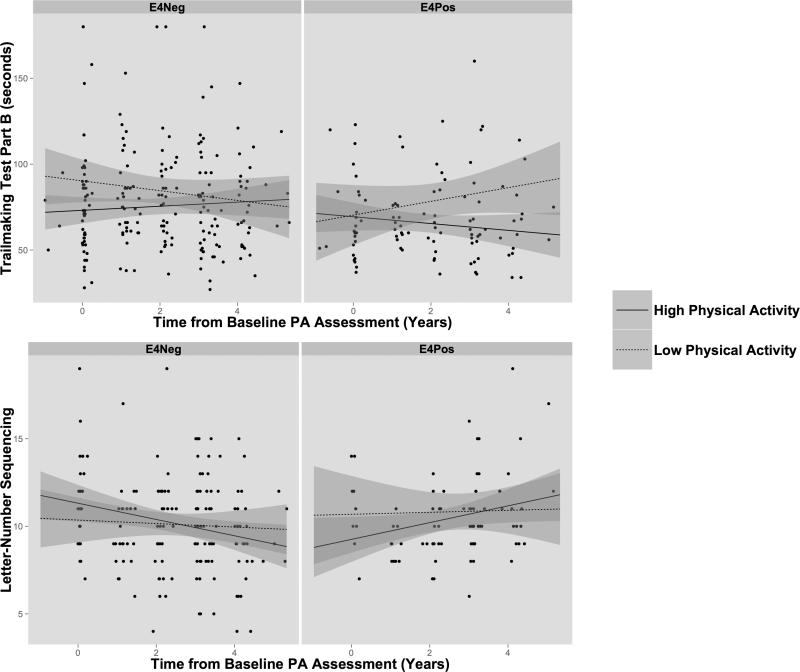
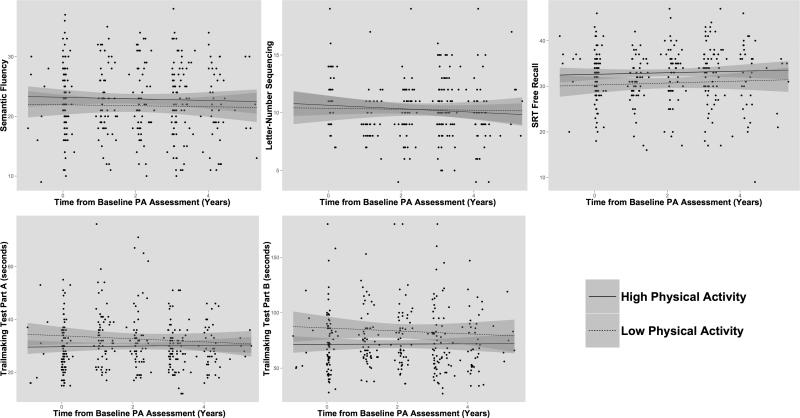
Increased physical activity may protect against cognitive decline, the primary symptom of Alzheimer disease. In this study, we examined the relationship between physical activity and trajectories of cognitive functioning over serial assessments. Cognitively normal (Clinical Dementia Rating 0) middle-aged and older adults (N=173; mean age, 60.7 ± 7.8 y) completed a self-report measure of physical activity and a battery of standard neuropsychological tests assessing processing speed, attention, executive functioning, and verbal memory. At baseline, individuals with higher physical activity levels performed better on tests of episodic memory and visuospatial functioning. Over subsequent follow-up visits, higher physical activity was associated with small performance gains on executive functioning and working memory tasks in participants with one or more copies of the apolipoprotein ε4 allele (APOE4). In APOE4 noncarriers, slopes of cognitive performance over time were not related to baseline physical activity. Our results suggest that cognitively normal older adults who report higher levels of physical activity may have slightly better cognitive performance, but the potential cognitive benefits of higher levels of physical activity over time may be most evident in individuals at genetic risk for Alzheimer disease.
增加身体活动可能有助于预防认知能力下降,这是阿尔茨海默病的主要症状。在这项研究中,我们研究了身体活动与认知功能在多次评估中的轨迹之间的关系。认知正常(临床痴呆评定量表 0 分)的中老年成年人(N=173;平均年龄 60.7±7.8 岁)完成了一份身体活动自我报告量表和一系列标准神经心理学测试,评估处理速度、注意力、执行功能和言语记忆。在基线时,身体活动水平较高的个体在情节记忆和视空间功能测试中表现更好。在随后的随访中,在携带一个或多个载脂蛋白 E4 等位基因(APOE4)的参与者中,较高的身体活动与执行功能和工作记忆任务的较小表现增益相关。在 APOE4 非携带者中,认知表现随时间的斜率与基线身体活动无关。我们的研究结果表明,报告身体活动水平较高的认知正常的老年人可能具有稍好的认知表现,但随着时间的推移,更高水平的身体活动对认知的潜在益处在阿尔茨海默病遗传风险较高的个体中可能最为明显。