Yale University School of Medicine, New Haven, CT, USA.
Drugs Aging. 2013 Aug;30(8):613-28. doi: 10.1007/s40266-013-0093-9.
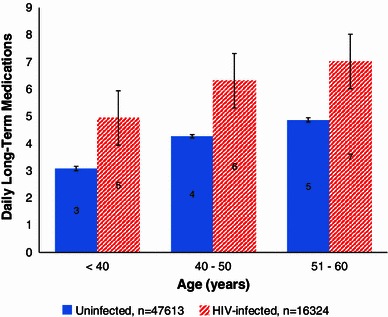
With the adoption of combination antiretroviral therapy (ART), most HIV-infected individuals in care are on five or more medications and at risk of harm from polypharmacy, a risk that likely increases with number of medications, age, and physiologic frailty. Established harms of polypharmacy include decreased medication adherence and increased serious adverse drug events, including organ system injury, hospitalization, geriatric syndromes (falls, fractures, and cognitive decline) and mortality. The literature on polypharmacy among those with HIV infection is limited, and the literature on polypharmacy among non-HIV patients requires adaptation to the special issues facing those on chronic ART. First, those aging with HIV infection often initiate ART in their 3rd or 4th decade of life and are expected to remain on ART for the rest of their lives. Second, those with HIV may be at higher risk for age-associated comorbid disease, further increasing their risk of polypharmacy. Third, those with HIV may have an enhanced susceptibility to harm from polypharmacy due to decreased organ system reserve, chronic inflammation, and ongoing immune dysfunction. Finally, because ART is life-extending, nonadherence to ART is particularly concerning. After reviewing the relevant literature, we propose an adapted framework with which to address polypharmacy among those on lifelong ART and suggest areas for future work.
随着联合抗逆转录病毒疗法(ART)的采用,大多数接受治疗的 HIV 感染者需要服用五种或更多种药物,面临着药物过多的风险,这种风险可能随着药物数量、年龄和生理脆弱性的增加而增加。药物过多的既定危害包括降低药物依从性和增加严重药物不良反应,包括器官系统损伤、住院、老年综合征(跌倒、骨折和认知能力下降)和死亡。关于 HIV 感染者中药物过多的文献有限,而关于非 HIV 患者中药物过多的文献需要适应那些长期接受慢性 ART 治疗的患者的特殊问题。首先,随着年龄的增长感染 HIV 的人通常在他们的第三或第四十年开始接受 ART,并期望在他们的余生中继续接受 ART。其次,HIV 感染者可能面临更高的与年龄相关的合并症风险,进一步增加了他们药物过多的风险。第三,由于器官系统储备减少、慢性炎症和持续的免疫功能障碍,HIV 感染者可能更容易受到药物过多的伤害。最后,由于 ART 可以延长生命,ART 不依从性尤其令人担忧。在审查了相关文献后,我们提出了一个适应性框架,以解决那些需要终身接受 ART 治疗的患者的药物过多问题,并提出了未来工作的领域。