Human Technology Research Institute, National Institute of Advanced Industrial Science and Technology (AIST), Tsukuba, Ibaraki, Japan.
PLoS One. 2013 May 31;8(5):e65701. doi: 10.1371/journal.pone.0065701. Print 2013.
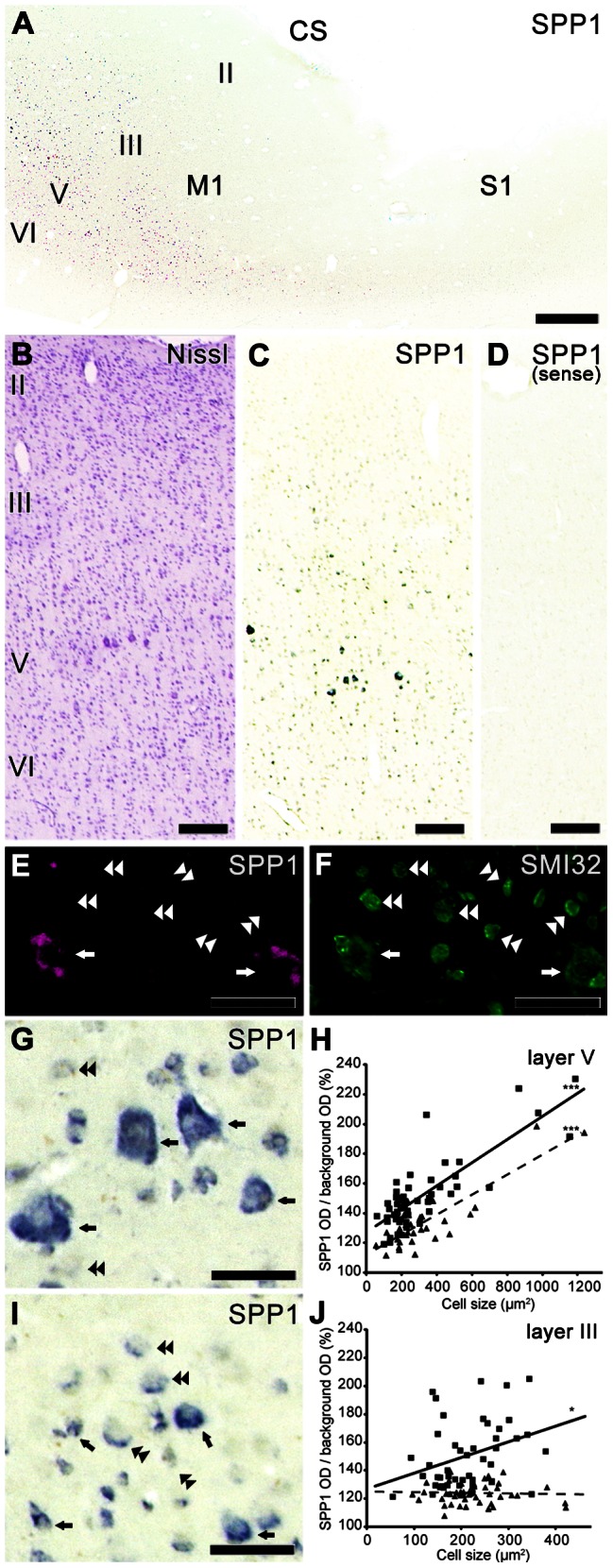
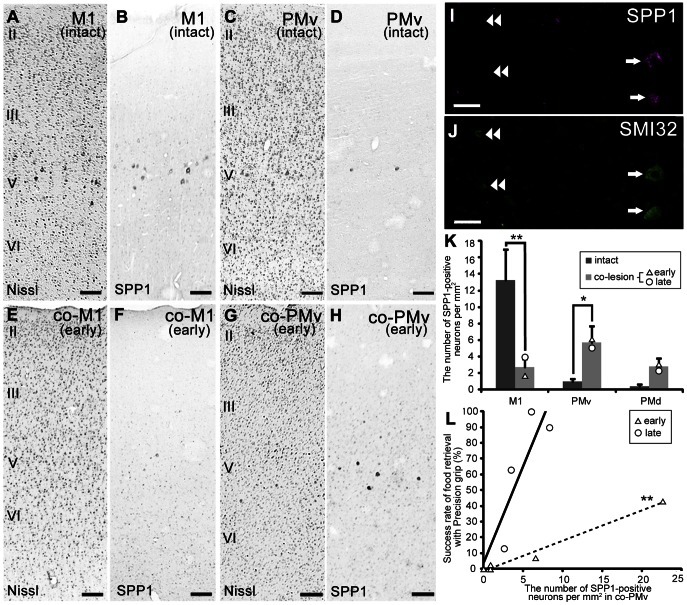
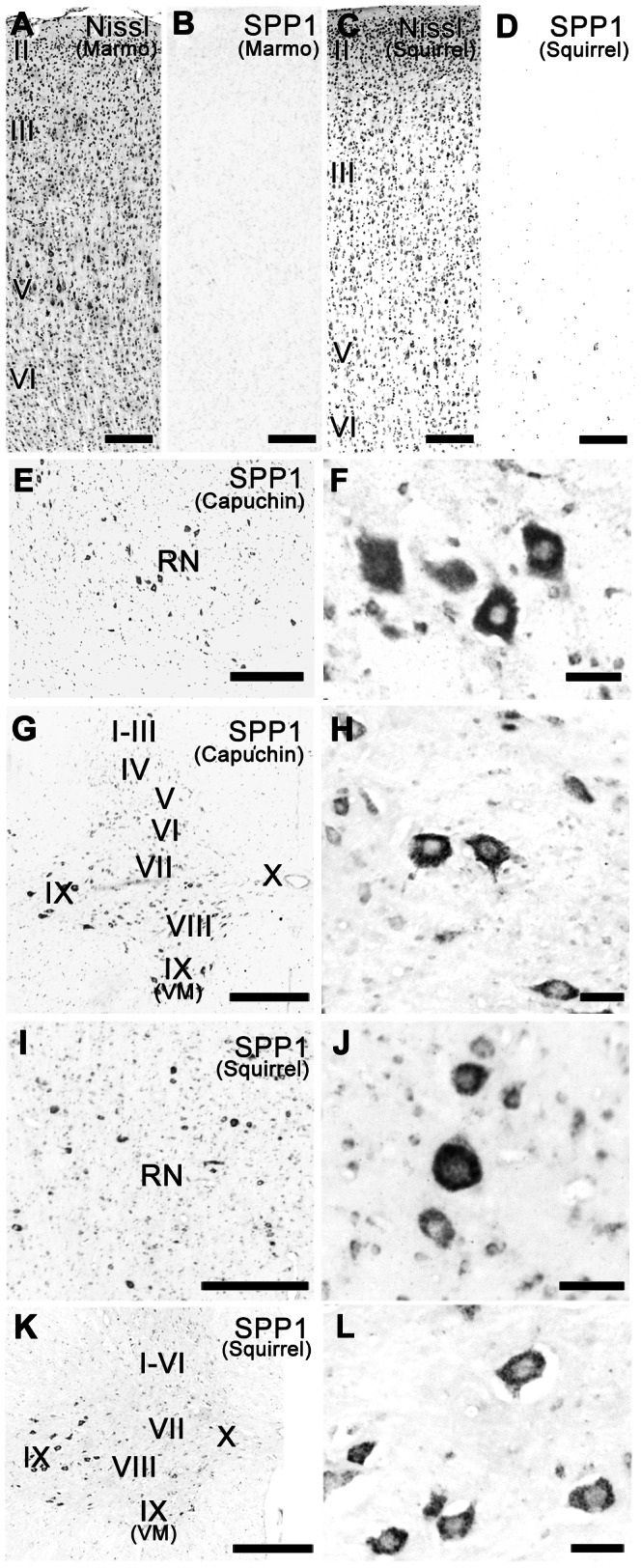
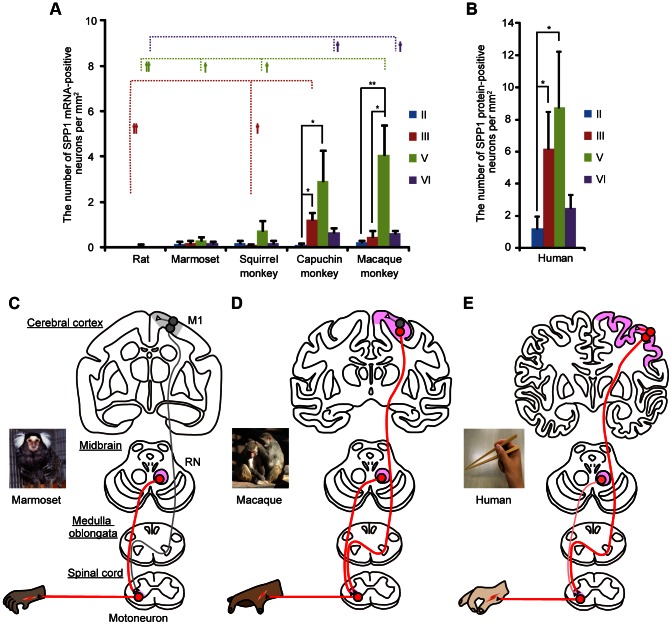
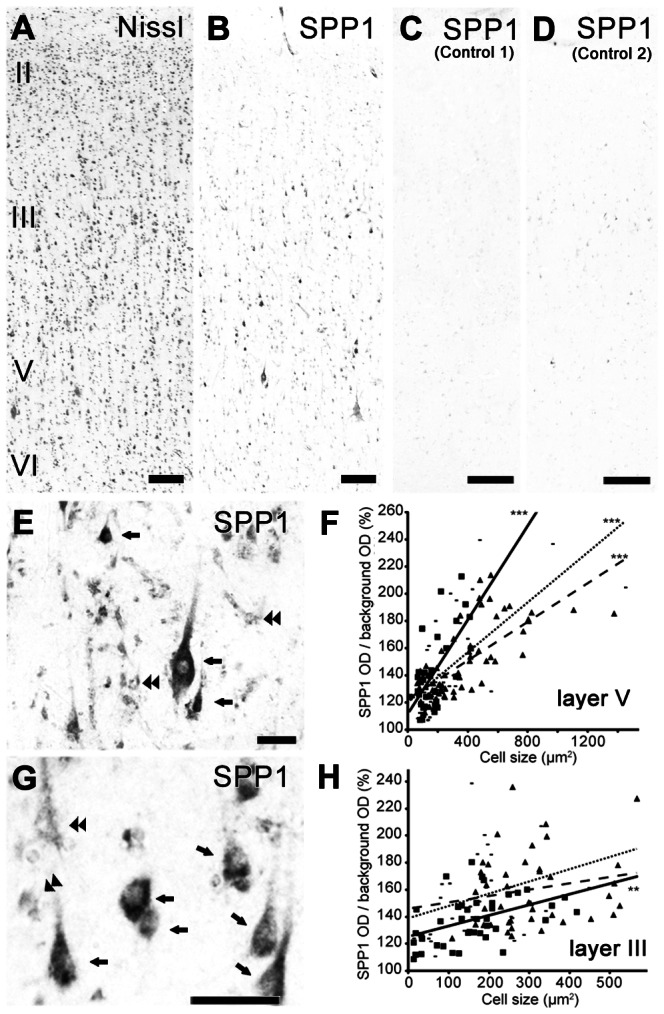
We previously reported that secreted phosphoprotein 1 (SPP1) mRNA is expressed in neurons whose axons form the corticospinal tract (CST) of the rhesus macaque, but not in the corresponding neurons of the marmoset and rat. This suggests that SPP1 expression is involved in the functional or structural specialization of highly developed corticospinal systems in certain primate species. To further examine this hypothesis, we evaluated the expression of SPP1 mRNA in the motor cortex from three viewpoints: species differences, postnatal development, and functional/structural changes of the CST after a lesion of the lateral CST (l-CST) at the mid-cervical level. The density of SPP1-positive neurons in layer V of the primary motor cortex (M1) was much greater in species with highly developed corticospinal systems (i.e., rhesus macaque, capuchin monkey, and humans) than in those with less developed corticospinal systems (i.e., squirrel monkey, marmoset, and rat). SPP1-positive neurons in the macaque monkey M1 increased logarithmically in layer V during postnatal development, following a time course consistent with the increase in conduction velocity of the CST. After an l-CST lesion, SPP1-positive neurons increased in layer V of the ventral premotor cortex, in which compensatory changes in CST function/structure may occur, which positively correlated with the extent of finger dexterity recovery. These results further support the concept that the expression of SPP1 may reflect functional or structural specialization of highly developed corticospinal systems in certain primate species.
我们之前报道过,在外周形成皮质脊髓束(CST)的神经元中表达分泌型磷蛋白 1(SPP1)mRNA,但在绒猴和大鼠的相应神经元中不表达。这表明 SPP1 的表达参与了某些灵长类物种高度发达的皮质脊髓系统的功能或结构特化。为了进一步检验这一假说,我们从三个角度评估了运动皮层中 SPP1 mRNA 的表达:物种差异、出生后发育以及在颈中部外侧 CST(l-CST)损伤后 CST 的功能/结构变化。在高度发达的皮质脊髓系统(即猕猴、卷尾猴和人类)中,初级运动皮层(M1)V 层中 SPP1 阳性神经元的密度明显高于皮质脊髓系统发育较差的物种(即松鼠猴、绒猴和大鼠)。猕猴 M1 中的 SPP1 阳性神经元在出生后发育过程中呈对数增加,与 CST 传导速度的增加时间进程一致。在 l-CST 损伤后,SPP1 阳性神经元在腹侧前运动皮层 V 层中增加,CST 功能/结构可能在此处发生代偿性变化,与手指灵巧度恢复的程度呈正相关。这些结果进一步支持了这样的概念,即 SPP1 的表达可能反映了某些灵长类物种高度发达的皮质脊髓系统的功能或结构特化。